Get Full Government Meeting Transcripts, Videos, & Alerts Forever!
Get email alerts on the Home Occupation topic
No spam. Unsubscribe anytime.
Planning commission recommends two‑year home‑occupation permit for T10 Construction with conditions
Summary
The commission recommended a two‑year interim use permit allowing T10 Construction to operate administrative functions at 17822 Hundredth Lane NW, with limits on nonresident employees, inspections, a ban on on‑site employee meetings and a single annual employee social event.
The Oak Grove Planning Commission voted to recommend approval of an interim use permit (IUP) that would allow T10 Construction to operate administrative functions from an accessory building at 17822 Hundredth Lane NW.
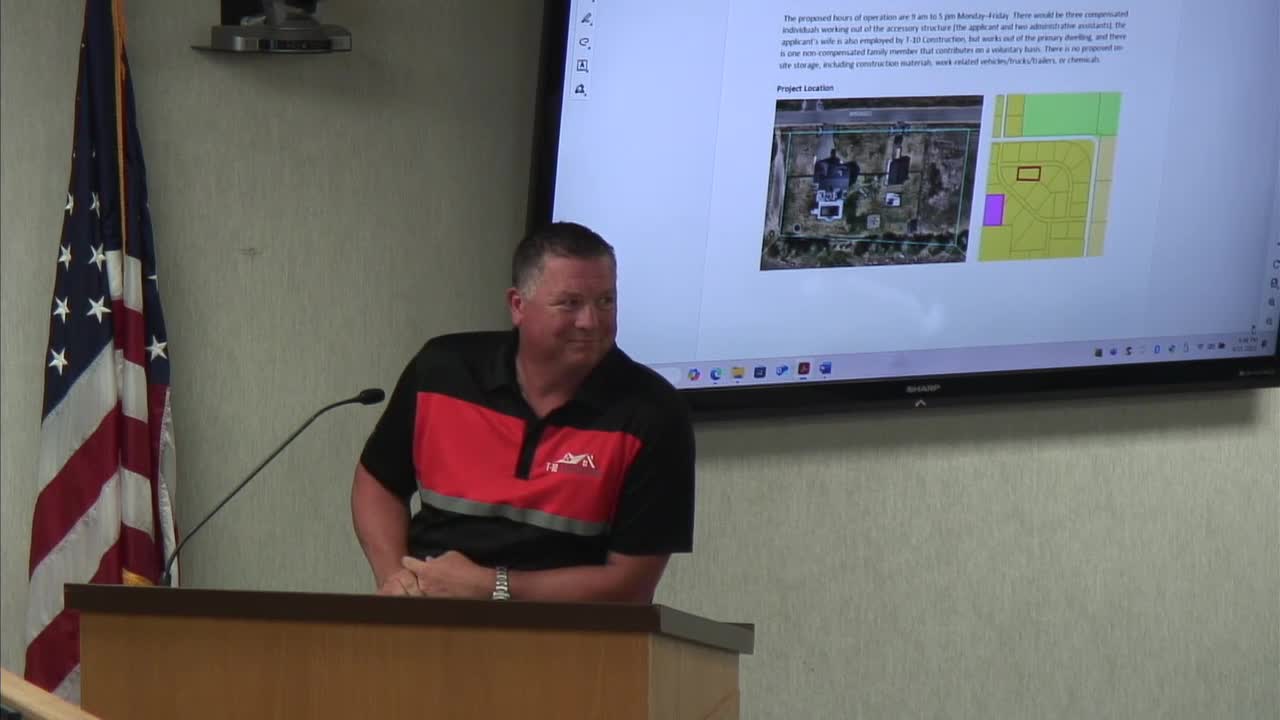
Planner (consultant) Jansen summarized staff’s review: the 1.81‑acre property is in the single‑family residential district and the applicant proposes to use the accessory building for office and administrative work only; all construction work and materials would remain off site. The accessory structure contains two finished rooms and a bathroom that are proposed to serve as an office. The application requests weekday hours of 9 a.m. to 5 p.m. and proposes up to three compensated employees who do not live at the residence.
Jansen said the proposed use exceeds standards in Oak Grove city code sections cited in the staff report, and therefore an IUP is required. Staff recommended approval to city council with conditions including: the permit is granted only to the property owner and expires if the owner moves or if the business ceases for six months; the permit term is two years; city staff (including fire department) may inspect the dwelling and accessory building; the number of nonresident employees is limited to three; and operation must follow the submitted narrative unless modified by conditions.
Applicant Jay Solum told the commission he uses the accessory building for invoicing and paperwork and that “we're doing all the invoicing paperwork stuff out of there. No construction materials or anything dropped off there. It's all done off‑site.” He acknowledged past in‑person sales meetings and training that drew multiple company vehicles; the applicant said those in‑person meetings have stopped and sales meetings now occur by videoconference.
Several neighbors testified with mixed views. Some neighbors said parking and vehicle traffic from earlier on‑site meetings had been a safety concern for children and an annoyance for homeowners, while others said the applicant is a “stand‑up neighbor” who remedied parking issues when they occurred. City staff explained that on‑street parking of commercial vehicles is restricted by city code except when parked for contracted work during daylight hours, and that enforcement and revocation of an IUP would follow the city’s code and administrative procedures.
After discussion commissioners added two conditions: a prohibition on on‑site employee meetings (trainings) and allowance for one annual employee social event at the residence. The commission voted to recommend approval to city council; the planning commission recorded three votes in favor, one abstention and the motion carried. The recommendation will be forwarded to city council for final action.