Get Full Government Meeting Transcripts, Videos, & Alerts Forever!
Get email alerts on the Coastal Hazards Erosion topic
No spam. Unsubscribe anytime.
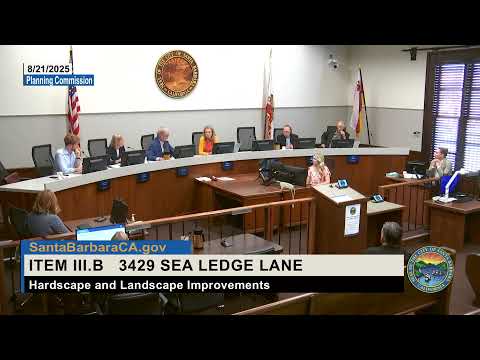
Planning Commission approves permanent erosion-control systems at Sea Ledge Lane and Cliff Drive
Summary
The Santa Barbara Planning Commission on Aug. 21 approved a coastal development permit to retain erosion-control systems installed after multiple bluff slides, imposing expanded biological monitoring, deferred design review for landscaping, and conditions on mechanized work and potential removal.
The Santa Barbara City Planning Commission voted Aug. 21 to approve a coastal development permit allowing permanent retention of erosion-control systems installed after bluff failures at Sea Ledge Lane and Cliff Drive.
The decision authorizes high-tensile steel mesh anchored by soil nails, subsequent hydroseeding and road repair, and installation of a cable guardrail along the roadway. Commissioners added conditions requiring extended biological monitoring, a pre-design-review evaluation of nonnative plantings at the base of the slope, and limits on mechanized equipment absent director approval.
Project planner Barbara Buckhart told commissioners the site sits in the appealable coastal zone within the Arroyo Burro component of the Local Coastal Program and includes four lots on the coastal bluff face. She said the installed system uses high-tensile steel mesh pinned with soil nails “25 feet long and embed back into the bedrock,” followed by hydroseeding of a seed mix chosen to restore native species including the special-status cliff aster. Buckhart said staff had approved two emergency coastal development permits (October 2023 and April 2024) to stabilize separate slide events and that three subsequent biological monitoring reports show the repair areas remain intact and native plants are becoming established.
Staff recommended approval under the California Environmental Quality Act exemption for existing facilities (CEQA Guidelines §15301) and asked the commission to make findings in the staff report and adopt conditions in Exhibit A. Commissioners pressed for more detail on monitoring, financing and conditional flexibility. Buckhart said the project biologist, Store Environmental, has performed monitoring and would continue to do so; she added that if plantings had not established “at the end of 5 years, we will extend the monitoring period” until performance standards are met.
Commissioners amended several conditions before approval. Key changes adopted by the commission include: - Extending required biological monitoring from one year (the emergency-permit practice) to five years, with the monitoring period subject to further extension if restoration performance standards are not met. The property owners (identified in materials as Kivo 6000 LLC/David and Barbara Maline) are required to finance monitoring; a qualified biologist or other certified expert must perform the monitoring and file reports with the city. - Requiring that the Single Family Design Board (SFDB) not grant project design approval until a certified biologist evaluates the appropriateness of existing cypress plantings at the toe of the slope; the commission added a specific condition that the biologist’s evaluation occur before SFDB action. - Allowing mechanized equipment only for narrow, specified work (installation of grade beams and drilled piers for slope stabilization) and otherwise prohibiting mechanized construction within sensitive bluff areas unless approved by the community development director or public works director. Commissioners also encouraged use of handheld mechanical tools “where feasible” for demolition tasks to reduce slope disturbance. - Replacing an absolute removal mandate with a requirement for reevaluation and possible removal directed by the community development director or public works director when erosion reaches the removal trigger (the condition retains the policy trigger language but adds reevaluation flexibility).
Commission discussion touched on long‑term funding and enforcement. Commissioner Barnwell characterized the coastline as a “public trust issue” and urged stronger financial mechanisms for private‑road maintenance agreements and monitoring funds. Commissioner Bauke and others pressed staff on what would happen if restoration failed after five years; staff replied that monitoring would continue and the period would be extended as necessary.
Buckhart said staff found the mesh netting to be the “least damaging alternative” after jute netting failed and that the Single Family Design Board had earlier indicated the required findings could be made. The project will return to SFDB for design review of landscape and guardrail details if the Planning Commission’s coastal development permit is upheld.
Vote: The Planning Commission approved the coastal development permit as amended in a roll-call vote with six yes votes and no recorded nos or abstentions. The action is subject to the standard appeal period noted in the staff report.
Why it matters: The commission’s action keeps stabilizing work in place that was installed under emergency permits after successive bluff slides and ties future design approval to biologist review and extended monitoring. The case highlights the tension between stabilizing private property and minimizing interventions on the coastal bluff face; commissioners sought both enforceable monitoring and flexibility to reevaluate removal decisions if new techniques or conditions warrant future changes.
What’s next: The project returns to the Single Family Design Board for design review and final approvals required by the planning permit conditions. The permit includes detailed monitoring and reporting requirements and a requirement that owners fund monitoring work by certified experts.