Get Full Government Meeting Transcripts, Videos, & Alerts Forever!
Get email alerts on the Public Safety Dispatch topic
No spam. Unsubscribe anytime.
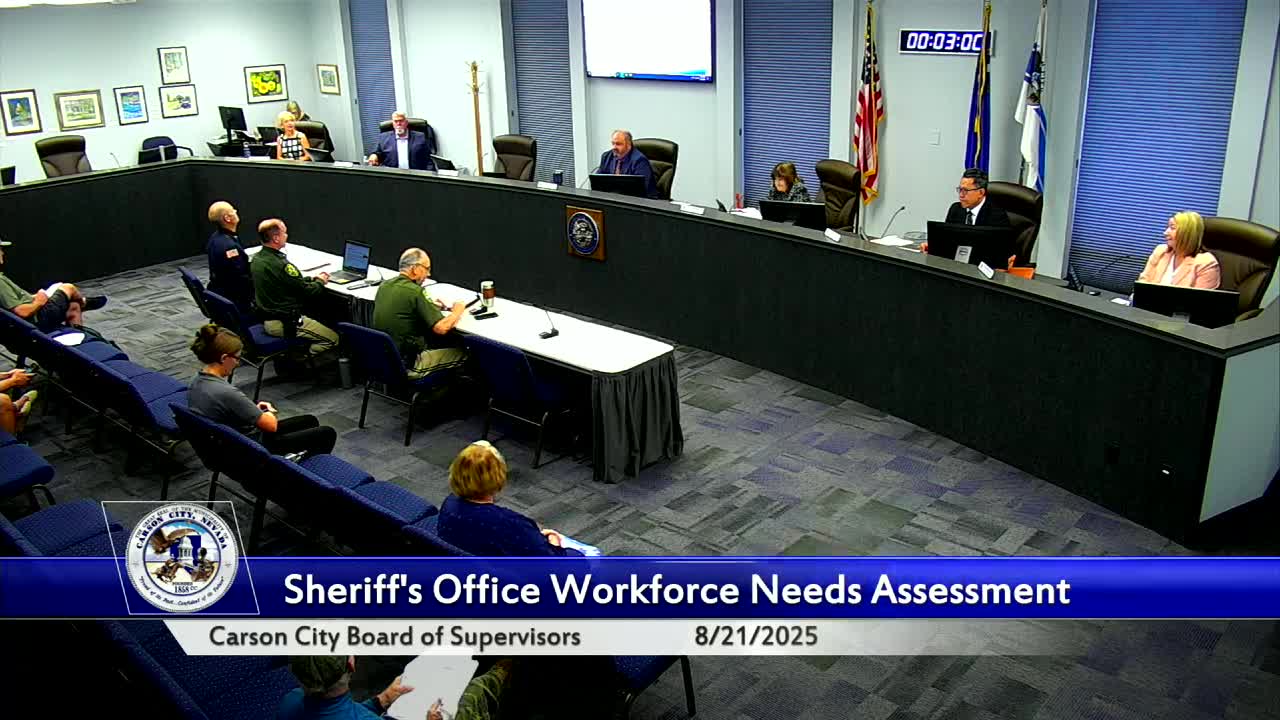
Mission Critical Partners presents workforce needs assessment for Carson City dispatch; recommends new PSAP roles, training and compensation study
Summary
Mission Critical Partners presented a workforce needs assessment for the Carson City Sheriff’s Office public safety answering point (PSAP), recommending organizational changes, training assignment, a compensation study and interagency collaboration ahead of a Tyler CAD implementation.
Mission Critical Partners on an undisclosed August meeting date presented the findings of a workforce needs assessment for the Carson City Sheriff’s Office public safety answering point (PSAP), concluding that the agency has a strong foundation but should add leadership roles, refine training assignment and study compensation to position the center for upcoming technology upgrades.
Gigi Smith, project manager for Mission Critical Partners, told the board the firm conducted two days of on-site stakeholder sessions and additional interviews and data review. Using national standards and industry best practices, MCP identified strengths — including dedicated staff, strong leadership and an improved training program — and offered recommendations intended to create a short- and long-term strategic roadmap.
Key MCP recommendations presented to the board included creating a PSAP director and an operations supervisor to align duties and create a clearer succession path; assigning the training program to the operations supervisor to reduce new-hire washout and overtime; conducting a compensation study to determine pay adjustments; and enhancing interagency collaboration with the Carson City Fire Department to align policies and procedures. MCP also recommended operational changes such as assigning at least one public safety communications officer as a dedicated call taker per shift, standardizing candidate sit-along observation forms, and reviewing ancillary tasks that could be shifted out of the communications center to reduce workload.
Sheriff Furlong and undersheriff Jerome Tushpan framed the report as a step in a broader, multi-year modernization effort that includes a planned implementation of a Tyler computer-aided dispatch (CAD) platform and other technology projects such as records management and jail systems. Tushpan said the department has been implementing significant technology upgrades since 2021 and emphasized the need to get foundational infrastructure correctly configured to avoid costly rework later.
Kevin Nyberg, speaking for the department, said the study gives the agency a foundation for 5-, 10- and 15-year planning and that some recommendations are already under way, including organizational changes and closer coordination with fire department partners. Nyberg and others told the board that maintaining and updating IT and communications infrastructure is one of the largest ongoing challenges for the dispatch center.
MCP project manager Gigi Smith said the recommendations are designed to be implemented on varied timelines and that not all items will be accepted in full; they are intended to form the basis for a strategic plan to be developed with city leadership and the sheriff’s office.
Why it matters: the assessment is intended to reduce staffing strain, improve candidate retention and prepare dispatch to integrate new technology; the board received the study as an informational item and did not take formal action.