Get Full Government Meeting Transcripts, Videos, & Alerts Forever!
Get email alerts on the Business Improvement Districts topic
No spam. Unsubscribe anytime.
City Plan Commission approves small expansion of East Side Business Improvement District 20
Summary
The City Plan Commission unanimously approved annexing additional commercial properties into Business Improvement District (BID) 20 on Milwaukee’s East Side, adding about $34,233 in annual assessments to the district while preserving the BID’s $5,000 per-property cap and excluding residential properties from assessments.
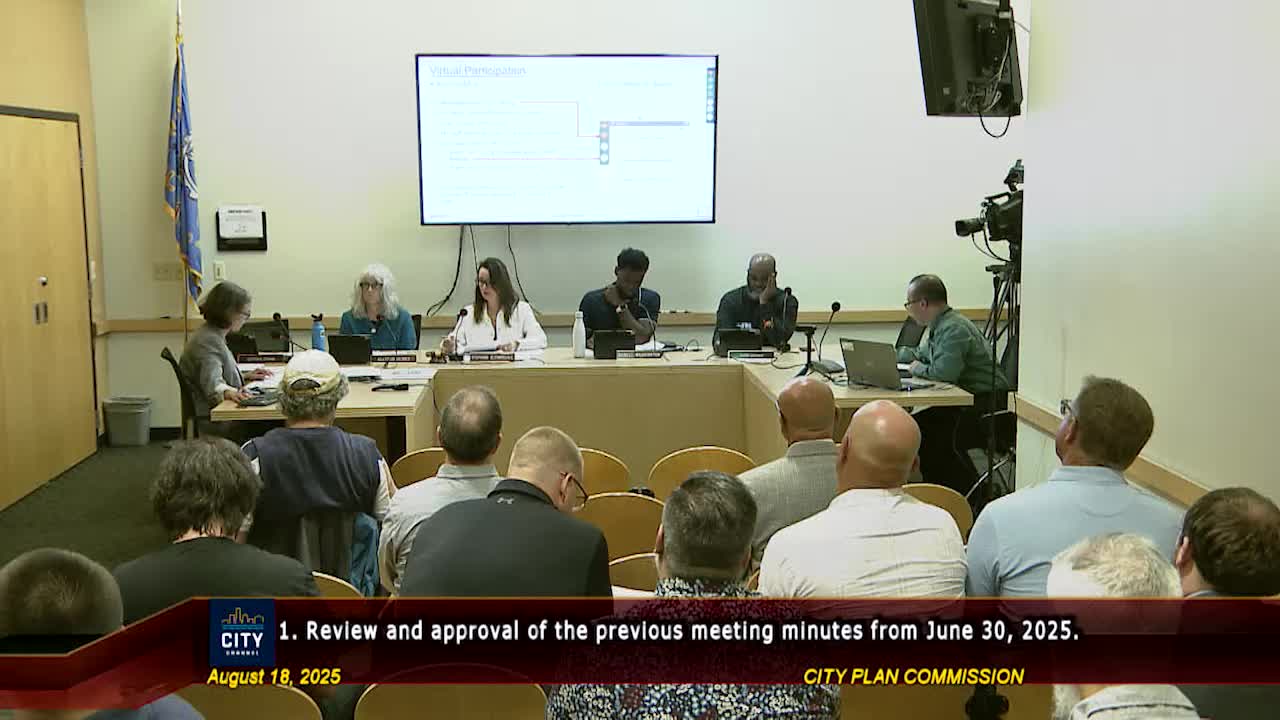
The City Plan Commission on Aug. 18 approved a request to expand the boundaries of Business Improvement District Number 20 (East North Avenue) in the Third Aldermanic District, adding a set of commercial properties and including the Columbia St. Mary’s hospital campus in the BID’s footprint.
Neighborhood Business Development Administrator Matt Redrick of the City of Milwaukee Department of City Development told the commission that business improvement districts are authorized by state statute and act as a taxing overlay on commercial properties. “Business improvement districts are permitted by state statute, specifically 60 six‑eleven oh 9, and they are essentially a taxing overlay,” Redrick said.
Ryan Lasig, executive director of East Side BID 20, described services the BID provides—“security, graffiti removal, safety, sanitation, as well as beautification through holiday lighting, flowers, and planters”—and said the expansion is intended to bring newer businesses and the hospital into that service area. Lasig said the BID’s assessment rate remains $5 per $1,000 of assessed value with a maximum assessment of $5,000 per property. He provided financial context: the BID’s 2024 assessment revenue was $227,686.55 and the proposed expansion would increase that by roughly $34,233.35.
During public comment, resident Raul Morales, of 1709 East Thomas Avenue, said he and his neighbors were surprised to see residential parcels included on the proposed map and said he had received only the meeting notice by certified mail. “Every single property that is in this area that is proposed to be annexed into the Business Improvement District is residential,” Morales said, noting long‑term occupancy by neighbors and asking for clearer reasons for including those parcels.
Chair Stephanie Bloomingdale and commissioners clarified how BID assessments are applied. Bloomingdale told Morales that the expansion “would only affect businesses within that district. So it will not affect single family, duplexes, multi families at all,” and reiterated that state law prohibits assessing properties used for residential purposes. BID representatives and DCD staff described outreach that preceded the proposal: a public meeting at the UWM Cambridge Café, postcards to affected businesses, social media notices and 130 certified mailers to residents and business owners; BID staff said some businesses also contacted the BID directly asking to join.
The commission voted to close the public hearing and approve file 250414 on a motion by Commissioner Tariq Moody, seconded by Commissioner Katrina Crane; the motion carried by voice vote.
Why this matters: BIDs levy assessments on commercial property owners to fund services above baseline city operations, so boundary changes affect which commercial parcels contribute to those services and which businesses can request BID services. Including Columbia St. Mary’s binds a major institutional property into BID service area planning, while the commission and BID and DCD representatives repeatedly emphasized that residential parcels are not subject to BID assessments under the law.
What’s next: The commission’s approval forwards the ordinance to the Common Council for final action; implementation of the expanded services will follow the BID’s annual budgeting and contracting processes.