Get Full Government Meeting Transcripts, Videos, & Alerts Forever!
Get email alerts on the Police Transparency topic
No spam. Unsubscribe anytime.
Austin police oversight panel presses to begin case reviews, seeks safeguards after state bill and rapid adjudication concerns
Summary
The Community Police Review Commission on Aug. 15 voted to review an internal affairs investigation into a May officer-involved shooting, discussed clearances and training needed to access non-redacted records, and heard public pleas to safeguard access to police misconduct records amid references to a state bill, HB 15.
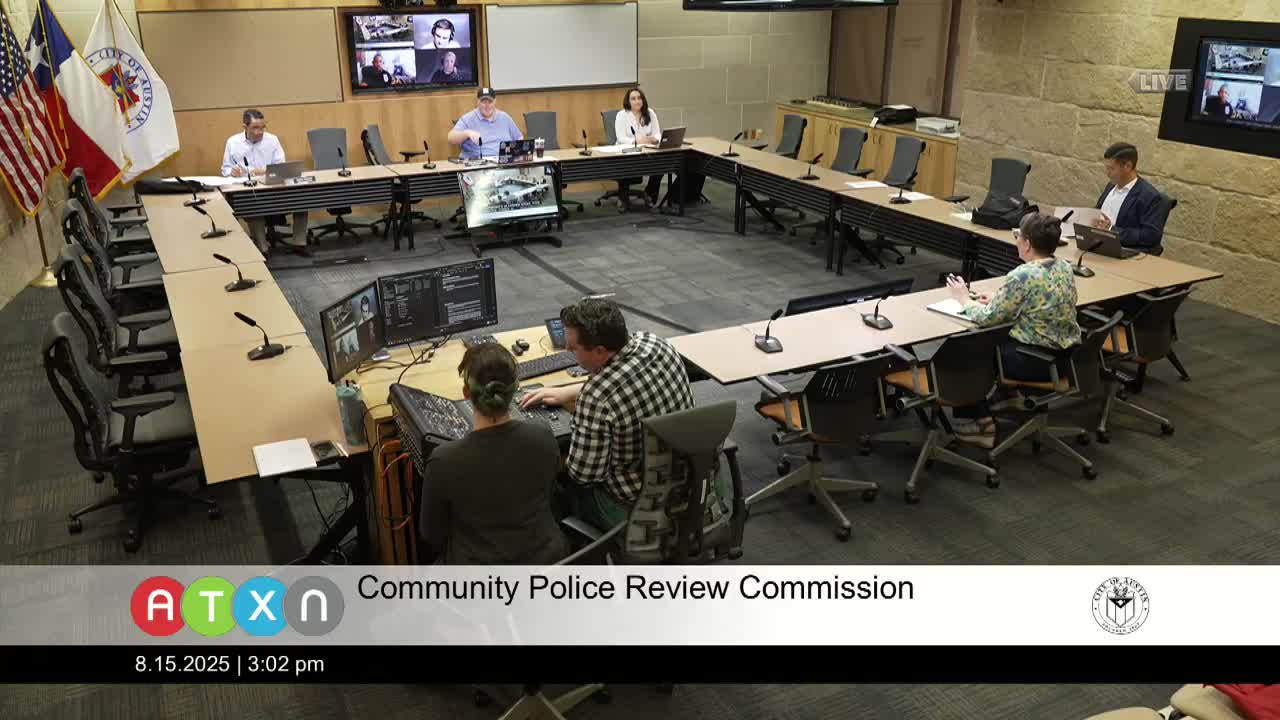
AUSTIN — The Community Police Review Commission on Aug. 15 voted to begin formal review of an internal affairs investigation into an officer-involved shooting and spent much of its monthly meeting pressing staff for concrete steps to start case reviews and protect public access to police records.
The commission approved a request to review internal affairs case 2025-01411, related to a May 31 officer-involved shooting. Commissioners also discussed training and clearances required for commissioners to view non-redacted records — including criminal-justice information system (CJIS) certification and criminal background checks — and debated what the commission can do if state law limits local transparency.
The meeting opened with two public commenters raising related concerns. Loyah Mitchell asked whether the commission “have a plan for, protecting itself from the legislature,” saying she had seen bills that would remove the commission’s access to police documents. Mary Elizabeth, who identified herself as a longtime hotline intake worker, said, “The bill to keep police misconduct unavailable to the public is now HB 15,” and said restricted access would hamper community healing after incidents such as Uvalde.
Those public comments framed several agenda discussions. Commissioners and staff described a series of operational steps intended to move the commission from planning to active case review: the Office of Police Oversight (OPO) provided a packet listing active internal and external cases; staff said there are 46 active investigations in the OPO docket; and the commission’s newly formed case-review working group — led by Commissioners Flood and Cortes Franco — said it had just received the first copy of open-case materials and would begin triage.
Commissioners emphasized practical barriers that must be cleared before many members can independently review non-redacted files. Kevin, an OPO staff member who briefed the commission, said commissioners must complete CJIS certification to view non-redacted footage and file materials, and that CJIS training is roughly a four-hour course. Ryan Alvarez, OPO support staff, told commissioners that human-resources background-check steps required by a recent state law have been forwarded to HR and that commissioners should watch for HR emails to complete those checks.
Several commissioners pressed for deadlines and a “gap analysis” to identify what prevents the commission from doing its work. “We are really good at planning things and putting things on the agenda to discuss, but we’re very bad at actually executing things,” Commissioner Flood said, urging the body to adopt an intentional timeline and clearer communications between members.
Commission business at the meeting included motions the commission approved by voice vote. The commission unanimously approved the minutes of its July meeting and unanimously approved the request to review internal affairs case 2025-01411; the transcript shows motions made, seconded and carried, though individual roll-call vote names were not recorded on the public audio.
Two transparency questions drew sustained discussion. One was a draft recommendation — prepared by Commissioner Brandt — asking APD to proactively release redacted body-worn camera footage from arrests made during June protests related to Immigration and Customs Enforcement. Commissioners agreed the subject warranted a formal recommendation but tabled that specific draft so members could receive and review the most recent version before voting. Another transparency concern grew from a separate, earlier internal review of a May incident on Sixth Street that staff described as adjudicated unusually quickly; several commissioners said the speed created an appearance problem and asked the commission to examine APD’s adjudication timelines and recommend policy changes to prevent future circumvention of external review.
The commission also discussed filling vacant commissioner seats. Staff said the original application process produced 31 applicants and that 15 remain on a standby list; commissioners instructed staff to contact those 15 to confirm interest and to bring nominations back to the commission for selection at a future meeting.
Members asked staff to assemble several items for the next meeting: the standby-applicant list, the OPO and internal-affairs processes for adjudication, the current case packet, and a briefing on what training and clearances remain. Commissioners asked that new appointees be onboarded and trained as quickly as the interdepartmental schedules allow.
The commission ended the meeting by adding an action item to develop a recommendation for APD policy changes to ensure the commission and OPO are not routinely precluded from participating in or reviewing high-profile internal adjudications. Commissioners asked staff to coordinate with internal affairs and OPO on a joint review of timelines and procedures and to return a proposed recommendation for the commission to vote on at a future meeting.
For follow-up and records requests, the meeting notice and staff contact were included in the posted agenda: Ryan Alvarez at the Office of Police Oversight (512-974-9090).