Get Full Government Meeting Transcripts, Videos, & Alerts Forever!
Get email alerts on the Public Transit topic
No spam. Unsubscribe anytime.
Josephine County transit officials propose daily service cuts, cite staffing and funding uncertainty
Summary
Transit staff presented a federally required coordination plan and said they plan to cut 7.75 service hours per day because of staffing shortages and uncertain grant funding for 2026–27; no board action was required at the Aug. 14 meeting.
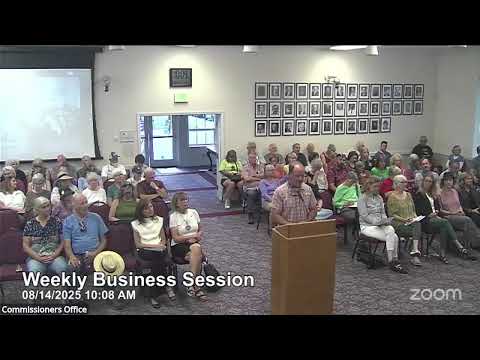
GRANTS PASS, Ore. — Josephine County transit staff told the Board of Commissioners on Aug. 14 that the county will seek to reduce daily fixed-route service by 7.75 hours because of staffing shortfalls and uncertainty about future transit funding.
Scott Chancey, the county’s transit program manager, presented two informational items: a federally and state-required transit coordination plan that outlines funding priorities and projects for the next three to five years, and a proposal to reduce daily transit service. Chancey said the coordination plan is a final draft and will return to the board for formal adoption, likely in October, and that the plan’s appendices are available upon request.
On service cuts, Chancey said the county plans to eliminate some commuter runs and shorten evening fixed-route hours to align service with available staff and uncertain funding for 2026–27. He told the board, “We plan on reducing our services by 7.75 hours a day.” Specific reductions noted in the presentation included:
- Eliminating one commuter run per day to Cape Junction. - Eliminating one commuter run per day to Medford. - Reducing evening fixed-route service that now runs to about 9:30 p.m. to a 7:00 p.m. end time on the Rogue Community College route between Sixth and Seventh streets and Rogue Community College.
Chancey said the county will not reduce staff hours in concert with these service cuts; instead the agency expects to cover current runs with existing employees. He said there will be a secondary call-in or app-based on-demand option for riders in the affected areas, so "there's no true reduction in service for that," although that option requires riders to schedule a trip.
Why it matters: Several residents at the meeting expressed concern about cuts that could affect workers and students who rely on evening or commuter service. Commissioner Barnett and other speakers emphasized stewardship of limited budgets; Barnett said cutting underused runs is sometimes necessary to match service to demand. Transit staff said the reductions are meant to avoid hiring new personnel for hours that may not be funded in future grant cycles.
Board action: This was an informational item; the board took no formal action at the Aug. 14 meeting. Chancey said he plans to return with the coordination plan for formal adoption in October and that any service changes will be public noticed.
Details and context: Chancey said the transit plan's development was funded from transit-specific planning monies, not from the county general fund. He also said current-year budgets are balanced but that state and federal funding for the following fiscal year are uncertain. The proposed service reductions are intended to maintain fiscal prudence rather than to reduce payrolls immediately.
Who spoke on this item
Scott Chancey — Transit Program Manager, Josephine County (presenter) Commissioner Chris Barnett — Josephine County Board of Commissioners Multiple residents raised operational concerns in public comment (e.g., potential impact on workers and students who rely on evening runs).
Next steps
Chancey said the coordination plan will come back to the board for first and second readings and adoption, with staff aiming for October. Service changes will be public-noticed and implemented consistent with transit rules and rider-notice requirements.