Get Full Government Meeting Transcripts, Videos, & Alerts Forever!
Get email alerts on the Public Safety Radio System topic
No spam. Unsubscribe anytime.
Harrison County weighs two public-safety radio proposals as state NG911 funding changes loom
Summary
County officials reviewed competing radio-system proposals from Motorola and CI, discussed differences in coverage testing, costs and control, and heard that new state law will withhold a portion of NG911 surcharge revenue for next-generation 911 planning rather than local radio systems.
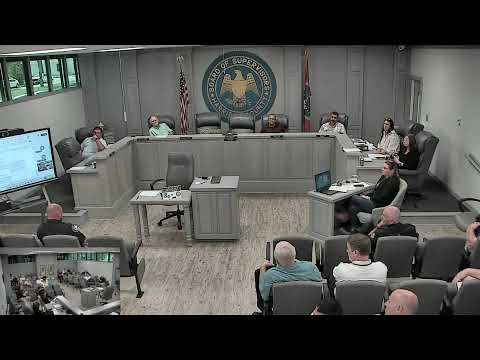
Harrison County officials and public-safety leaders spent a multi-hour session reviewing two competing proposals to replace or upgrade the county's land-mobile radio network, weighing differences in coverage, testing methods, local control and long-term costs.
The discussion focused on a proposal from Motorola (presented through the state-managed MSWIN arrangement) and a proposal from CI (a managed-services approach). County staff and consultants said the two bids were "technically comparable," but differ on site placement, system ownership, how coverage will be verified and which costs the county would carry.
Why it matters: the county's choice affects how reliably first responders can communicate inside buildings and across unincorporated areas, who will manage the system, and whether future state NG911 funding rules will limit access to some new state money for radio projects.
Both proposals included the coverage areas required by the county's request for proposals, officials said, but they take different technical approaches. CI's plan relies on three additional county-area towers (county would need to acquire or lease sites) and uses simulcast towers within the county; Motorola's plan proposes reusing more existing statewide towers and adding fewer locally leased towers. "With CI's approach, in-building coverage near those new towers would generally be better because the towers are closer," a presenter identified in the meeting as Terry said. "Motorola proposes reusing existing county sites and two sites outside the county that would still provide coverage inside the county."
Officials emphasized that the maps and studies are proposals until acceptance testing is completed. The CI proposal calls for objective bit-error-rate testing (an automated measurement); Motorola's initial materials relied on subjective delivered-audio-quality (DAQ) testing, though the county pressed Motorola to provide objective testing as well. County staff said the RFP requires vendors to show that 95% of the half-mile test tiles in each required service area pass the acceptance test; passing criteria and test methods differ between the two vendor approaches.
Technical and operational differences discussed at length include: - Core redundancy and control: CI's proposal included more distributed core equipment located closer to the county and additional redundancy (two cores in Harrison plus two in Jackson County in their design), while the Motorola/MSWIN option would interconnect to statewide cores that are farther away. Staff warned that "distance is dangerous" for resiliency: losing connectivity several hops away can sever dispatch consoles from sites even if simulcast sites keep transmitting. - Backhaul and microwave loops: Motorola proposed reusing the county's existing microwave backhaul to create a ring connecting sites; CI proposed a different microwave topology. A closed microwave loop would allow sites to keep communicating with each other if a single hop fails. - Coverage and in-building testing: both vendors offered to perform portable-on-street and in-building tests for a list of critical buildings (schools, public buildings, colleges). County staff noted there has been no in-building testing yet; both firms said they would conduct DAQ/DAQ-equivalent testing inside listed critical buildings and report results for information. - Push-to-talk app licensing: both vendors proposed a smartphone push-to-talk capability with 50 licenses. County staff said Motorola's app would carry a recurring subscription charge ($13 per user per month as presented, about $7,800 per year for 50 users), while CI's pricing bundled the app license as a one-time cost included in the proposal. - Network management and ownership: CI's managed-services offering would give the county broader direct access to system management functions; the Motorola/MSWIN approach would rely more on state-level management and would limit local network-management access unless the county pays extra.
Costs and financing: staff said the Motorola/MSWIN option in the presentation ran about $26 million net, while the CI managed-services total was about $27 million (figures reflect vendor proposals and may change after further negotiation). County staff also noted the CI option assumes three additional towers the county would need to fund; the estimated cost for three new towers was discussed at roughly $6 million. Staff warned some line items (shelters, lease costs, and recurring annual payments tied to producer-price-index adjustments) may change during final contract negotiations.
State funding question: Matt Haley, identified in the meeting as a local representative to the state 9-1-1 board, reviewed the new state law (referred to in the meeting as Senate Bill 2835). He said the law will redirect a portion of surcharge revenue into an escrow for NG911 planning. "Thirty percent of the fees collected by the state are set aside into what I kind of think of as escrow," Haley said. "We can't access that 30% until we have an approved NG911 plan." Haley said 70% of the funds will flow to local communications districts as before; the escrowed portion, he said, is not available for local radio-system purchases under the legislation as he read it.
Next steps and local direction: supervisors and city representatives asked for more detail from Motorola on test methodology, response times and local technical support capability and asked staff to seek a final, best offer from Motorola comparable to the CI negotiated proposal. County staff asked cities and agencies to return a written preference or a list of additional conditions/questions to the county administrator (Robbie) by the end of next week (or by the date the county publishes) so the county can compile negotiated items and ask the vendors for firm, comparable final offers. "If you go with CI, you're going to own more; if you go with the statewide solution, you're buying into the state's support structure and potentially lower upfront cost," a consultant said.
Public comment: a private citizen, John Weatherford, urged elected leaders to unify county and city decisions and to move promptly. "We owe it to our citizens to do something," Weatherford said. "Whatever radio system we go with, we need to go with one radio system."
The board did not take a formal vote during the session. Officials set a short timetable for jurisdictions to return preferences and requested clarified technical responses and final pricing from Motorola and CI before the board takes a procurement decision at a later meeting.
Ending: County staff said further negotiation and clarified test protocols are necessary before a final recommendation; staff and several elected officials asked that each city and agency coordinate with their CFOs or elected leadership and return a formal position to the county administrator so the procurement team can obtain final, comparable offers from both vendors.