Get Full Government Meeting Transcripts, Videos, & Alerts Forever!
Get email alerts on the Land Use topic
No spam. Unsubscribe anytime.
Planning Commission backs special-use permit for food truck at 1710 Country Club Road
Summary
The Harrisonburg Planning Commission voted unanimously Aug. 13 to recommend that City Council approve a special-use permit allowing a mobile food truck and related restaurant activities at 1710 Country Club Road, subject to conditions addressing parking, curb work and floodplain issues.
The Harrisonburg Planning Commission voted unanimously Aug. 13 to recommend that City Council approve a special-use permit allowing a mobile food truck and related restaurant activities at 1710 Country Club Road, advancing the proposal to the Sept. 9 City Council public hearing.
Staff and commissioners said the approval was conditioned to limit parking and require coordination with Public Works to restore or delineate a rebuilt entrance curb. Planning staff also flagged the site’s location largely within the 100-year floodplain and the floodway and said engineering work will be required to determine whether picnic tables or other site furnishings can remain in their current locations.
A city planner told the commission that staff had issued a notice of violation after discovering a mobile food truck operating on the property in May 2025 and had worked with the applicants to pursue a special-use permit to correct the violation. “Staff recommends that ... the mobile food truck should have no adverse effect on the health, safety, and comfort of those living and working in the area and recommends approval with conditions,” the planner said.
The staff presentation described several site constraints. The property is “almost entirely located within the 100-year floodplain and the floodway,” the planner said, and base flood elevations in the immediate area range between 1,403 and 1,406 feet; a 1989 site plan lists the building elevation at 1,408 feet. The planner said the city had reached out to the Virginia Department of Conservation and Recreation for guidance but had not yet received a response; staff said engineering analysis would likely be required to confirm whether seating and other structures could lawfully remain within the floodplain or floodway.
Staff also noted parking and access concerns tied to the site plan. By the zoning ordinance, the vehicle service and repair use on the property requires six parking spaces; a mobile food business does not require additional parking. The applicants told staff they have a temporary agreement with a neighboring property owner, identified by the applicant as Brandon, to use some parking on an adjacent lot. Planning staff recommended a condition prohibiting parking between the existing service building and Country Club Road and said the property owner would have to submit a plan meeting the city’s design and construction standards if they later sought to reconfigure parking in that area.
The staff presentation also documented that curbing shown on a 2012 image now appears covered with gravel; staff recommended that the property owner coordinate with the Department of Public Works to replace the curb or remove gravel to delineate the previously designed entrance.
Christian Kevin Arostigi, who said he is the son of property owner Ignacio Adosti and lives at 1710 Country Club Road, told the commission the family had operated a vehicle service business on the site since about 2016 and began expanding the food-truck operation in December. “We’ve been operating there since, I think, 2016,” Arostigi said. He told the commission the neighboring lot owner had allowed customers to park there temporarily and that he believed the site had sufficient off-street parking on the property’s left-hand side if the temporary arrangement ended.
A caller during the public hearing described the staff discussion as a return to technical deliberation and urged flexibility. “I am calling today first and foremost to celebrate what looked like a new era on planning commission where, we’re back to deliberating technical details,” the caller said, urging a favorable recommendation.
Commissioners debated the floodplain issues and whether staff could allow the food truck to continue operating while the property owner works to resolve violations. Planning staff said the city typically will allow continued operation when there is no immediate safety concern and the owner is actively working with city staff, but that denial of the special-use permit would require the operation to cease after City Council’s decision. Commissioners asked staff to confirm elevations and expressed interest in permitting solutions if a modest grade change could allow the tables to remain.
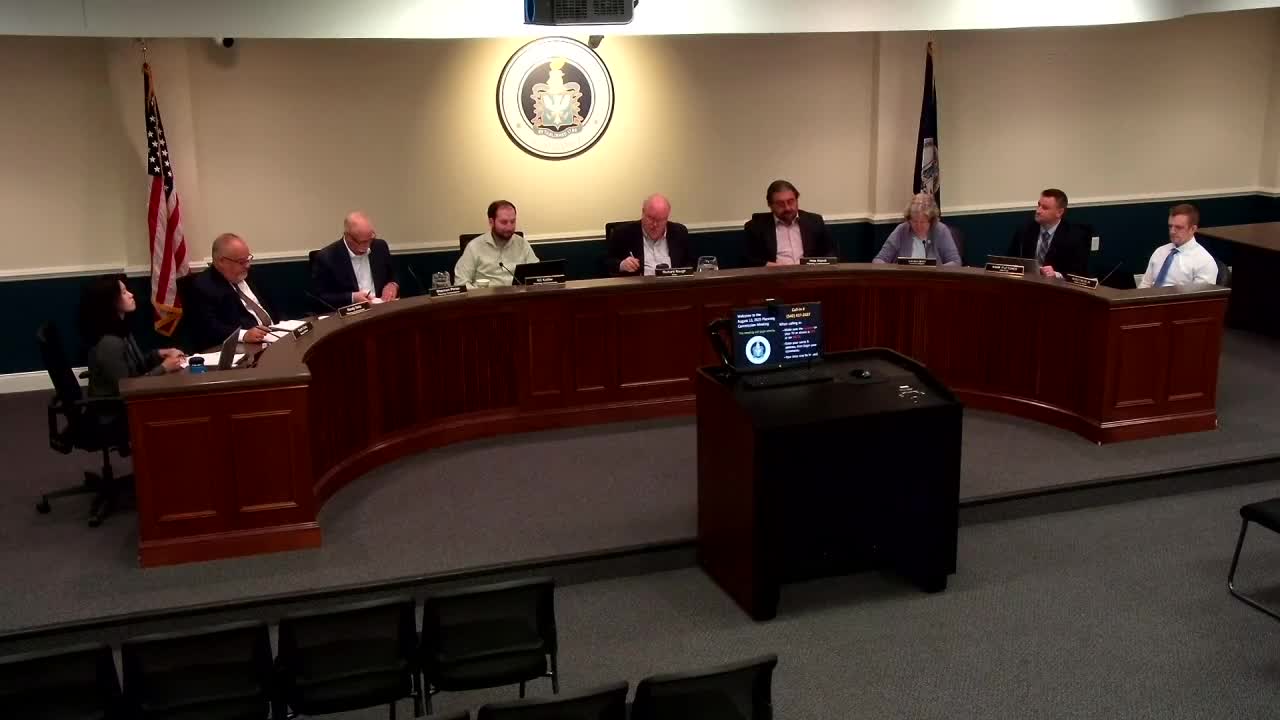
Commissioner Porter moved to recommend approval of the special-use permit with the conditions proposed by staff; Commissioner Kettler seconded. The commission’s roll-call vote was unanimous: Porter, Kettler, Dent, Sykes, Alcinde and Chair Paugh all voted aye. Planning Commission members stated the matter will go to City Council with a favorable recommendation; commission members noted council is likely to consider the item at its second meeting in September, Sept. 9.
The city planner and building-inspections staff are working separately with the property owner to resolve the work already performed inside the floodway and said an engineer will likely need to document what was constructed and whether any fill was used. Staff said that, because DCR guidance had not yet been received, the permit conditions emphasize that tables and chairs located in the floodway may be limited until required engineering or regulatory guidance is provided. The commission also included a compliance timeline: staff noted similar cases have used a 60-day window for meeting conditions with the possibility of an extension.
If City Council approves the special-use permit, the conditions discussed by staff will remain attached to the permit; if Council denies the request, staff said the applicant would need to cease the food-truck operation immediately after Council’s decision. The food-truck operation and outstanding floodway corrections remain under active review by city departments.