Get Full Government Meeting Transcripts, Videos, & Alerts Forever!
Get email alerts on the Municipal Budget topic
No spam. Unsubscribe anytime.
Omaha residents and organizations urge investment in housing, mental‑health and outreach while many oppose police budget increase
Summary
City Council President Festersen opened a public hearing on the City of Omaha’s proposed 2026 budget and capital improvement program; nonprofit leaders, firefighters and residents urged funding for hotlines, street medicine, firefighter health screenings and job programs while many speakers opposed a proposed increase in police spending and asked the council to reallocate money to housing, mental‑health responders and community services.
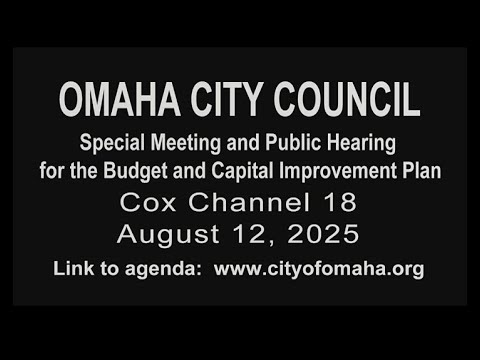
City Council President Festersen opened a public hearing on the City of Omaha’s proposed 2026 budget and capital improvement program, inviting written and spoken testimony before the council continues review and votes on the budget at its regular meeting on Tuesday, Aug. 26 at 2 p.m.
Advocates and nonprofit leaders told the council they support targeted city funding for services such as domestic‑violence hotlines, street medicine, youth programming and firefighter health screenings. Several dozen opponents, however, pressed the council to roll back or reallocate a proposed increase in police funding and to prioritize investments in housing stability, restorative justice, mental‑health crisis response, parks, transit and constituent outreach.
Why this matters: The hearing brought numerous concrete funding requests and policy arguments into the public record ahead of the council’s scheduled budget vote. Speakers named specific grant amounts and program needs, and several said the budget fails to make long‑term investments in housing and social services that, they argued, would reduce demand for policing. City officials and council members will consider this input as they finalize the 2026 budget.
Most prominent support and funding requests
- Jeanette Taylor, CEO of the Women’s Center for Advancement, said the organization is slated to receive $40,000 to support its 24/7 hotline for survivors of domestic violence, sexual assault and human trafficking. She described a long partnership with the city and offered to answer questions about the program’s work.
- Julian Andrade, executive director of Police Athletics for Community Engagement, asked the council to continue support for program personnel and said his group served about 1,700 unique athletes last year across multiple sports and expects growth in 2026.
- Trevor Towey, president of Omaha Professional Firefighters, praised proposed investments for firefighter cancer and health screenings but said the department still needs more staffing, training officers, investigators and inspectors; he noted recent annexations that add households without corresponding added fire staffing.
- Melissa Neuwenfeldt of Heal Omaha Street Medicine urged the council to fund the mayor’s recommended $216,000 to support a community health worker, volunteer manager and an additional vehicle; she described volunteer clinical capacity and coordination with the county health department and homeless services partners.
Themes from opponents and other public commenters
Speakers opposing the budget and several advocacy groups raised recurring concerns:
- Police funding: Multiple speakers criticized a proposed increase in police spending, citing figures given in testimony such as a 6.6% department increase, a proposal that would add 113 officers and 30 cruisers, and increases described by speakers as “nearly $13 million” or “$27 million” depending on the commenter’s calculation. Testimony urged reallocating marginal increases to mental‑health responders, violence interruption programs and housing stability initiatives.
- Housing and Right to Counsel: Several speakers called for the council to fund a Right‑to‑Counsel program for public housing tenants. Maureen Piper and others said a state law granting Omaha Housing Authority tenants access to counsel was passed in 2024 but remains unfunded; the Omaha Housing Authority’s estimate of annual cost cited in testimony was about $1,000,000.
- Homelessness and outreach: Multiple commenters urged larger investments in homeless outreach, coordinated entry, and a full‑time homeless services coordinator or task force staffing rather than further criminalizing homelessness.
- Mental‑health crisis response: Several speakers recommended funding community crisis models such as Denver’s STAR or Eugene’s CAHOOTS rather than relying primarily on armed officers for mental‑health and substance‑use calls. Testimony proposed mobile teams staffed by EMTs and licensed mental‑health practitioners as lower‑cost alternatives for many 9‑1‑1 calls.
- Food insecurity and refugee support: Christine Kramer and others warned that federal changes to SNAP eligibility could worsen local food insecurity, particularly among newly arrived refugees; they asked the city to increase support for local food banks and pantries.
- Transparency and accessibility: Numerous residents said the budget was difficult to find and understand, urged more outreach and earlier opportunities for public comment, and asked for consolidated, easy‑to‑read budget materials and district‑level engagement.
- Infrastructure priorities: Opponents also questioned large proposed spending on parking garages and road maintenance, urged more funding for parks and pedestrian and bicycle infrastructure, and requested the city fund planned bike lanes and safer pedestrian projects tied to new facilities like the forthcoming library on 72nd and Dodge.
Other recurring requests and examples cited in testimony
- Calls to fund restorative justice programs (including juvenile restorative justice), expand community policing training and youth programs, and reinstate or create positions for outreach and constituent services.
- Requests for increased oversight, accountability and legal protections for tenants of the Omaha Housing Authority, including funding for tenant legal representation and stronger enforcement of housing quality standards.
Council process notes and formal action that occurred
President Festersen noted the city charter and the Open Meetings Act were followed for the hearing, and city clerk Elizabeth Butler read the public‑hearing speaker procedures. The council did not vote on the budget at this meeting; the council president announced the budget vote is scheduled for Aug. 26 at 2 p.m. The only formal council action recorded in the transcript of this hearing was a motion to adjourn, which the roll call recorded as passing 7‑0. The council adjourned at 8:05 p.m.
Ending: The council will consider public testimony collected at this hearing as it finalizes the 2026 budget at its upcoming regular meeting; speakers asked the council to prioritize housing stability, mental‑health crisis response and community programs over expanded police headcount and vehicle purchases.