Get Full Government Meeting Transcripts, Videos, & Alerts Forever!
Get email alerts on the Sobering Center Expansion Budget topic
No spam. Unsubscribe anytime.
Sobering Center seeks operating funds to open second‑floor expansion; county paid renovations, CEO says
Summary
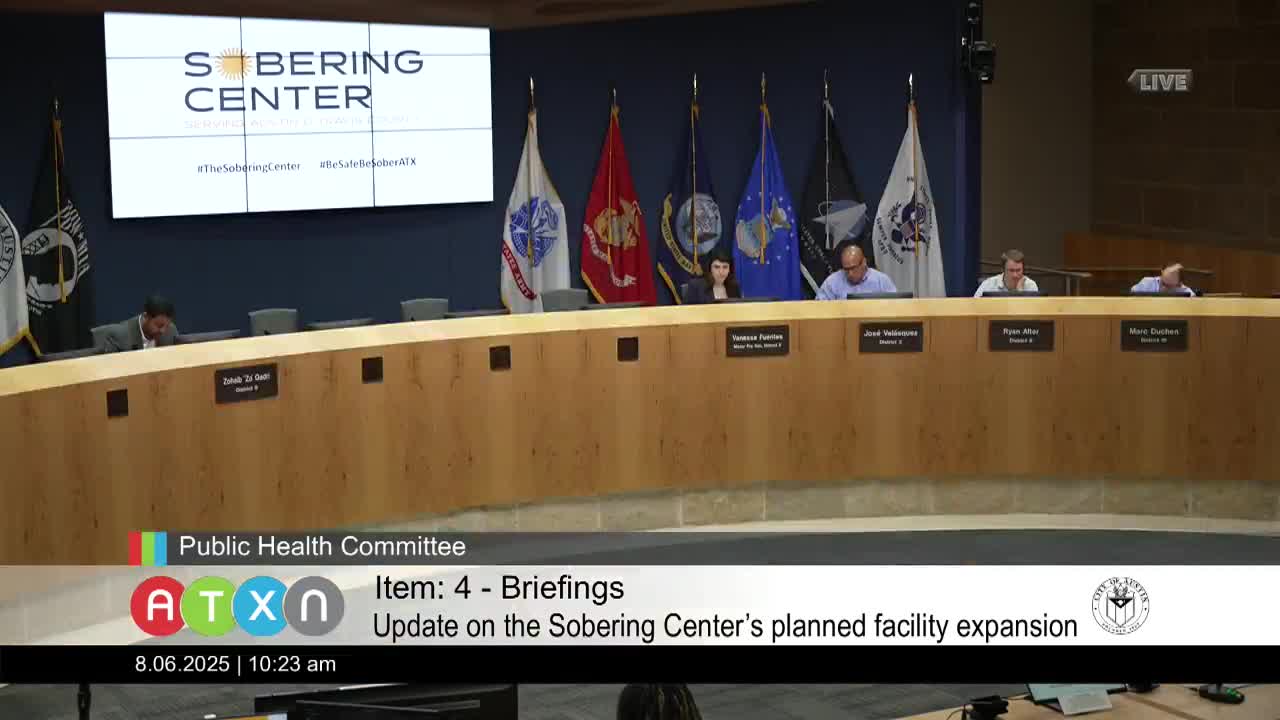
Laura LeBlanc, chief executive officer of the Sobering Center, told the Austin Public Health Committee Wednesday that a county‑funded renovation of the center’s second floor is complete and ready for staff, but the center needs city operating funds to open it.
Laura LeBlanc, chief executive officer of the Sobering Center, told the Austin Public Health Committee Wednesday that a county‑funded renovation of the center’s second floor is complete and ready for staff, but the center needs city operating funds to open it.
LeBlanc said the center, which opened in 2018 under an interlocal agreement between the city and Travis County, has conducted about 13,000 intakes since it began and operates "24/7, 365." The planned second‑floor opening would move sober clients who are waiting for treatment beds off the first floor and create space to accept more intoxicated intakes from first responders, she said.
"We are open 24/7, 365," LeBlanc told the committee. "The Second Floor is ready to go. The county paid to renovate the building and also to furnish it, put security cameras in it, put technology in it… We just have to hire the staff to open it."
LeBlanc said the center submitted a $2,800,000 FY26 operating request to the city, including enhancements, but that the city manager’s proposed budget cut the enhancement packages and set a $2.4 million figure. She said Council Member Vela later placed the center’s operating request and enhancement items into a tax rate election (TRE) budget item that will go before council.
The second floor was renovated with leftover ARPA funds from the county and includes a dorm and three private rooms; LeBlanc said it would be a location to hold sober clients who have been assessed and are awaiting treatment placements. She described the center’s recent practice of arranging transportation to treatment — sometimes outside Austin — when local detox beds are unavailable, saying the center now performs that placement work about 200 times per year when beds can be found.
LeBlanc told the committee that the center has broadened allowable referrals beyond law enforcement and EMS to roughly 90 referral partners, including hospitals, the university and social service agencies. She said law enforcement and EMS remain the top two referral sources.
On funding and partnerships, LeBlanc said Central Health has begun contracting with the sobering center for certain clients who are MAP‑eligible and staying past a specified period; Central Health is also part of the center’s plan to help open the second floor. LeBlanc described the center as an independent local government corporation and a 501(c)(3), with operating funding historically provided by the city and capital improvements provided by the county under the interlocal agreement.
LeBlanc also said an outside cost‑benefit analysis shows the center returns roughly $2 for every $1 invested through diversions from emergency care or jail. She urged committee members to support a sustainable funding solution, raise concerns about the budget negotiation process tied to the interlocal agreement, and said the center needs clarity on the budget process so operating dollars are aligned with actual costs.
Why it matters: the center is a point of diversion from emergency rooms and jail for people with severe intoxication, provides bridge medications and other on‑site medical services, and its ability to open the renovated second floor depends on a recurring operating budget that the city must provide under the interlocal agreement.
No committee vote was taken on the sobering center budget at Wednesday's meeting; members discussed the center’s funding request and the interlocal agreement during the briefing.