Get Full Government Meeting Transcripts, Videos, & Alerts Forever!
Get email alerts on the Homelessness Shelter Marshaling Yard topic
No spam. Unsubscribe anytime.
Public Health Committee hears update on Marshaling Yard shelter; capacity now 282, 29% positive exit rate
Summary
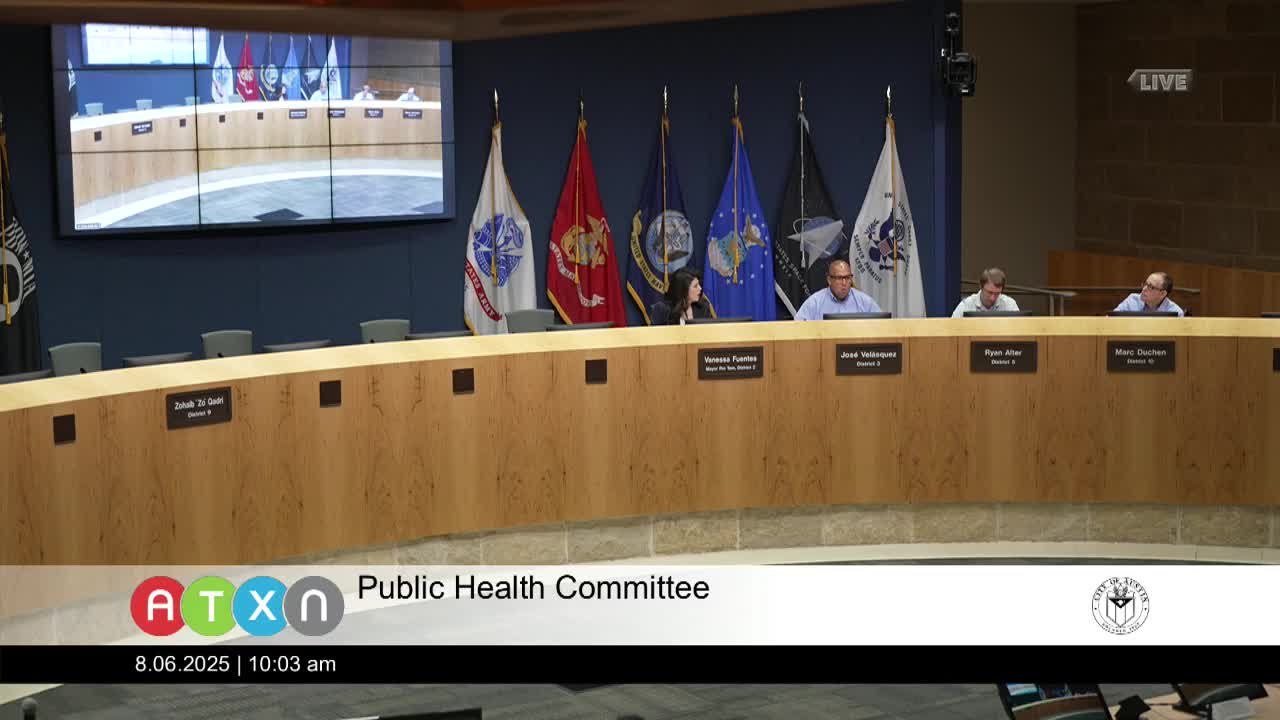
The Austin Public Health Committee received an update Wednesday on the Marshaling Yard, a temporary shelter for people experiencing homelessness that opened in August 2023 and has served about 1,323 people, city staff said.
The Austin Public Health Committee received an update Wednesday on the Marshaling Yard, a temporary shelter for people experiencing homelessness that opened in August 2023 and has served about 1,323 people, city staff said.
The update, presented by Greg McCormack, program manager for Homeless Strategy Operations, focused on current capacity and services, staffing levels, outcomes and next steps as the city balances short‑term shelter needs with plans for longer‑term shelter capacity.
McCormack said the facility opened in August 2023 and that Endeavors has been the operator from the start. "We used to have a capacity of 300 there. We now have a capacity of 282," he said, attributing the change to the convention center reclaiming some of the building for storage. He told the committee the yard has served roughly 1,323 individuals since opening and that the Marshaling Yard’s positive exit — people who left to housing or stable arrangements — is 29 percent.
McCormack described services provided at the site: three meals a day through a partnership with Central Texas Food Bank; daily transportation to bus stops and appointments; drop‑off and pickup laundry services; temporary bathroom and shower trailers; pet accommodations in a climate‑controlled Connex unit that holds about 20–25 dogs; on‑site peer support and activity programming; and frequent outreach by community providers.
Staffing at the site includes nine case managers from a mix of Endeavors and Sunrise staff, a ratio McCormack said is approximately 1 case manager per 30 clients. "Without case managers, people just are not gonna get housed," he told the committee, arguing for the importance of both numbers and staff skill sets, including social workers and peer specialists.
On outcomes, McCormack said 244 people were recorded as positively exited (housed) in the Homeless Management Information System and that 87 people were housed from May 2024 to May 2025. He also highlighted a peer specialist hire who had been a Marshaling Yard client and later secured housing and certification and returned to work at the site.
Committee members asked operational questions. Councilman Ralster asked whether the convention center had asked for more space; McCormack said the city had concluded negotiations and "we're able to make the space that was left work for us," and he did not expect the 282 figure to change. A committee member asked for cost‑per‑bed figures; McCormack said the office has compiled those numbers and would arrange for staff to send them to the committee.
Looking ahead, McCormack said the city is seeking replacement or additional shelter capacity. He described an anticipated 100‑bed expansion by a local foundation (referred to in the briefing as TUV/the other one's foundation) that staff hope could be available by the end of the year or the start of next year and said the bond proposal under discussion could include a large shelter with a notional 800–1,000 bed capacity. McCormack cautioned that moving beds between sites requires ensuring services follow the beds and that the Marshaling Yard is not intended to be permanent.
Why it matters: the Marshaling Yard is one piece of the city's emergency shelter system and the committee heard that staffing — particularly case management and peer specialists — and connections to housing remain the key constraints to increasing successful exits to housing.
Committee Chair Vanessa Fuentes opened and closed the update; no committee action or vote on the Marshaling Yard was taken at the meeting.
Next steps noted during the briefing included possible beds shifting to the foundation expansion if it becomes available, continued tracking of positive exits in HMIS, and follow‑up by staff to provide cost‑per‑bed and other fiscal details to committee members.