Get Full Government Meeting Transcripts, Videos, & Alerts Forever!
Get email alerts on the Housing topic
No spam. Unsubscribe anytime.
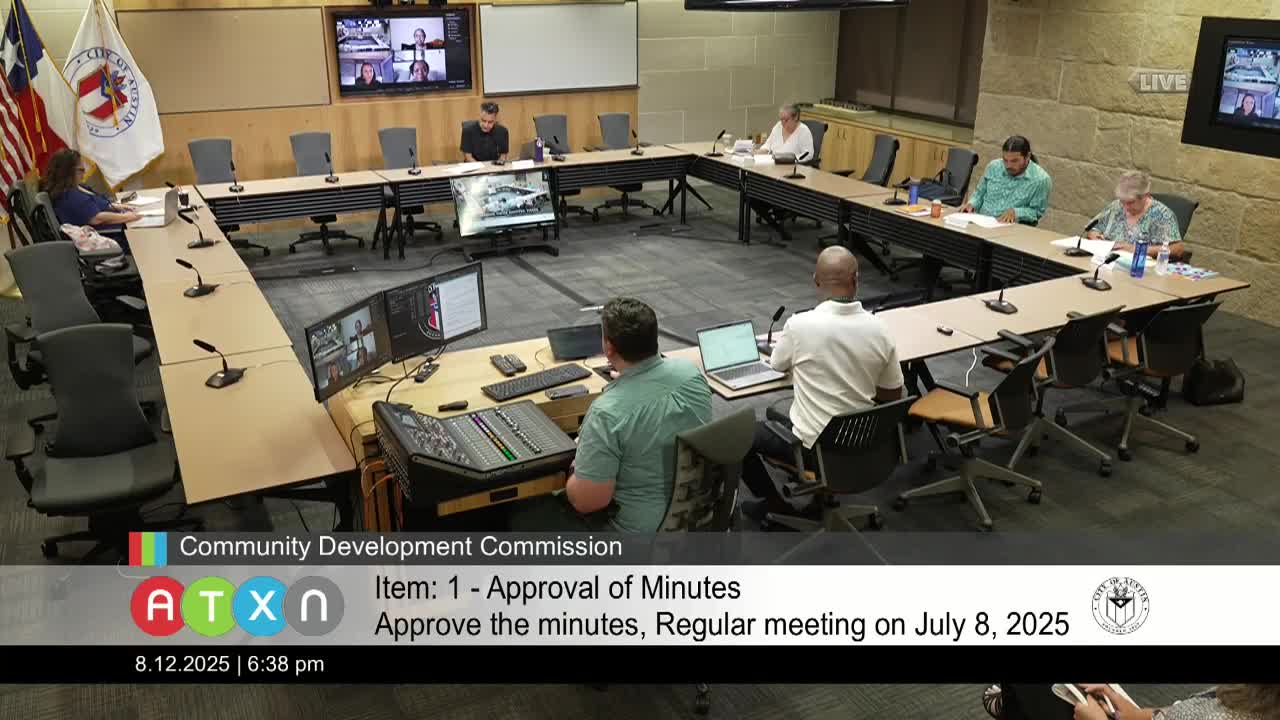
Community Development Commission appoints two commissioners to Housing Investment Review Committee after overview of GAP financing process
Summary
Austin Housing staff briefed the Community Development Commission on the GAP financing application and the Housing Investment Review Committee (HIRC). Chair Elias nominated Commissioners Menard and Medrano to serve on the HIRC; both accepted and were appointed without a formal vote.
Chair Elias appointed two Community Development Commission members to the Housing Investment Review Committee after Austin Housing staff reviewed the Housing Development Assistance GAP financing application process and HIRC responsibilities.
The HIRC, which per staff was created by a City Council resolution in 2007 and retitled in 2018, is an advisory body that includes three public members and two CDC commissioners. Chris Duran and Ellis Morgan, financial analysts in the Housing Department, told the commission the GAP program is administered by staff on behalf of the Austin Housing Finance Corporation (AHFC) and typically fills the “final piece” of a project’s capital stack with loans in exchange for long-term affordability restrictions.
Why it matters: HIRC members provide a biannual review of rental and ownership applications and submit post‑meeting feedback to staff; that feedback informs AHFC funding recommendations and the board’s award decisions.
Staff presented the program’s five-step review and award process: (1) application deadline and staff scoring, (2) underwriting and interdepartmental review, (3) HIRC meeting with applicant and staff Q&A, (4) housing department leadership recommendations and (5) AHFC board consideration and award. Duran and Morgan described typical HIRC duties: attend a pre‑meeting with staff, join the virtual HIRC meeting, ask developers questions, and submit post‑meeting feedback.
Staff gave recent project examples HIRC members review. Generation Housing Partners is pursuing a roughly 227‑unit, six‑story project east of I‑35 and south of U.S. 290 that would use 4% low‑income housing tax credits and include about 5,000 square feet of nonprofit commercial space and roughly two floors of structured parking. Staff said more than half of that development’s AHFC‑restricted units would be at or below 40% MFI. Another example was a Visino Group project in Montopolis that includes permanent supportive housing units and a mix of senior and LGBT‑focused supportive units. For homeownership, staff highlighted Johnny Limon Village, where more than 25% of units would target 60% MFI—deeper affordability than typical ownership programs, staff said.
Commissioners asked technical questions about how deeper affordability (30%–50% MFI units) is negotiated in tax credit developments and how GAP loans function. Morgan said the tax credit application process is competitive and that applicants can increase the number of lower‑income units to make an application more competitive. He also confirmed GAP financing is structured as a loan that helps complete a project’s capital stack; affordability periods are typically at least 40 years for rental projects and 99 years for ownership projects.
For the HIRC appointment, Chair Elias nominated Commissioner Menard and Commissioner Medrano. Both commissioners accepted the nominations and were appointed; staff will follow up to coordinate HIRC participation. No formal roll‑call vote was required or recorded at the meeting.
Ending: Staff said HIRC meetings are typically virtual and biannual; commissioners interested in volunteering were invited to contact housing staff. Staff also offered to return with additional briefings on specific financing tools such as LIHTC at a later date.