Get Full Government Meeting Transcripts, Videos, & Alerts Forever!
Get email alerts on the Land Use Development topic
No spam. Unsubscribe anytime.
Hooper council delays decision on Terra Strada development after public objections to CRA and questions about $2.5M lift station
Summary
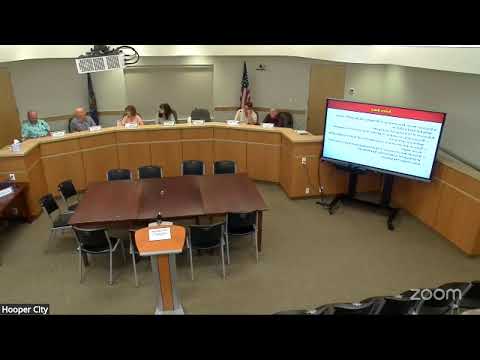
At a recent Hooper City Council meeting, councilors discussed a proposed Terra Strada commercial and residential development — referred to by several speakers as "Smith Plaza" — but did not take a final vote after extended public comment and technical questions about project financing and infrastructure.
At a recent Hooper City Council meeting, councilors discussed a proposed Terra Strada commercial and residential development — referred to by several speakers as "Smith Plaza" — but did not take a final vote after extended public comment and technical questions about project financing and infrastructure.
Councilors and city consultants focused on how to pay for a sewer lift station that engineers estimate could cost roughly $2.5 million, and on whether a community reinvestment area (CRA) or tax‑increment financing (TIF) would be used and supported by other taxing entities. Jason Burningham of LRB Public Finance Advisors told the council his fiscal impact analysis assumed the full cost of the lift station (based on an engineering estimate from JUB Engineering) and explored tax increment as one possible vehicle but did not assume taxing‑entity participation.
Why it matters: The council is considering a general plan amendment, rezoning and related development agreements that would allow the Terra Strada project to proceed. If the city adopts a CRA/TIF or other financing tool connected to the project, those decisions could change how property‑tax revenue is collected and used in Hooper and might require interlocal participation or additional legal mechanisms such as a public infrastructure district.
Burningham summary and financing options Jason Burningham, who authored the fiscal study, said the analysis treated the lift station’s estimated cost as about $2.5 million after construction‑inflation adjustments and that the study did not assume that other taxing entities had agreed to provide property tax increment. "We did not undertake a full feasibility ... of the participating taxing entities' interest or willingness to provide a property tax increment," Burningham said. He explained impact fees could be used if the city adopted them, that proportionate shares could be assessed, and that alternatives include city bonds, a public infrastructure district, or development agreements that pledge increment to finance improvements.
Developer response Stuart Adams of Terra Strada spoke through the meeting and said the development team would work with the council to answer questions and that he and his team had submitted information for council review. Adams and his representatives said they were willing to discuss details in follow‑up meetings; no developer‑sponsored funding pledge beyond statements about paying the developer’s proportional share was finalized during the meeting.
Public comment: CRA, pump station, density and plan consistency Multiple residents told the council they oppose the use of a CRA/TIF to fund off‑site infrastructure. Bruce Taylor, a Hooper resident, criticized repeated attention on the financing mechanism: "All that's ever talked about is the CRA," he said during public comment. Jake Kelso, another resident, said TIFs redirect taxes earmarked for local services: "It's just another way for crony capitalists to put in laws that allow them to take our tax money that is earmarked on our property taxes for specific taxes and use them for their own benefit and their own gain."
Other speakers warned about traffic, proximity to schools, and long‑term changes to Hooper’s character if higher‑density residential development proceeds. Larry Ropelato spoke in favor of the project, saying he supports the development after reviewing materials and attending prior meetings.
Council reaction and next steps Council members said several planning‑commission conditions and council questions remain unanswered — including whether quarter‑acre lots shown on the draft plan would be removed and how the developer’s proportional share of infrastructure would be secured. Multiple councilors said they were not ready to vote. One council member suggested using a public survey or ballot question as a way to get broader resident input before making a major land‑use decision; staff and several councilors also recommended follow‑up meetings between the developer, staff and a smaller council working group.
No land‑use ordinance or development agreement was adopted at the meeting. Council members directed staff and the developer to continue answering the written questions and to return when the remaining concerns have been addressed.
Ending Council members scheduled additional follow‑up and said the item will return to a future work session or council meeting after staff and the developer provide requested clarifications and any revised development materials.