Get Full Government Meeting Transcripts, Videos, & Alerts Forever!
Get email alerts on the City Hall Redevelopment topic
No spam. Unsubscribe anytime.
Gallatin council directs developer to draft Project Phoenix plans, approves amended MOU after extended debate
Summary
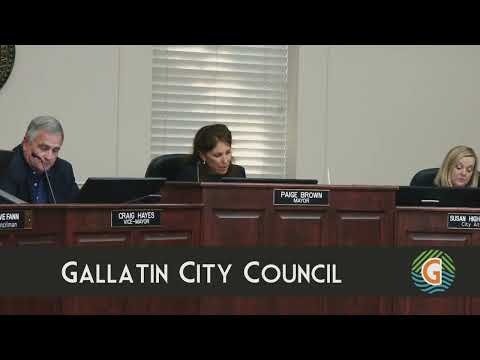
Gallatin City Council members voted on Aug. 5, 2025, to direct developer Boyle to prepare preliminary concept plans for Project Phoenix, a proposed redevelopment of the City Hall block, and to approve an amended and restated memorandum of understanding to advance feasibility work.
Gallatin City Council members voted on Aug. 5, 2025, to direct developer Boyle to prepare preliminary concept plans for “Project Phoenix,” a proposed redevelopment of the City Hall block, and to approve an amended and restated memorandum of understanding (MOU) to advance feasibility and financing work. Both measures passed on separate votes, each recorded as 4-2-1.
The decisions move the project from initial outreach into a formal planning phase so Boyle can produce design, parking and financing options for council review. Council members and residents spent more than an hour debating legal structure, bidding rules, parking, revenue assumptions and protections for municipal tax revenue.
Why it matters: Project Phoenix would reshape property around Gallatin’s downtown square and could affect municipal revenue, parking availability and future development rules. Council members who supported moving the plans forward described the effort as a way to produce the factual information — designs, cost estimates and financing plans — the council will need before making any final commitments. Opponents said the process risked limiting competition and could lead to concessions that reduce city revenue.
Discussion and public comment
Edwin Mims, a Gallatin resident, urged the council to reject Project Phoenix during the public comment period. "I come before you tonight asking you to vote no on Project Phoenix," Mims said, arguing City Hall should not be conveyed for private development and asking the council to publish space-utilization and contingency plans.
Council debate focused on three recurring questions: whether using the Industrial Development Board (IDB) as a vehicle would circumvent public bidding; how and whether parking for a new City Hall, hotel and residences would be provided and paid for; and whether the city could lose tax revenue if incentives such as a tax-increment financing (TIF) or payment-in-lieu-of-taxes (PILOT) were offered.
City attorney Tom Trent and staff answered several legal and process questions. Trent explained the rationale for the IDB route: "The Industrial Development Corporation Act says the city can grant its property ... to the IDB, and the IDB then can negotiate with private parties and doesn't have to publicly bid it," he said, adding that the MOU was structured so "the decision making as to whether to proceed is entirely vested in this city council." Trent also highlighted that the financing details would be provided later, saying it was premature to decide on TIF or incentives until the developer’s financing plan is produced.
Concerns about exclusivity and bidding
Several council members said they were uncomfortable that the initial approach to developers appeared to single out one firm. One council member pressed that "everything we do in the city, we put it to bid," arguing the council should not limit consideration to a single developer. Supporters replied that Boyle had already spent substantial sums on predevelopment — staff referenced an estimate that the developer had spent well over $177,000 on feasibility work — and that requiring an open RFP at this stage could deter a firm willing to fund early design work.
Parking, hotel size, and revenue protections
Council members repeatedly returned to parking: whether the parking facility would be below grade, structured or surface level; who would pay for it; and which uses (hotel, residences, City Hall) would have priority. The draft MOU and subsequent discussion included language that the parking "shall be made available to the city as may be required for parking for city hall or other public parking needs" and that specific terms "shall be set forth" later in a project agreement.
Council members also questioned the certainty of projected tax revenues if the IDB or a developer negotiated incentives. Trent said the TIF process requires council approval and other approvals if county taxes or state-level review are involved: "The TIF statute in Tennessee requires that the city council approve the TIF. Period. ... It's way too premature to answer that question until we know the financing and equity structure they're proposing," he said.
Votes and formal actions
- Amended resolution R2507-41: The council approved an amended resolution directing Boyle to develop preliminary concept plans for Project Phoenix based on a new City Hall footprint. Motion by Vice Mayor Hayes; second by Councilman Carter. Outcome: approved (vote recorded as 4-2-1). Note: a motion to postpone the item to the next council meeting died for lack of a second.
- Resolution R2508-47 (Amended and Restated MOU): The council approved a resolution authorizing the mayor to sign an amended and restated MOU for Project Phoenix, which memorializes the scope of predevelopment work and the role of the IDB and developer in producing a project agreement and budget for future council action. Motion by Councilman Jones; second by Councilman Carter. Outcome: approved (vote recorded as 4-2-1).
What the votes do and do not do
Council members and the city attorney emphasized that the votes authorized further study and plan development but did not authorize sale of city property or a final project. Trent said the project agreement and any conveyance would require separate council approvals later, after the developer delivers plans and a financing package. Staff and Trent indicated the developer is expected to deliver a financing plan by the following spring for the council’s evaluation.
Next steps and outstanding questions
The developer is expected to complete preliminary design work, parking options and a financing plan for council review. The council will then decide whether to proceed with any conveyance, financing assistance, or incentive package. Outstanding issues flagged during the Aug. 5 meeting included the detailed parking plan and cost allocation, whether any incentives (TIF/PILOT) would be requested, and guaranteed protections to ensure municipal tax revenues are preserved if incentives are offered.
Councilmembers who opposed the measures cited constituent opposition, uncertainty about revenue, and a desire for a more open procurement process. Supporters emphasized the need for factual plans and numbers before making a final decision and the potential for new revenue to fund municipal facilities without increasing current tax rates.
The council’s approvals on Aug. 5 move Project Phoenix into a formal feasibility phase but stop short of committing the city to any sale, redevelopment or incentive package.