Get Full Government Meeting Transcripts, Videos, & Alerts Forever!
Get email alerts on the Telecommunications topic
No spam. Unsubscribe anytime.
Santa Rosa board weighs telecommunications ordinance update, seeks clearer concealment and siting standards for wireless facilities
Summary
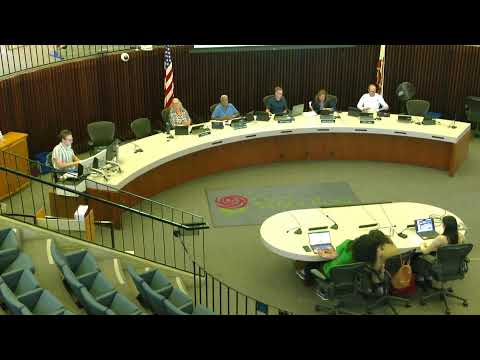
Santa Rosa — On June 19, 2025, the Design Review and Preservation Board heard a staff presentation and legal briefing on proposed updates to the city's telecommunications ordinance and offered feedback on aesthetic and siting standards for wireless facilities.
Santa Rosa — On June 19, 2025, the Design Review and Preservation Board heard a staff presentation and legal briefing on proposed updates to the city's telecommunications ordinance and offered feedback on aesthetic and siting standards for wireless facilities.
Amy Nicholson, the city's supervising planner for advanced planning, and Suzanne Hartman, city planner, joined outside counsel Bennett Givens of the law firm BBK for a review of federal and state constraints, local code provisions and draft design preferences. Nicholson said the item was before the board "to seek your feedback on standards that we can include in this ordinance update, before it moves to public review as well as the planning commission and city council later on in the process." Hartman told the board the Planning Department had received seven wireless applications over the past three years and showed examples of water-tower, faux-tree and rooftop concealment approaches.
Why it matters: The update is intended to give the city clearer, pre-published aesthetic rules as wireless carriers expand both macro sites and small cells. That expansion is governed by federal and state rules that limit local discretion, and by a fast review timeline for applicants known as "shot clocks." Givens summarized those constraints, noting that the Telecommunications Act of 1996 and Federal Communications Commission rules restrict local regulation where a requirement would "prohibit or have the effect of prohibiting the provision of personal wireless service." He also described the FCC shot clocks and the potential "deemed granted" remedy if the city does not meet required timeline targets.
Discussion and board feedback
Board members repeatedly urged context-sensitive standards. Several members said concealment preferences should differ in urban and rural settings and recommended incentives for rooftop installations where they are feasible. Board Member Drew Fajent and others suggested treating sites near residences with greater care; one member said a rear-of-parcel preference should be qualified so an installation at the back of one parcel would not sit unacceptably close to a neighboring house.
Members and staff discussed common concealment types: faux trees ("mono pines"), water towers, steeples or rooftop enclosures. Hartman and Givens warned of maintenance problems with faux trees, including leaf and branch loss; staff said those faux trees in the city historically have tended to be 75 to 80 feet tall. Givens added that typical monopole facilities range from about 35 to 90 feet depending on local needs. Hartman said the current Santa Rosa Zoning Code includes a 2-mile separation rule for visible macro towers but described the language as vague and potentially difficult to enforce.
Ground equipment and security were another focus. Participants discussed screening options for equipment cabinets and generators, with some board members preferring chain-link enclosures (with landscaping) for visibility and safety and others preferring solid screening for aesthetics. Staff reminded the board that large macro facilities in high fire-threat areas are subject to California Public Utilities Commission requirements for at least 72 hours of backup power, which affects equipment size and ventilation needs.
Small cells vs. macro sites
Givens and staff explained the functional differences: small wireless facilities can carry higher data loads but have a much shorter range and often require many more installations in dense areas; large macro sites cover miles. Givens reviewed federal rules on "eligible facilities requests," which require nondiscretionary approval for certain modifications to existing sites, and said the city should draft concealment and condition-of-approval language carefully so future routine modifications do not defeat previously imposed concealment objectives.
Public comment and next steps
A resident, Janice Carmen, praised the presentation and urged caution about generator placement relative to residences and about maintenance requirements for concealed facilities. Planners said the staff can and does condition permits to require ongoing maintenance and, where appropriate, remediation and removal of obsolete towers.
Staff said they will incorporate the board's feedback into a draft ordinance for public review and subsequent consideration by the Planning Commission and City Council. There was no motion or formal vote on the ordinance update at the meeting.
Ending
City staff will draft objective and context-sensitive concealment standards, refine conditions of approval to preserve concealment elements against routine modifications, and return the ordinance to the public-review process and later land-use hearings.