Get Full Government Meeting Transcripts, Videos, & Alerts Forever!
Get email alerts on the Economic Development topic
No spam. Unsubscribe anytime.
Consultant: Commercial component and CRA financing needed to make Hooper development net positive
Summary
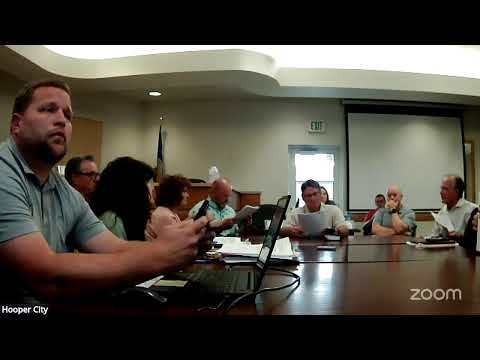
At a Hooper City Council work session, Jason, the consultant who led the city's fiscal‑impact study, told council members that the proposed mixed‑use project would be fiscally beneficial only if its commercial component is built and financed and if financing is secured for a needed sewer lift station.
At a Hooper City Council work session, Jason, the consultant who led the city's fiscal-impact study, told council members that the proposed 46-acre mixed‑use project would be fiscally beneficial only if its commercial component is built and guaranteed and if financing is in place to fund an off‑site sewer lift station.
"The commercial development really is the crown jewel of the project in terms of financial benefit to the residents and to the town of Hooper," Jason said, describing sales tax and other commercial revenues as the key drivers that offset the higher service costs associated with new residential construction.
The consultant summarized the study's major conclusions and recommendations. He presented model outputs showing cumulative incremental taxable value of about $53,800,000 generated by the project and said sales‑tax receipts could total roughly $13,533,000 over the modeled period. Jason reported the model's estimate of incremental property taxes as about $11,100,000 (total) and said the city's share of new property tax revenue was shown in the materials at about $363,000 over the analysis period.
Jason repeatedly told council members that, as modeled, residential development alone would generate higher incremental service costs than it would produce in local tax revenue, while commercial uses—because of sales tax—produce a net positive fiscal impact. "Residential is still bringing in less revenue per unit than what the cost is to offset that with your public services," he said.
Because the sewer lift station required for the development is expensive and the project on its own may not bear the full up‑front cost, the consultant recommended a financing mechanism to close the “gap.” He described a Community Reinvestment Area (CRA) / tax‑increment approach as one feasible option, explaining that the CRA model as presented assumed 75% participation by taxing entities and would allocate 10% of increment to affordable or moderate‑income housing and up to 5% for agency administration, per the statutory framework he cited.
Jason described estimated CRA proceeds in the presentation: with the assumed participation levels and project-area boundaries, the study showed the development producing roughly $6,047,000 in nominal CRA revenue (present‑value numbers were also cited in the materials). He said impact fees, developer contributions or a city loan could be used to monetize or credit against tax increment as the project and cash flows mature.
On approvals and timing, Jason advised council caution about entitling all residential units before there was a firm financing plan and commitment for the commercial development. "I would advise not to approve the retail without having the commercial," he said, recommending a development agreement that phases residential entitlements and ties later phases to demonstrated commercial financing or construction.
He also described alternative financing tools and the allocation of risk: if the developer secures the financing (for example, by taking a development agreement-backed portion of the tax increment), the financing risk shifts to the developer and its lenders; if the city were to finance the lift station up front, the city would carry the risk that projected tax increment or sales tax revenue could fall short. "If the city were to finance, whether you use capital project funds to fund it all upfront ... the risk then is that the tax increment doesn't materialize at the same level that you thought," he said.
Council members raised questions about assumptions and local competition. Jason said the study used a conservative 2.5% annual sales‑tax growth rate and a 4% discount rate for net‑present‑value calculations, and that the sales‑tax estimates were intentionally conservative to reflect nearby competition (including a planned Walmart in adjacent West Haven) and other market factors.
Next steps discussed on the record: the consultant said the council could pursue a CRA/project‑area designation and interlocal agreements with other taxing entities, complete an impact‑fee facilities plan (IFFP) to apportion costs, or explore public infrastructure districts or developer financing. Jason said he had talked informally with Weber County staff and that, based on those preliminary conversations, county participation at the 75% level used in the model appeared plausible but had not been committed.
The presentation concluded with the consultant reiterating his principal recommendation: pair the commercial and residential components, secure commercial financing (or phase residential entitlements), and use an appropriate financing tool—CRA, public infrastructure district, developer financing, or a city loan with impact‑fee credits—to fund the sewer lift station so the project becomes economically feasible.
The item remains scheduled for future council consideration on the agenda; no formal vote or binding action on the development or financing mechanism was recorded during the session.