Get Full Government Meeting Transcripts, Videos, & Alerts Forever!
Get email alerts on the Water Infrastructure topic
No spam. Unsubscribe anytime.
State water officials propose integrated approach to move Alkali Creek Reservoir forward
Summary
Water Development Office staff outlined a plan to combine storage, conservation and conveyance work to revive the long‑running Alkali Creek Reservoir project and asked the commission for support as they seek landowner easements and additional funding.
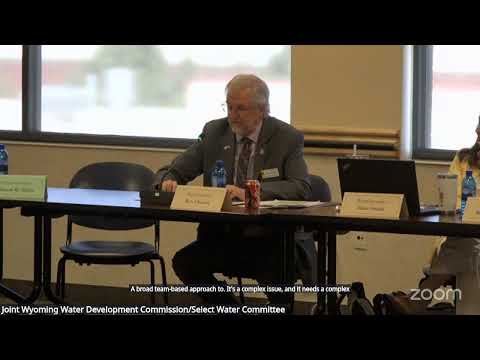
State water officials on May 7 described a multi‑pronged effort to revive the Alkali Creek Reservoir project, a permitted storage site in the Norwood/North Platte basin that has been under study and partial design for nearly two decades.
Director Jason Mead of the Wyoming Water Development Office told the Water Development Commission and the Select Water Committee that the project — which the office and local sponsors have estimated at roughly 8,900–9,000 acre‑feet of storage — has federal and state permits in place but has stalled because some landowner easements and other agreements remain unresolved. Mead said about $59 million has been appropriated for construction; the statutory reversion date on that appropriation was extended during the last legislative session to July 1, 2026, and staff are proposing further extension to July 1, 2027, if work progresses.
The office described an "integrated watershed" strategy that blends the reservoir with related conservation and conveyance work: piping portions of the Anita Ditch to reduce seepage and improve water quality on Paint Rock Creek (listed for E. coli), installing center pivots or implementing irrigation efficiencies where appropriate, adding livestock watering turnouts and addressing associated rights and easements. The office said some landowners who would be affected by construction are interested in ditch‑to‑pipe conversions and other on‑farm investments that could make the overall package more acceptable to neighbors.
Representative Lawley (House District 27) — whose district includes the project area — urged the office to reengage landowners and to show “meaningful progress” by November, so lawmakers can determine whether to extend appropriations. Mead said staff plan targeted outreach, will pursue federal partners such as NRCS for cost‑share where eligible, and may fold some measures into the reservoir project budget if outside grant funding is not available.
Derek Thompson, assistant project engineer with Trihydro (the consultant under contract), said about 86% of the ditch length now has easement coverage and that when BLM and acquired parcels are counted the total exceeds 90%, but that several of the remaining landowners are recent purchasers who had not been involved in earlier planning and whose requests (for example, ditch piping) increase project cost. Thompson said full conversion of the Anita Ditch to pipe had been presented earlier as a design alternative and a rough order‑of‑magnitude increase; he described options to optimize design that could reduce per‑landowner costs, such as shorter pipe lengths and smaller diameters, but told commissioners that detailed, parcel‑level numbers have not yet been developed.
Several legislators and commissioners pressed the Water Development Office on funding and timing. Senator Gru and Senator Bonner said the project risks losing purchasing power as appropriations sit unused; they urged staff to show a clear, near‑term path to consensus with landowners. Commissioner Anselmi‑Dalton said the office should avoid “being held hostage” by individual landowners; Mead replied the office seeks "win‑win" solutions that provide watershed benefits and avoid appearing to give individual landowners a pure gift.
Mead said possible next steps are (1) targeted negotiations with remaining landowners to secure easements or workable alternatives, (2) further design refinement and cost estimates for the piping and other elements, (3) pursuing federal and trust funding for complementary conservation measures, and (4) returning to the commission and select committee with a recommendation in November, including a request to extend the reversion date if necessary.
The discussion did not include a formal vote on the reservoir project or on any appropriation amendment. Commissioners signaled general interest in the integrated approach and asked staff to proceed with landowner outreach and funding exploration. The office noted it may request an amendment to its Trihydro contract to cover additional design and easement negotiations.
Ending
Commissioners and legislators repeatedly emphasized the project’s potential benefits for irrigation reliability, fisheries and water quality in the Norwood basin but said advances will depend on getting more landowners “to the table” and on identifying funding partners for ditch piping, livestock water facilities and other attachments to the reservoir project. Mead said the office will report back at the November meeting with options and — if outreach is successful — a legislative recommendation for extending the appropriation reversion date.