Lifetime Citizen Portal Access — AI Briefings, Alerts & Unlimited Follows
UN, Turkmenistan call for financing, connectivity and climate support for landlocked developing countries at LLDC3
Loading...
Summary
At a press conference opening the third United Nations conference on landlocked developing countries in Avaza, UN Secretary‑General António Guterres and Turkmenistan Foreign Minister Rashid Meredov urged expanded concessional finance, trade connectivity and climate adaptation support for the 32 landlocked developing countries.
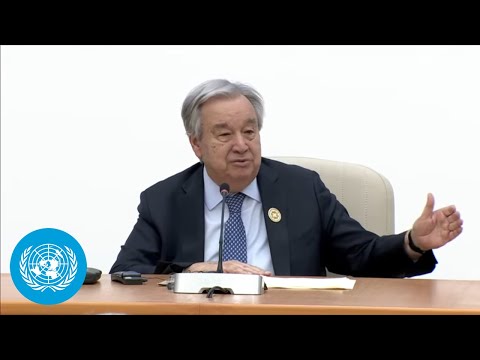
United Nations Secretary‑General António Guterres and Turkmenistan Foreign Minister Rashid Meredov used a brief press conference at the opening of the third United Nations conference on landlocked developing countries (LLDC3) in Avaza to press for stronger finance, trade links and climate support for landlocked developing countries.
Guterres said the conference highlights both “the scale of the challenges these countries face and the scale of the opportunity before us,” noting that the 32 landlocked developing countries together represent “nearly 600,000,000 people.” He urged global partners to focus on financing, connectivity, human capital and climate resilience, and to reform international financial institutions to increase concessional lending and de‑risk private investment.
“Landlocked developing countries don't want charity. They want justice,” United Nations Secretary‑General António Guterres said, adding that reform should include “effective debt relief” and development banks that are “bigger and bolder.” He identified four priority areas: unlocking economic potential through investment in infrastructure and skills (including digital access and frontier technologies such as artificial intelligence); improving trade corridors and transit systems; confronting the climate crisis with more adaptation finance; and reshaping the international financial architecture to provide concessional finance and debt relief.
Guterres also called for operational changes to ease transit and trade, saying freedom of movement for goods and people and reduced red tape are essential. He cited Portugal as an example of how access to neighbors’ markets can expand trade, saying, “Portugal before joining European Union had 4% of its foreign trade with Spain. Today, it has 40%.”
Turkmenistan Foreign Minister Rashid Meredov, whose country is hosting LLDC3 and was announced during the session as president of the conference, described Avaza as a platform for concrete proposals. Meredov outlined initiatives proposed by President Serdar Berdimuhamedov and by the host delegation, including an initiative called Global Medicine of the Future, a proposal for a global atlas of sustainable transport connectivity, consultations toward a global program for a transition to hydrogen energy for the 2030–2040 period, and a proposed global framework for a circular economy in cooperation with UN institutions.
“We are deeply grateful to the secretary general of the United Nations for his support and leadership,” Meredov said, and described a program of meetings for the conference that includes five high‑level thematic round tables, a civil society forum, a private sector forum, a youth forum, a women leaders forum, a ministerial meeting on South‑South cooperation and more than 40 side events.
On a question from Toby Gregory of Euronews about how the international community should work better with landlocked developing countries, Guterres reiterated the need to reform multilateral institutions and scale up concessional finance, derisking and debt relief so LLDCs can access investment. Meredov emphasized the role of interconnectivity and referenced the European Union’s Global Gateway investment strategy as a foundation for cooperation with Europe and for expanding transport, energy and people‑to‑people links.
The statements at the press conference outlined priorities that conference participants said they expect to carry into the Avaza programme of action discussions over the coming days. No formal votes or binding commitments were recorded during the press conference; Turkmenistan’s election as president of the conference was announced by the host delegation.
The LLDC3 conference in Avaza continues with plenary sessions, thematic round tables and side events during the week, and speakers called on member states and financial institutions to turn the Avaza programme of action into tangible financing, connectivity and climate outcomes for landlocked developing countries.