Get Full Government Meeting Transcripts, Videos, & Alerts Forever!
Get email alerts on the Federal Grants Procurement topic
No spam. Unsubscribe anytime.
Dallas council adopts HUD consolidated-plan budget as city pauses equity tools to comply with federal directives
Summary
The Dallas City Council approved a $29.9 million HUD consolidated-plan budget for FY2025–26 while city staff said several equity- and race‑conscious policies were temporarily paused as part of a cross‑department legal review to comply with recent federal executive orders and revised grant rules.
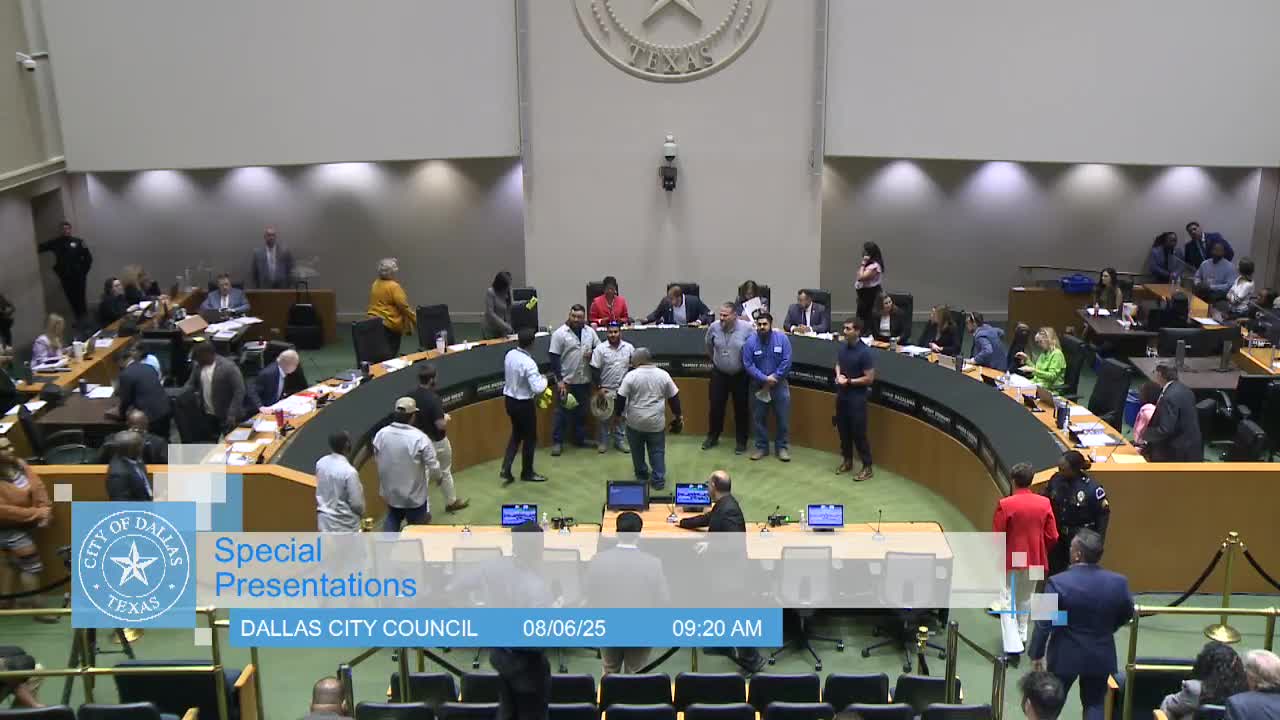
The Dallas City Council adopted a fiscal 2025–26 HUD consolidated-plan budget estimated at $29,886,873 on Aug. 6 after a brief public‑hearing closing motion and a unanimous approval to move the item forward. Councilmember Paula Blackman moved to close the May 28 public hearing and approve the budget, which the council adopted as presented.
City staff said the vote clears submission of the city’s HUD budget to the U.S. Department of Housing and Urban Development (HUD) so federal funds can be secured. Assistant city manager Liz Cedillo Perera told the council a cross‑department “grant compliance task force” reviewed recent presidential executive orders and revised federal grant guidance and advised pausing some policies that pose legal risk to federal funding.
The adopted HUD consolidated-plan budget includes estimated allocations of $12,944,689 for Community Development Block Grant (CDBG); $5,082,901 for HOME Investment Partnerships; $1,144,567 for Emergency Solutions Grant; $10,014,716 for Housing Opportunities for Persons With AIDS (HOPWA); and $700,000 estimated CDBG and HOME program income.
Why it matters: the city manager’s office said the pause is intended to avoid jeopardizing federal funds while staff and the city attorney complete legal reviews. Staff described the action as temporary: departments will continue reviews, stakeholder engagement and return to council in September with recommended policy changes and a proposed implementation plan slated to begin Oct. 1.
What was paused and why: staff listed several city tools that were temporarily suspended to reduce compliance risk, including the Business Inclusion and Development (BID) policy’s MWBE numeric subcontracting goals, the city’s Racial Equity Plan (adopted in 2022) and the Equity Impact Assessment Tool. The city said it will replace numeric MWBE goals with a proposed “Dallas Capacity Building Collaborative” that emphasizes good‑faith efforts, training and geographically and size‑based metrics for small and local business participation.
Officials said the change aims to preserve community impact while aligning procurement and grant practices with federal directives that bar certain selection or funding criteria that the federal government says may discriminate on the basis of race, gender, national origin or religion. Liz Cedillo Perera said the city has retained external procurement consultants and will engage certification agencies, chambers of commerce and community partners while staff develop a more detailed program for council consideration.
Timing and next steps: staff said they will submit the HUD budget this month to secure FY2025–26 funds, then return Aug. 27 with a preliminary amendment to the city’s five‑year HUD plan and hold a 30‑day public comment period before seeking final adoption Oct. 8. Staff recommended returning to council Sept. 24 with policy recommendations for formal adoption.
Council questions and concerns: council members raised several concerns during the briefing, including the scope and speed of the staff review, how the new local/size‑based procurement criteria will be defined (geography, employee residence, headquarters location), the potential budget and staffing impacts of the changes, and the degree of community engagement used to shape the proposal. Staff said some stakeholder outreach has occurred (vendor/certification groups and civic partners) and promised broader community meetings before formal policy adoption.
What staff said about legal risk: Willow Sanchez, assistant city attorney, advised the council that some existing program descriptions and selection criteria in city planning documents could conflict with the federal guidance. Sanchez described a distinction between collecting demographic data for planning and making funding allocations explicitly based on protected classes; staff said the review will identify necessary edits and legally resilient alternatives.
Ending note: city staff framed the work as a pivot to preserve federal funding while sustaining the city’s community goals. The council adopted the HUD consolidated-plan budget on the Aug. 6 consent action and directed staff to return with a fuller set of recommendations and a community engagement plan ahead of formal policy changes this fall.