Get Full Government Meeting Transcripts, Videos, & Alerts Forever!
Get email alerts on the Budget topic
No spam. Unsubscribe anytime.
Lakeway City Council reviews FY2026 budget, weighing tax increase to fund capital projects and staff
Summary
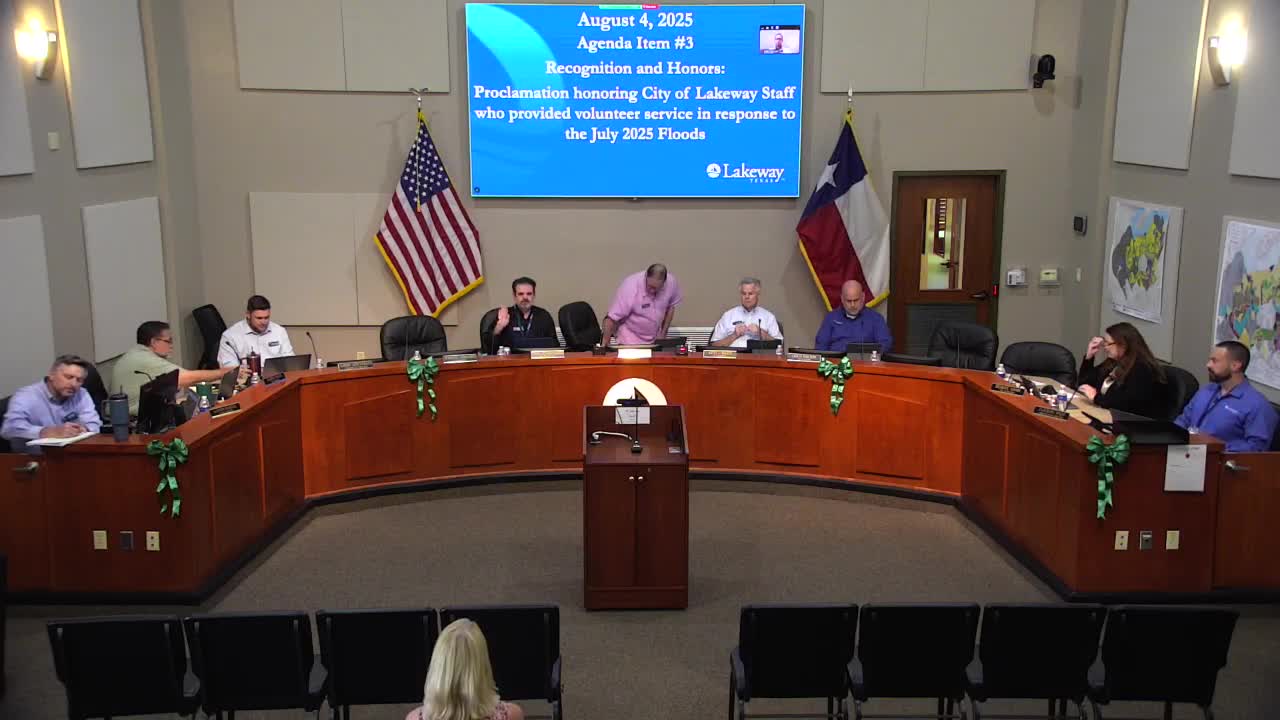
City Manager Joseph presented the Lakeway City Council with an interactive FY2026 budget worksheet during a special meeting on Aug. 4, laying out revenue projections, departmental requests and capital-improvement priorities and asking council members to use the spreadsheet to test tax-rate scenarios.
City Manager Joseph presented the Lakeway City Council with an interactive FY2026 budget worksheet during a special meeting on Aug. 4, laying out revenue projections, departmental requests and capital-improvement priorities and asking council members to use the spreadsheet to test tax-rate scenarios.
The presentation matters because Lakeway’s new-growth revenue has fallen sharply while inflation and debt-service costs have risen, leaving limited headroom for both one-time capital projects and recurring personnel costs without raising the city’s tax rate or reducing transfers to the capital reserve. Joseph told the council, “it is my responsibility to present a budget to you,” and encouraged members to “crunch the numbers between now and the next council meeting.”
Joseph said Lakeway’s taxable value has risen substantially since 2012 — about $5.8 billion — but that new-growth revenue is declining, with new-growth contributions falling from about 1.3% in 2024 to 0.83% in 2025 and “less than half of that” in the current year. He presented several tax-rate metrics the city uses: the no-new-revenue maintenance-and-operations (M&O) rate, an M&O rate adjusted for debt (I&S), and the voter-approval rate above which an election would be required. Under the scenarios shown, the estimated impact on a typical home (average appraised value roughly $846,000) ranged from a $44 annual increase at the no-new-revenue M&O level to about $111 annually at the voter-approval rate — Joseph framed the difference this way: for $9 a month, “that puts us in the positive with most of the asks of the departments.”
On the revenues and expenditures Joseph showed the worksheet producing roughly $20.5 million in revenues and $20.449 million in expenditures under the baseline assumptions, a narrow surplus on the order of about $1,200. He described the city’s approach as conservative: sales-tax receipts were budgeted at about $5.8 million for the coming year after a $300,000 chargeback reduced the current-year total; permit and development revenues were down because several large projects’ timing slipped; and FEMA reimbursements tied to recent storm response had been placed in the “miscellaneous” revenue line.
The council discussed personnel and recurring program requests. Staff recommended one new assistant in IT as the only new recurring position in the presented draft, and Joseph said the police department’s request for a fourth motor officer had been deferred while the department pilots a traffic-sergeant approach and prioritizes IT support for police. On compensation, Joseph said staff were “looking at a 2% COLA and a 2.2% merit,” numbers used in the worksheet but not yet finalized.
Capital and one-time requests were grouped in a proposed first-year capital-improvement program (CIP) of about $2.5 million, funded primarily from the capital reserve. Notable year‑one items shown included City Hall and Justice Center remodel rollovers, equipment and vehicle replacements across departments, West-side Lakeway Boulevard trail improvements, AV upgrades to allow remote or relocated meetings, and a variety of police items (radar trailers, license-plate readers, a scalable drone program and more robust event radios). Joseph noted some capital requests are scalable or can be phased and that some department asks could be paid from other restricted funds (for example, the budget presentation removed a canine request after staff identified opioid-settlement funds that could pay for it).
Councilmembers asked staff for clarifications staff committed to provide: confirmation whether hotel occupancy (HOT) funds would be included in any state “all revenues” cap under consideration; a clearer line item breakdown of the capital reserve rollover amounts (City Hall/Justice Center); and drill‑down access to the underlying budget lines (Questica access or exported detail). Joseph said he would check the hotel-occupancy question with the city’s financial adviser and provide the spreadsheet to council so members could test tax scenarios before the next meeting.
The meeting closed with scheduling and procedural notes: staff recommended a public-hearing schedule tied to the statutory process, and Joseph proposed a special meeting the week after the regular September meeting (week of Sept. 22) to adopt the budget and tax rate if needed. The council then moved into an executive session that the mayor identified as held under Texas Government Code sections 551.071, 551.087 and 551.074; the council returned to open session at about 9:11 p.m. and took no action on the executive-session items.
Next steps listed by staff included: circulation of the interactive worksheet to council; follow-up on FEMA and HOT‑fund treatment; updated capital-reserve line items; and further review of pay-scale adjustments for police, should council decide to pursue competitive starting pay adjustments.