Alva board raises student meal prices and pushes for free/reduced lunch signups to pursue federal programs
Summary
The board approved modest increases to student meal prices for 2025-26 and heard district staff outline the thresholds and timeline for federal programs such as the Community Eligibility Provision (CEP) and USDA Provision 2, and urged families to complete free and reduced-price applications so the district can qualify for broader meal subsidies.
The Alva Public Schools Board of Education voted to raise student meal prices for the 2025-26 school year and discussed strategies to increase free-and-reduced-price application returns so the district can pursue federal meal programs that would subsidize meals for more students.
Child nutrition staff and the superintendent told the board that Alva—s district-wide direct-certification and free/reduced percentages are currently around 50%, well below Community Eligibility Provision (CEP) thresholds often cited at 75–80%. The district also reviewed the USDA—s Provision 2 option, which typically requires a lower threshold (state staff described a 65–70% guidance point) and could be an alternative path to broader subsidized meals if application rates rise.
Why it matters: Moving to CEP or Provision 2 would allow the district to serve more students without individual chargebacks, but both programs require higher participation or direct-certification rates. Staff said increasing the count of free/reduced applications helps in multiple federal funding areas, including E-rate and other program calculations.
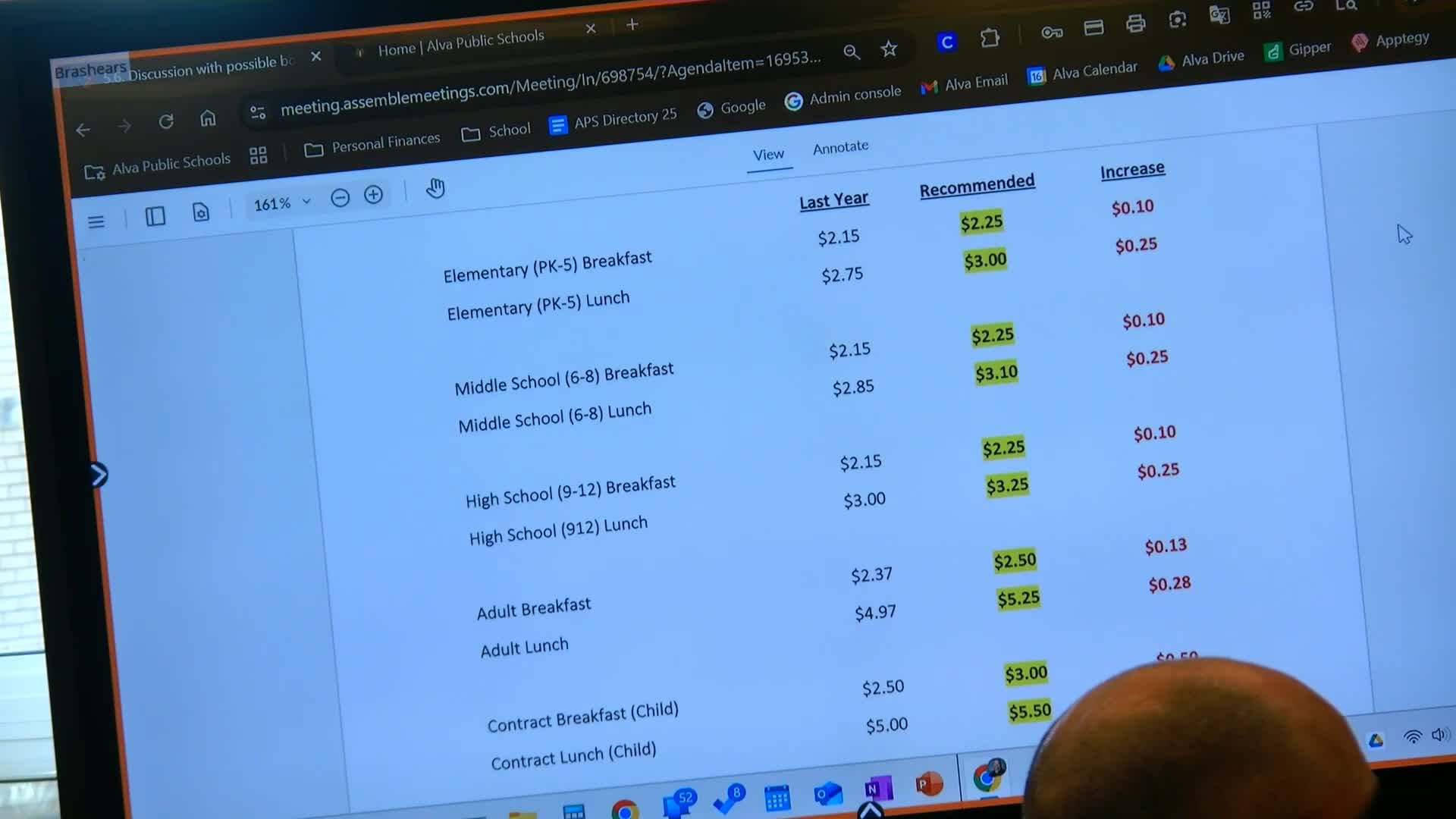
Key decisions and figures - Price changes: The child nutrition director recommended and the board approved a modest increase: a 10-cent raise for student breakfasts and a 25-cent raise for student lunches compared with the prior year. District staff presented example prices: student breakfast set at $2.25; student lunch at $3.00 for elementary, $3.10 for middle school and $3.25 for high school. (Adult and contract rates were discussed separately.)
- Program thresholds: Staff said CEP commonly benefits districts at or above roughly 75–80% direct certification. Provision 2 eligibility can be viable at lower free-and-reduced percentages (staff discussed a 65–70% guidance point). Alva—s current direct-certification and free/reduced rates were reported near 50% district-wide with building-level variation.
- Cost if district-funded universal meals: District estimates presented to the board indicated that offering free meals for all students using district funds would cost roughly $100,000 annually; staff said they were exploring mixed or sustainable subsidy approaches before committing district dollars.
Board action and next steps - Motion to approve the child nutrition meal prices for 2025-26: approved during the meeting. - District will run a targeted outreach campaign to increase free-and-reduced application returns when the state—s forms are available; administrators noted the state form release timeline has slipped in prior years and committed to pushing enrollment and application outreach when the form is released.
District comments and context District staff emphasized that free-and-reduced application counts affect more than school meals: they influence several federal and state funding calculations (for example, E-rate and other program eligibility). The superintendent urged broad community participation in filling out the forms "whether you think you qualify or not," saying higher participation can unlock programs that reduce costs and support classroom resources.
The board and staff said they are also exploring legal and program options with the state education department and legal counsel to identify a sustainable model for expanding meal subsidies without depleting funds that support classroom resources.