Get Full Government Meeting Transcripts, Videos, & Alerts Forever!
Get email alerts on the United Nations Humanitarian Aid topic
No spam. Unsubscribe anytime.
Israel's U.N. ambassador accuses OCHA of bias, backs U.S. UNESCO withdrawal and cites journalist safety for Gaza access limits
Summary
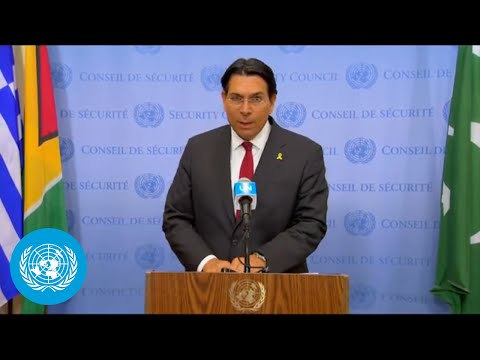
Danny Dunham, Israel's ambassador to the United Nations, told reporters before a U.N. Security Council session that the U.N. Office for the Coordination of Humanitarian Affairs (OCHA) "has abandoned neutrality" and accused the agency of inflating casualty figures and relying on Hamas-run sources.
Danny Dunham, Israel's ambassador to the United Nations, told reporters before a U.N. Security Council session that the U.N. Office for the Coordination of Humanitarian Affairs (OCHA) "has abandoned neutrality" and accused the agency of inflating casualty figures and relying on Hamas-run sources.
In a roughly six-minute statement and follow-up questions recorded before the council met, Dunham said Israel has been "facilitating the entry of aid" through two mechanisms and that "approximately 950 trucks" were awaiting collection "on the Gaza side," a figure he offered while criticizing OCHA's public reporting. He also referenced a remark by OCHA's head, naming Tom Fletcher, that he said was later walked back.
Why it matters: Dunham's remarks directly challenge the credibility of a U.N. humanitarian agency during an active conflict and align Israel with the U.S. decision to withdraw from UNESCO, signaling diplomatic friction that could affect humanitarian coordination and international oversight.
Dunham accused OCHA of publishing "grossly inflated casualty figures" and said those numbers were later reduced "by more than 10,000," statements he attributed to OCHA's internal conduct. He also repeated an allegation that OCHA "relies almost exclusively on Hamas-run sources," and said the agency "made no distinction between civilians and terrorists" in its reporting. He characterized a prior statement by OCHA's head that "14,000 babies in Gaza would starve to death within 48 hours" as a "blood libel" and said the official "quietly walked it back." Those assertions were presented by Dunham as evidence OCHA had "abandoned neutrality."
On next steps, Dunham said, "Israel will not allow this to continue," and told the council Israel was "taking action" though he did not specify steps or formal measures in the remarks on the record.
In response to a reporter's question about UNESCO and a recent U.S. announcement to withdraw from the agency, Dunham said, "I think it was the right decision of President Trump," and described UNESCO as having been "hijacked by some elements." He added that he would not speak on behalf of the United States and said the U.S. was conducting a review of U.N. agencies. Dunham noted that the United States is a major funder of UNESCO and framed the U.S. decision as related to how member states use the agency's resources.
A reporter, Ahmed Fadhi of ATN News, pressed Dunham on why Israel does not allow international journalists into Gaza and asked whether Donal(d) Trump's UNESCO withdrawal was justified for both countries. Dunham responded that the main reason Israel limits journalist access is safety: "when you bring journalists into a war zone, you don't want to see any casualties, God forbid," and "the main concern for us [is] that journalists might get killed in a war zone." He added that qualified war reporters decide for themselves whether to accept that risk.
The transcript record does not include any formal U.N. response, details of specific actions Israel plans to take regarding OCHA, nor independent verification of the casualty-figure changes Dunham described.
Less-critical details: Dunham opened and closed his remarks to the press in the minutes before the Security Council convened; a short question-and-answer exchange followed. The reporter who questioned the ambassador identified himself as Ahmed Fadhi of ATN News.