Get Full Government Meeting Transcripts, Videos, & Alerts Forever!
Get email alerts on the Sheriff Budget Sros topic
No spam. Unsubscribe anytime.
Sheriff pares staffing request, presses school board over funding for SROs as taser and body‑camera costs strain budgets
Summary
Sheriff Billy Woods reduced his original staffing ask and removed several capital items from his FY2025–26 request. Commissioners and the sheriff debated how school resource officers are funded and flagged rising costs for body-worn cameras and taser contracts that could be treated as capital to free up sales-tax funding.
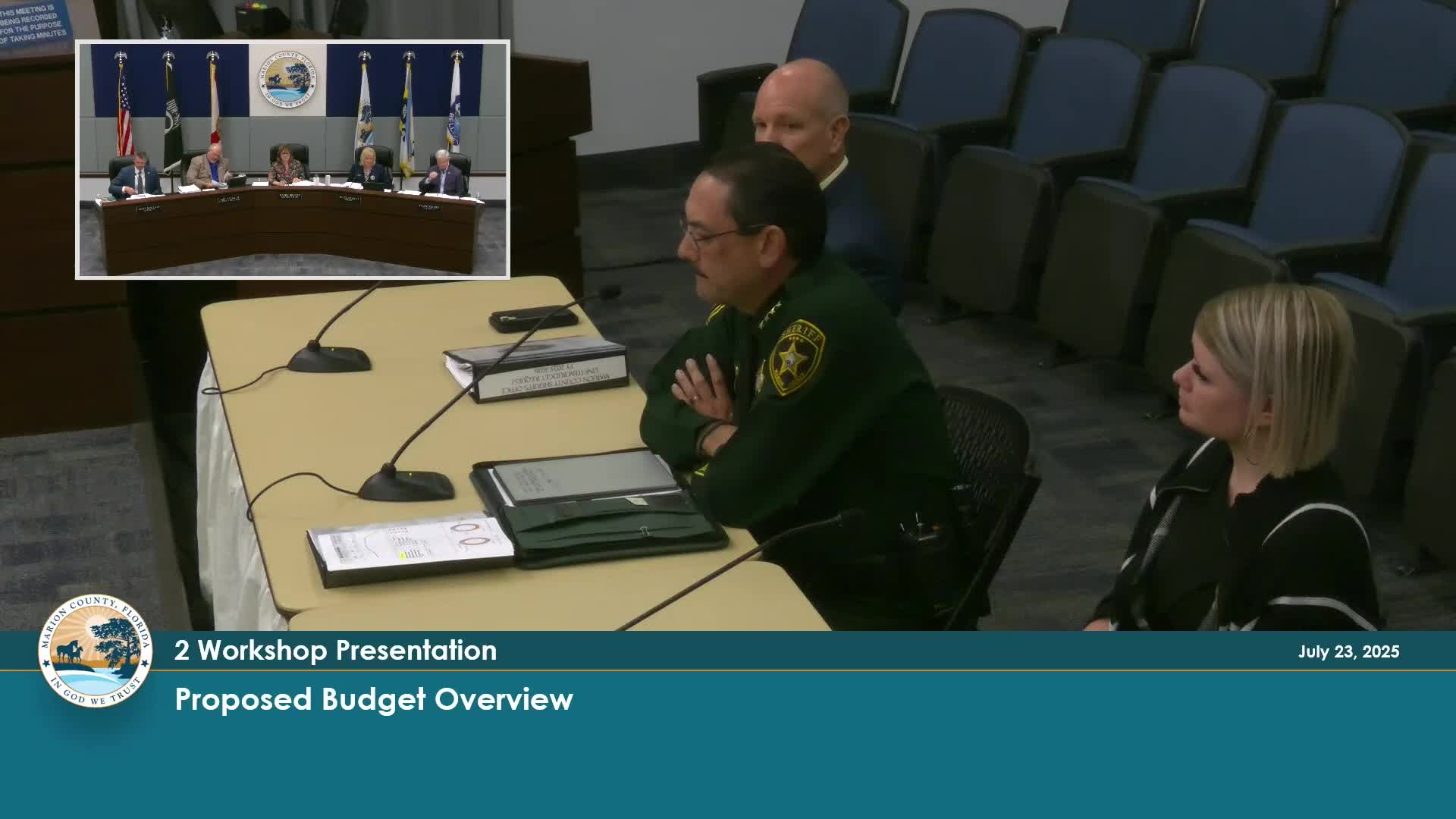
Sheriff Billy Woods told the Board he trimmed his original FY2025–26 staffing and capital requests but warned that the county remains short-staffed relative to a recent staffing study. Woods said he reduced an initial request for 25 new sworn deputies and a few community-service positions to a revised request for 12 sworn deputies and 10 community-service specialists, and removed a number of one‑time capital items, including a $3.0 million vehicle purchase line.
“Currently, the experts made it abundantly clear that we sit 108 deputies short,” Woods said, noting a five‑ and ten‑year projection that showed substantially higher needs as Marion County grows. The sheriff told the board the county’s vehicle-replacement needs for his fleet run roughly $6 million–$8 million a year and that those recurring replacement costs consume most sales-tax capital funding for public-safety purposes.
Commissioners questioned how school resource officers (SROs) are funded. Woods said private schools that contract for SROs pay the full package; for public K‑12 SROs he currently charges about half the full deputy cost to a school or district. Commissioners and the sheriff debated what share the county should pay. Commissioner Curry and others said the county should be involved in future negotiations if the county is expected to continue paying a portion of SRO salaries; several commissioners argued the school district now has dedicated revenue streams and should pay more of the SRO cost. Woods said he opposed the district creating a separate school police department, arguing it would fragment accountability and the local juvenile-justice ecosystem.
Equipment costs were a separate budget pressure. Woods removed a proposed contract for tasers and put body-worn-camera procurement on hold pending further discussion. Commissioners and staff discussed whether long-term leases for items such as body cameras, in-car cameras and tasers could be treated as capital for sales-tax funding if the arrangements exceed multi-year thresholds; county legal staff was asked to research whether leases of significant dollar value qualify under the county’s sales-tax capital definitions. Woods said the overall proposed contract for tasers, body cameras and fleet cameras was approximately $3.2 million per year, with roughly $1.0 million of that tied to taser equipment and leases.
The sheriff also reported operational reductions in the fine-and-forfeiture budget (removing pilot positions and cutting aviation repair and training requests) and confirmed he would turn back an earmarked $1,405,231 from FY2024–25 for the county to hold. Commissioners asked staff to explore whether any nonrecurring general-fund dollars could assist fine-and-forfeiture shortfalls in the coming year.
Ending: The board did not take formal votes on staffing or capital; they asked staff and the county attorney to analyze whether multi-year leases for cameras and related equipment can be treated as capital for sales-tax funding, and requested more detailed multi-year staffing and budget projections so the board can evaluate phased hiring and funding strategies.