Get Full Government Meeting Transcripts, Videos, & Alerts Forever!
Get email alerts on the Chatham Park South Village Sap topic
No spam. Unsubscribe anytime.
Residents urge pause on Chatham Park’s 5,000‑acre South Village small area plan amid flooding, infrastructure concerns
Summary
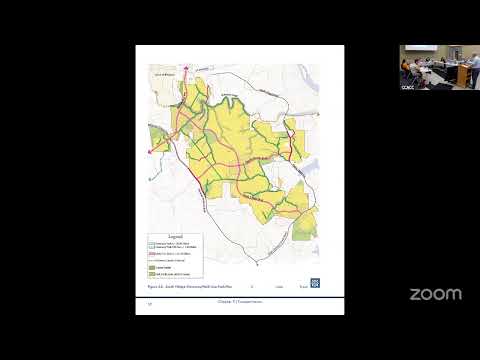
Chatham Park’s proposed single 5,000‑acre South Village small area plan drew a stream of residents and environmental advocates Monday who urged the Town of Pittsboro Planning Board to pause, citing recent flood damage, stormwater capacity concerns and the loss of phased town oversight.
Chatham Park’s proposal to treat its South Village as a single 5,000‑acre small area plan drew sustained public opposition and technical explanation at the Town of Pittsboro Planning Board meeting on Monday, July 21.
Residents, members of the Chatham Climate Action Network and homeowners affected by recent flooding urged the board to delay or reject a single large small area plan and instead require multiple phased plans and more detailed town review. They said the town’s stormwater infrastructure and tree protections are not adequate for the pace and scale of proposed development.
Why this matters: The Chatham Park master plan previously contemplated multiple, phased small area plans. Locals and environmental advocates said consolidating South Village into one massive plan would reduce local oversight over land use, stormwater and tree protections for decades and could worsen flood and infrastructure impacts after Tropical Storm Chantelle inundated parts of the county.
Public comments opened the meeting. Tianna Thurber, a Pittsboro resident and small business owner, described damage to her business and said of the October storm, “This flood was more than a natural disaster.” Joy Hewitt, a river monitor and longtime resident, called for a halt on additional development until revised stormwater rules and tree‑protection standards are adopted, saying, “We need a moratorium on development until standards impacting climate change can be reviewed.” Leslie Keith, whose property borders the area proposed for rezoning, told the board, “I’m asking the Planning Board to please not rezone from RA2 to MUAC, the Mixed Use Activity Center.”
After the public comment period, the applicant and technical consultants presented the South Village Small Area Plan concepts. Teresa Thompson, Pittsboro’s planning director, introduced the applicant presenters and said staff was still reviewing the plan and had not issued a formal recommendation.
Chuck Smith, identified as a Chatham Park representative and licensed landscape architect, framed the application as a continuation of the master plan and the development “elements” previously adopted. He said many topic areas raised by residents — stormwater, tree protection, parks and affordable housing — were addressed in Chatham Park’s additional elements and master plan commitments, and stressed that the small area plan itself focuses on higher‑level coordination of roadways, utilities, parks and land uses. Smith said the development team and town meet periodically to review elements and standards and invited questions during the presentation.
Ron Freeman, described as Chatham Park’s stormwater administrator, explained technical aspects of stormwater design and how design storms and rainfall curves change over time with updated climate data. He said the engineering practice is to design and permit based on the best available rainfall data at the time of review, adding, “If we design and get something approved today, it would be based on today’s rainfall curves and probabilities.” Freeman and other technical presenters described Chatham Park’s scoring system for watershed protection that prioritizes streams, buffers, floodplains, steep slopes and tree cover, and listed typical on‑site stormwater measures (detention ponds, wetlands, bioretention cells, underground storage and permeable pavement). They also said devices for portions of Chatham Park already built “fared relatively well” in the recent extreme rainfall, while acknowledging some older municipal pipes outside Chatham Park underperformed.
Transportation consultant Kenley Moore (Kimley‑Horn) said the large planning area is being used to size a connected roadway network and to avoid piecemeal infrastructure that could later be impossible to widen. He said the team used an updated travel‑demand model and that individual developments will still require site‑level traffic impact analyses and coordination with NCDOT and the town.
Victor Zar, assistant city manager for Sanford (utilities), and Wes Hutchins, a registered professional engineer (McKim & Creed), described sewer and potable water planning at basin scale. Hutchins warned that planning utilities only on a section‑by‑section basis can produce undersized gravity mains and congested corridors requiring expensive later parallel installations; he recommended sizing transmission mains and pump stations with the basin‑level flows in mind. Zar said utility planning beyond Chatham Park’s boundary may be required because basins do not align with property lines.
Supporters of a phased, smaller SAP approach and many residents asked the board to pause action while the town updates stormwater standards, re‑examines floodplain mapping and ensures ongoing town oversight. Several speakers cited recent flooding along Robeson Creek and local creek tributaries and said clear cutting and development upstream intensified runoff.
Planning staff said they will continue reviewing the South Village small area plan and the applicant will provide a question‑and‑answer packet in a future presentation to the board. No formal action on the small area plan occurred at the meeting.
Votes at the meeting: the board approved the evening’s agenda and the minutes for the June 16, 2025 meeting before opening public comment. The agenda and minutes were approved by voice vote during the meeting; in both cases the chair called for “all in favor” and the board recorded the motions as approved.
What’s next: Town staff said they are continuing technical review and will return with a fuller presentation, answers to board questions and a Q&A document from the applicant. Residents and advocates said they will press commissioners and planning staff for phased small area plans, updated stormwater standards and stronger tree protection before the town approves long‑term entitlements.
Ending note: The meeting illustrated the tension between developer‑led, comprehensive infrastructure planning and residents’ calls for smaller, phased review to preserve town oversight, protect streams and reduce climate vulnerability.