Get Full Government Meeting Transcripts, Videos, & Alerts Forever!
Get email alerts on the Housing And Community Development topic
No spam. Unsubscribe anytime.
High Point staff preview 2025–29 consolidated plan, seek public comment ahead of Aug. 4 hearing
Summary
City staff presented the draft 2025–2029 Consolidated Plan and the 2025 Annual Action Plan, outlined CDBG and HOME allocations, explained citizen outreach, and said a public review period runs July 2–Aug. 1 with a public hearing slated Aug. 4 before a final plan is submitted by Aug. 16.
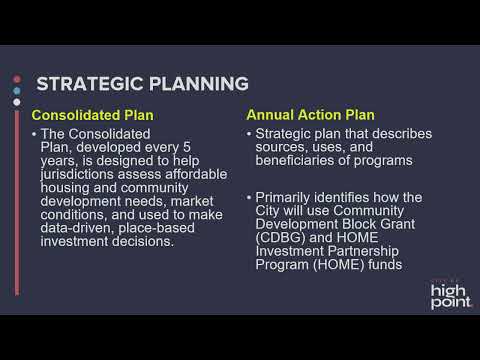
High Point officials on Tuesday reviewed the draft 2025–2029 Consolidated Plan and the 2025 Annual Action Plan, outlining how federally funded Community Development Block Grant (CDBG) and HOME dollars would be targeted to housing, homelessness and public services over the next five years.
“High Point is what’s considered a HUD entitlement community, which means that we receive Community Development Block Grant or CDBG funds on an annual basis, to assist low and moderate income families and households,” said Nina Wilson, director of Community Development and Housing, during the council’s special meeting. Wilson said the city also receives HOME funds, which “are specifically for housing activities” for low-income households.
The draft lays out five-year goals and annual priorities based on a housing needs assessment, homeless needs assessment and other data; staff said they used stakeholder interviews, surveys and two public meetings (May 20 and June 26) to develop the plan. The city’s public review and comment period runs July 2–Aug. 1, staff said, with a public hearing before council scheduled for Aug. 4 so the plan can be finalized and submitted to HUD by the statutory deadline of Aug. 16.
Wilson provided allocation figures and program details. For program year 2025 the draft lists a CDBG allocation of $841,529 and HOME funding of $424,074. Staff also reported other funding sources and program income: an urgent repair program of $165,000, a $70,000 construction training grant plus a $70,000 local cash match, $14,500 from the IRS Volunteer Income Tax Assistance program, and $2.3 million from the city general fund which supports department administration and local code activities. Wilson said HOME program rules require the city to reserve a minimum 15% of HOME funds for nonprofit community housing developers (CHDOs) but that the city typically sets aside more than the 15% minimum.
Wilson said rental assistance is included as a goal in the draft plan under public services but that the draft does not identify new annual funding from CDBG/HOME for rental assistance. She noted the city has previously used HOME-American Rescue Plan (HOME-ARP) dollars for eviction prevention, emergency hotel assistance and supportive services; Council was told staff plans to pursue requests for applications using existing HOME-ARP funds in the coming weeks. Wilson said about $200,000 is budgeted for support services under public services in the draft and that last year the city set aside $50,000 that was used for rental assistance and related needs.
Council members pressed staff for additional detail and context. Council member Andrew Cook asked whether the city typically sets aside more than the HOME 15% minimum; Wilson replied the city typically sets aside more, noting much HOME activity funds single-family construction. A council member who raised concerns about rental assistance asked why the plan shows $0 in new annual rental assistance from these allocations; Wilson repeated that rental assistance is a goal but that staff intends to rely in part on existing HOME-ARP funds and other agency partners for direct rental assistance.
Council members also requested additional materials to evaluate performance and leverage. One council member asked for a side-by-side comparison showing outcomes from the previous 2020–24 plan versus the 2025–29 draft. Another asked for an analysis that shows how federal and local funds have been braided to produce leveraged private investment and tax returns; Wilson said staff would follow up and said the draft plan will be revised to correct typographical and factual issues identified since the consultant’s draft went out.
Wilson apologized for errors in the initial draft that went to the public and said the consultant (Urban Design Ventures) will correct identified issues; she said staff will provide another draft before the Aug. 4 public hearing. “I do want to apologize for that,” Wilson said of the draft’s quality and typos. She noted, as an example, that the city’s change in Fair Housing Assistance Program status was not reflected in the earlier draft and will be corrected.
Wilson and council members also reiterated that HUD’s proposed federal budget at the time of the meeting included no HOME funding for fiscal 2026; she said the city is continuing work to ensure priorities can be advanced even amid funding uncertainty.
The Council did not take final action on the consolidated plan at the special meeting; staff said the council must approve the plan at the Aug. 4 public hearing in order for staff to submit the finalized plan by the Aug. 16 deadline.