
Residents and veterinary stakeholders urge board to re-open cases, demand audit and stronger discipline
Get AI-powered insights, summaries, and transcripts
Subscribe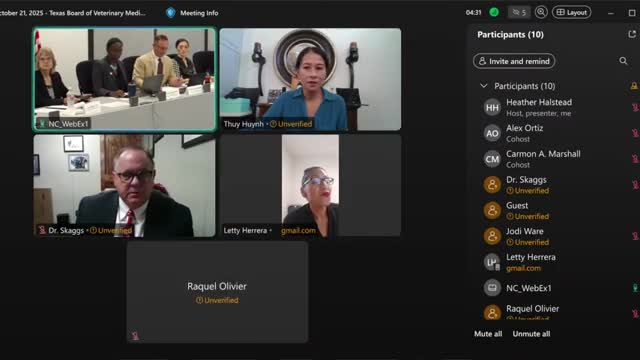
Summary
Multiple public commenters told the State Board of Veterinary Medical Examiners the board should not dismiss complaints in cases involving alleged veterinarian misconduct, and called for stronger sanctions and independent review. Speakers cited specific complaint IDs and urged a forensic audit of the board’s investigative process.
Several citizens and veterinary stakeholders urged the State Board of Veterinary Medical Examiners at its public comment period to reject recommended dismissals, investigate alleged patterns of misconduct and consider a forensic audit of the board’s handling of complaints.
Leticia Herrera, who gave her full name to the board, asked the board to “vote against the recommended dismissal of cases CP25189 and CP25190,” saying the record “is not a case of simple error” but rather “a failure of medical professionalism, standards, and breaches of trust.” She said the licensee involved had prior sanctions and called the pattern “an escalating pattern of misconduct leading to public hazard.”
Another commenter, identified on the record as Tuiyuan Winn, asked the board to reconsider the disposition of complaint TP24-492, a matter involving a spay performed at a clinic referred to as Macy’s Mission. Winn described the case in detail and said the dog “Gracie” died after what Winn characterized as a surgical error that required later intervention at Texas A&M, which performed surgery and found necrotic tissue before humane euthanasia. Winn requested that the board pursue “maximum sanctions allowed” and criticized the veterinarian’s initial response to the incident as refusal to accept responsibility.
Jody Ware said she had raised concerns previously with the board and other state agencies about consolidation of veterinary practices by a private-equity backed group she identified as Innovative Pet Care, and she alleged possible conflicts of interest between that company and the veterinary regulatory environment. Ware told the board she believed relationships between corporate consolidators and board leadership could “jeopardize the pet-owning public” and urged the board to act on concerns she has submitted to regulators.
Anita Ross, speaking on behalf of a dog named Pirate and “every Texas citizen who expects this board to protect the public,” cited the Texas Veterinary Licensing Act and called for the board to use its statutory powers to investigate, subpoena and discipline when appropriate. Ross urged the Texas Department of Licensing and Regulation to perform a forensic audit “into this board’s purposeful mishandling and possible collusion” in Pirate’s case and in the board’s investigation procedures more broadly.
Other speakers included Heather Kativa, who asked the board to consider a public subcommittee to improve transparency and public outreach about complaint processes, and urged stronger, clearer language for agreed orders; and Trent Hightower, who spoke for the Texas Veterinary Medical Association and acknowledged the board’s explanation of recent fee increases while offering to participate in upcoming rule reviews.
Speakers emphasized process concerns as well as case-specific allegations: multiple commenters said they had submitted supplemental records after staff reviews and asked the board to consider those materials before dismissing matters. Several requested that the board pursue sanctions available under law rather than administrative closures.
Board Chair Doctor Gola and staff acknowledged the public comments and thanked speakers for participating. The board did not take immediate action on specific requests during public comment; several of the complaint IDs cited (for example, CP25189, CP25190 and TP24-492) were discussed later in the meeting’s docket and were identified by staff as pending referral or review.