Get Full Government Meeting Transcripts, Videos, & Alerts Forever!
Get email alerts on the Alcoholic Beverages topic
No spam. Unsubscribe anytime.
Nolensville commissioners direct staff to draft ordinance updating liquor-store rules, keep population cap
Summary
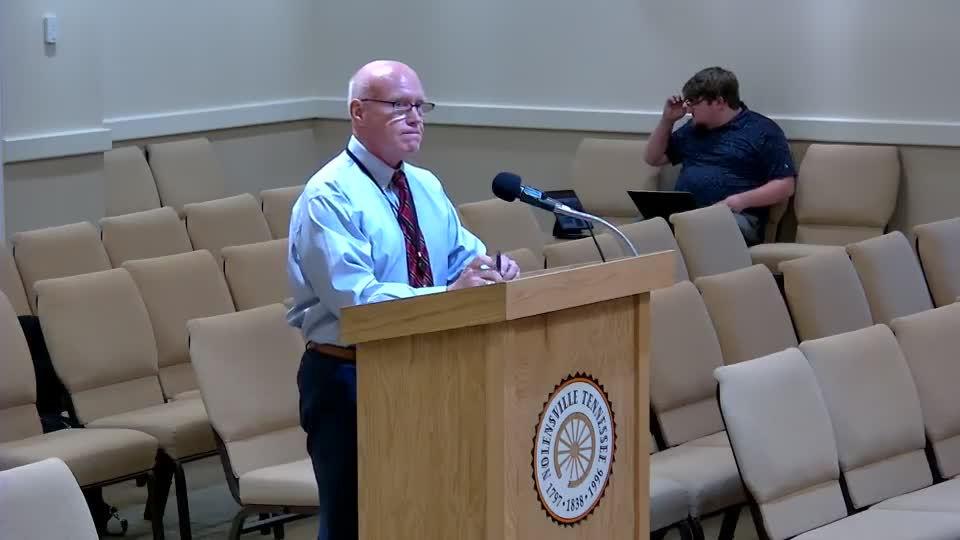
Town of Nolensville staff presented a draft amendment to Title 8, Chapter 3 of the municipal code on Aug. 25, proposing updated location and quantity rules for liquor/package stores.
Town of Nolensville staff presented a draft amendment to Title 8, Chapter 3 of the municipal code on Aug. 25, proposing updated location and quantity rules for liquor/package stores.
The presentation said the draft ties location standards to the current zoning ordinance, replaces obsolete zoning references and offers a population threshold per store as a way to limit the number of outlets. "You have sole discretion in regulating either from 0 to an infinite number," staff said, noting many jurisdictions regulate by population and others do not.
Commissioners generally supported a 300-foot separation from sensitive uses and retaining a population-based limit. "300 feet seems to be the average as you look across for the municipality," Vice Mayor Salamida said. Multiple commissioners said a 1-mile separation between stores is unnecessary; staff recommended removing that provision. Commissioner Carpenter and others urged the board to exclude broadly worded "places of public gathering" in favor of an explicit reference to "public park," with one commissioner saying, "Public park. Period. End it there." Several commissioners said they preferred market forces to govern store siting rather than an extensive inter-store separation rule.
One commissioner said a 1-per-5,000 population benchmark was reasonable for Nolensville; another said keeping a population tie gives the board a measurable policy to revisit. Staff said the next step will be to present the draft as an ordinance for first reading at a future meeting; staff said they will propose removing the one-mile provision, clarify the definition of "public park/facility" as land owned by the municipality, and consider deleting a provision on "public gathering places".
This was a policy discussion; no ordinance vote was taken at the workshop. Commissioners asked staff to return a redraft in ordinance form for a first reading in September (staff suggested the next regular meeting). The draft, as discussed, would: 1) reference the town's current zoning ordinance rather than obsolete zoning classifications; 2) set separation from specified sensitive uses (schools, churches, public parks) with a suggested 300-foot buffer; and 3) remove the separate one-mile minimum between liquor stores while keeping a population-based cap (one per 5,000 residents was discussed).
Staff presentation materials and example municipal practices from Middle Tennessee were distributed to commissioners for review.
Next steps: staff will prepare the ordinance draft for first reading and return with clarified definitions and final proposed distances.