Get Full Government Meeting Transcripts, Videos, & Alerts Forever!
Get email alerts on the Land Use Parking Landscaping topic
No spam. Unsubscribe anytime.
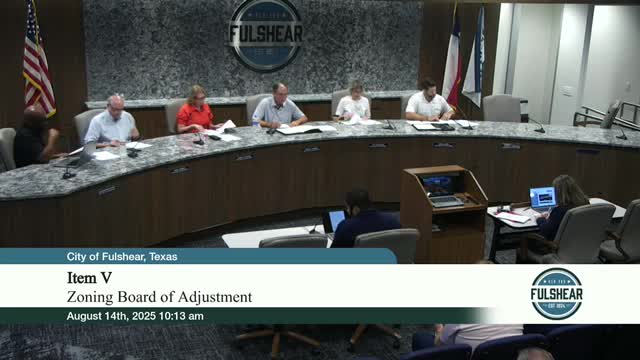
Fulshear ZBA approves Lamar CISD variance to omit parking-lot islands at new High School No. 8
Summary
The Fulshear Zoning Board of Adjustment unanimously granted Lamar Consolidated ISD a variance to avoid installing parking‑lot islands and associated trees at a proposed high school at 3220 Tiger Run, citing budget, maintenance and safety concerns; city staff had recommended approval with a condition to redistribute trees on site.
The Fulshear Zoning Board of Adjustment on Aug. 14 approved a variance allowing Lamar Consolidated Independent School District to omit required parking‑lot islands and their associated trees and shrubs at a proposed new high school at 3220 Tiger Run.
The board voted unanimously to grant the variance after a public hearing and discussion that centered on construction cost, ongoing maintenance and campus security. Rodrigo Rodriguez, a city planning staff member, told the board that staff recommended approval but asked that, if granted, at least the trees that would have been in the islands be redistributed around the site.
The request was presented by Michael Hoey, an architect with PBK Architects representing Lamar Consolidated ISD. Hoey said the district did not budget for the islands and estimated the cost of installing the required islands and planting at roughly $1.2 million to $11.3 million (figures presented by the applicant varied), and he said adding islands would increase irrigation needs by about 283,140 gallons per year and would add ongoing maintenance labor costs. "The district didn't budget for that," he said.
Scott Hartfield, bond design manager for Lamar CISD, said the district's maintenance crews are configured "to mow and not maintain massive amounts of landscape," and that recent expansion had already significantly increased the maintenance workload. "I'd rather not add additional trees," he said.
Rodriguez noted staff's preference that landscaping not be removed but reallocated: "...at least kind of be placed around the property to, at least still have that extra landscaping," he said. Board members discussed tradeoffs including aesthetic goals, water and maintenance impacts on local MUDs (municipal utility districts), and safety implications: Hoey and district staff argued that trees inside lots can create surveillance blind spots, a concern for campus security.
Board members also referenced coordination with adjacent Johnson Development on an eastern landscape buffer, which the applicant said is still being negotiated; the applicant indicated the buffer is roughly 22.5 feet along the eastern edge of the site.
After discussion, a board member moved to approve the variance, citing Section 2.11 of the Texas Local Government Code as the governing variance standard; another member seconded. The motion passed unanimously.
The variance is final under the city's process; the board chair noted the only way to challenge a decision is by filing suit in Fort Bend County district court.
Votes at a glance: one variance request (3220 Tiger Run) — approved unanimously.
The district and applicant said they will continue coordination with Johnson Development on buffer/landscape details and with city staff on where redistributed trees and landscaping will be located.