Get Full Government Meeting Transcripts, Videos, & Alerts Forever!
Get email alerts on the Retirement Benefits topic
No spam. Unsubscribe anytime.
TRS tells HR professionals how pensions, supplemental savings and post‑retirement rules work
Summary
Teachers' Retirement System presenters gave HR staff an overview of pension calculation, service credit rules, the new supplemental savings plan administered by Voya, disability and survivor benefits, employer reporting responsibilities and post‑retirement work limits.
Sandy Benhart, TRS presenter, and colleagues summarized benefit rules, employer responsibilities and retirement options for district human-resources staff during a TRS member‑services webinar on benefits and retirement preparation.
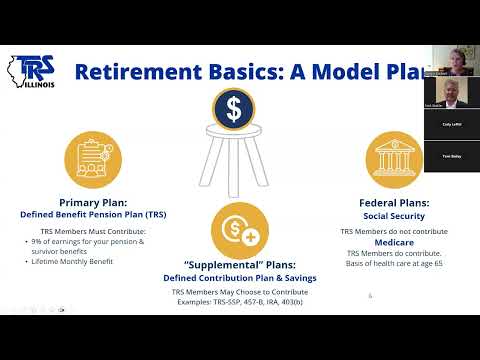
The presentation explained how the TRS defined‑benefit pension is calculated, what counts as service credit, the difference between tier 1 and tier 2 members, the TRS Supplemental Savings Plan (SSP) administered by Voya, and limits on returning to work after retirement. The session included guidance on employer reporting steps HR offices must complete when an employee retires.
Benhart opened by describing TRS’s core services: running benefit estimates, explaining how members may obtain optional service credit, and walking members through disability, survivor benefits and health‑insurance enrollment. She said TRS “does not provide financial advice” and that counselors will provide numbers and direct members to a financial adviser for personal decisions.
How TRS calculates a pension: Benhart said TRS combines service credit, a formula factor and a member’s final average salary to produce a starting pension. She described the formula factor currently used by TRS as 2.2 percent and explained final average salary is the average of a member’s four highest consecutive years out of the last 10 for tier 1 members and the eight highest consecutive years for tier 2 members. For tier 2 members, Benhart cited a salary cap of $127,002.83 for 2025; earnings above that year‑cap do not count toward the pension calculation.
Service credit and optional purchases: TRS told HR staff that one full year of service credit requires 170 days in the TRS fiscal year (July 1–June 30). Unused, uncompensated sick days may be converted to service credit up to a cap of 340 days (two years). Benhart described optional service purchases — for prior public service in other states, military service, refunded TRS service buy‑backs, and some student‑teaching paid service — and said members choose whether to buy optional service after TRS calculates the cost.
Tier differences and retirement ages: Benhart said members with any Illinois public‑pension contributions before Jan. 1, 2011 are in tier 1; those whose first contribution began on or after that date are in tier 2. She summarized unreduced retirement ages she attributed to each tier: tier 1 generally unreduced at age 60 with at least 10 years of service (or earlier under certain 35‑year rules); tier 2 unreduced at 67 with at least 10 years. She cautioned that early retirement produces reductions prorated to the day.
TRS Supplemental Savings Plan (SSP): Terry Bailey, identified as the SSP expert, said the Illinois General Assembly amended the pension code in 2018 to create a statewide supplemental retirement savings option and that TRS selected Voya as administrator. Bailey described the SSP as a defined‑contribution, employer‑sponsored plan offering pretax and Roth contributions, with a minimum contribution of $30 per pay period (or 1 percent) and an IRS annual limit of $23,500 for 2025 plus the $7,500 age‑50+ catch‑up.
Automatic enrollment and access rules: Bailey said employees who start work on or after Jan. 1, 2023 are automatically enrolled about 30 days after their begin date at 3 percent pretax into an age‑appropriate target‑date fund, unless they opt out. She noted a key difference between the SSP and many other accounts: under the SSP members may access pretax savings at separation of service without the 10 percent early‑withdrawal penalty that typically applies to IRAs and 401(k) plans, although ordinary income taxes would still apply.
Disability and survivor benefits: Benhart described TRS temporary disability rules: a member must have physician verification (two physicians in most cases; one for pregnancy), use all district sick days first, and temporary disability pays 40 percent of contract pay while the member continues to accrue service credit. For survivor benefits, she said 1 percent of contributions funds survivor benefits (monthly benefit if an eligible dependent exists, otherwise a lump sum) while the remainder of member contributions funds the retiree’s own pension account.
Retirement timing and employer responsibilities: Benhart advised members to contact TRS 6–12 weeks before their last workday to start the retirement packet; for reciprocal retirements members must also initiate retirement with the other pension system. HR offices must submit two employer forms after a member’s final pay: TRS’s electronically generated supplementary report (last day worked, final year earnings, unused sick days) and a sick‑leave granting certification for any granted sick days in the four prior years.
Post‑retirement work limits and subject‑shortage exception: The presenters warned HR staff about strict post‑retirement limits. TRS said members must receive their first pension check before they are officially retired; while collecting a pension current limits cited by TRS were 120 days or 600 hours through the next June (TRS said the pension code sets a floor of at least 100 days or 500 hours thereafter). Benhart emphasized members cannot sign a written agreement to return to work before retirement. She also described a time‑limited subject‑shortage exception (through June 2027 as described in the presentation) that can permit full‑time return without pension forfeiture but requires approval from the regional office of education and TRS before the teacher resumes work.
Health insurance and outreach: Benhart reviewed TRS retiree health‑insurance premium examples presented per person per month and urged HR to ensure retiring employees understand the cost implications of covering dependents versus Medicare‑eligible retirees. She encouraged HR staff to use TRS resources — employer‑services contacts, TRS webinars, recorded YouTube sessions and Voya enrollment assistance — and to remind retiring employees they still must submit retirement notice to TRS even if they notified the district.
The presentation closed with TRS urging HR staff to use the post‑retirement checklists and outreach tools, and to direct members to TRS or Voya for SSP enrollment and one‑on‑one questions.