Get Full Government Meeting Transcripts, Videos, & Alerts Forever!
Get email alerts on the Energy Storage Bess topic
No spam. Unsubscribe anytime.
Solano supervisors push draft battery storage rules after public safety, farmland concerns
Summary
Board heard a technical presentation and extended public comment on a draft battery energy storage (BESS) ordinance, asked staff to tighten site, fire-response and agricultural protections and to return quickly with a final draft and hearing schedule.
The Solano County Board of Supervisors on Tuesday heard a staff briefing and extensive public comment on a draft ordinance to regulate large, front‑of‑meter battery energy storage systems and asked staff to move quickly to finalize standards addressing fire risk, siting and community protections.
The draft ordinance would apply to systems greater than 1 megawatt and requires discretionary use permits, third‑party technical review, emergency‑response and decommissioning plans, and financial assurances. Staff framed the draft as a risk‑based approach that would prohibit BESS in some hazardous areas, require layered mitigations for thermal‑runaway risk and offer narrower pathways with fewer conditions for non‑flammable chemistries.
The issue matters because developers can currently take an alternative permitting route at the California Energy Commission (CEC), and supervisors said a local ordinance is the county’s main lever to influence outcomes, short of changes to state law. Director of Resource Management James Musick told the board that local rules are “important” because the CEC must consider local ordinances and general plan policies when it evaluates any AB205 opt‑in applications.
Eric Hagstrom, associate planner, described the draft’s core elements: mandatory pre‑application meetings with county agencies, a technical review fee to cover third‑party expertise, required emergency response plans and decommissioning financial assurances, air quality baseline testing, and a possible prohibition of indoor battery facilities. He said the county had formed a technical working group that included local fire experts, Office of Emergency Services, industry representatives and community members, and that the draft incorporated national standards and outside technical input including NFPA 855 and Underwriters Laboratories guidance.
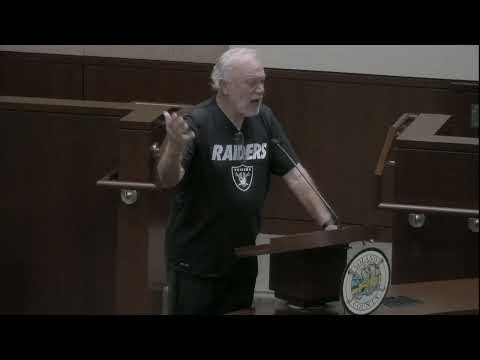
Supervisors and dozens of public speakers pressed for stricter protections. Supervisor Wanda Williams said the Moss Landing fire and subsequent studies left her worried about plumes of toxic smoke and long‑term soil contamination, and asked how close a BESS could be to schools, senior housing and hospitals. “This is wrong in so many ways,” Williams said, adding she wanted the ordinance “as tight as it can be.”
Community members and farming advocates urged a prohibition on prime agricultural land. Several speakers asked that the county either ban BESS on Williamson Act parcels and land mapped as prime, unique or statewide‑important farmland or require a countywide vote to convert agricultural zoning before any battery project could proceed. Sarah Dunn, who lives near proposed projects, told supervisors she supported prohibiting BESS on high‑value farmland and said commercial‑service zones, not farms near residents, are more appropriate locations for utility‑scale systems.
Fire and emergency preparedness was the most common topic at the public mic. County staff and the board discussed mitigation options that would require developers to pay for additional training, specialized equipment, radio interoperability, contributions to consolidated dispatch, and annual funding for county emergency response agencies. Hagstrom said the draft allows the department to require such community benefits as mitigation if a battery chemistry carries a thermal‑runaway risk; if a third‑party review determines a technology has no thermal‑runaway risk, the director could exempt applicants from some thermal‑runaway specific measures.
Other items in the draft: setbacks tied to risk (a staff recommendation would require a 300‑foot setback from sensitive receptors where thermal‑runaway risk exists); a 30‑foot fire‑rated access road encircling modules; requirements for air quality baseline monitoring; a decommissioning assurance that is 50% funded at commercial operation and fully funded by the start of year five (with options such as a bond, parent guarantee or irrevocable letter of credit); cybersecurity and reporting requirements; and a prohibition on indoor BESS facilities.
Several supervisors urged staff to pursue the strictest options that are legally defensible. Supervisor John Brown said succession planning and local government continuity made it important to adopt a defensible local standard rather than cede the field to the state. Supervisor Mitch Mashburn asked staff to model the effect of excluding Williamson Act properties on the map of feasible project parcels.
Staff said the draft would be updated based on the input and returned for formal introduction and a public hearing schedule. Musick told the board the ordinance is time‑sensitive because at least two BESS proposals have engaged the CEC AB205 opt‑in process and an adopted local ordinance sets the standards the CEC must consider.
The board did not adopt the ordinance; it directed staff to return with a final draft and hearing schedule and to explore options for stronger protections on prime agricultural land, setback options, and mechanisms to ensure fire‑response costs and training are covered by applicants.
Ending: Staff said it will revise the draft to incorporate the board’s direction and public comments and bring the ordinance back for formal action and a public hearing notice. The board emphasized urgency and asked staff to produce a version that maximizes local protections that can withstand CEC review and possible state scrutiny.