Get Full Government Meeting Transcripts, Videos, & Alerts Forever!
Get email alerts on the Elections And Governance topic
No spam. Unsubscribe anytime.
Charter committee recommends council not place elected-mayor or district measures on ballot
Summary
The Charter Review Committee voted 10–5 to recommend the City Council not place on the ballot an amendment to move Glendale from at-large elections to district elections, nor to establish a separately elected mayor; members debated representation, governance and local priorities.
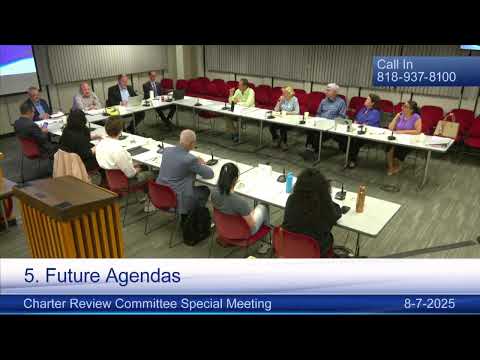
The Glendale Charter Review Committee voted Aug. 7 to recommend that the City Council not place on the ballot two charter amendments: one to change Glendale’s council from at-large elections to district-based elections, and a second to establish a separately elected mayor. By roll call the committee approved the recommendation 10–5.
Committee members and public speakers offered competing rationales during a lengthy discussion. Supporters of districts said smaller districts can improve local representation, lower the cost of campaigning for neighborhood-focused candidates and make elected officials more accessible to residents with concentrated local concerns. Several public commenters and committee members argued districts could help renters and communities with specific needs win attention from elected officials.
Opponents cautioned that districts can fragment citywide policymaking, create parochial competition for resources, and leave residents without recourse if their district representative is unresponsive. Multiple committee members said Glendale’s relatively compact, intermingled neighborhoods and citywide issues — aging infrastructure, rising energy costs and budget shortfalls discussed earlier in the meeting — argue against shifting to districts now. Several members said the city should focus on pressing financial and service-delivery priorities rather than a structural electoral change at this time.
The committee also debated whether a separately elected mayor would concentrate power or provide a single, citywide elected official who could represent Glendale in emergencies and regional negotiations. Some members supported a directly elected mayor with a four-year term and duties limited to an equal vote and citywide representation; others opposed adding a separately elected mayor at all, saying Glendale's current mayor-selection process (rotating among council members) is sufficient.
After extended public comment, including pro- and anti-district testimony, a committee member moved that the committee recommend the council not place either measure on the ballot. The motion passed by a 10–5 roll-call vote. The committee chair said staff would summarize the meeting record and public input for the City Council. The committee did not adopt an alternate design (for instance a seven-member council with six districts plus an elected mayor); members suggested the council itself could decide whether to put alternative maps or term/duty combinations before voters.
Committee discussion and the recorded public comments will be transmitted to the City Council for its consideration should the council decide to proceed with any charter amendments.