Get Full Government Meeting Transcripts, Videos, & Alerts Forever!
Get email alerts on the Budget topic
No spam. Unsubscribe anytime.
Colleyville officials outline proposed 2025–26 budget, say homestead increase will lower many homeowners' bills even as tax rate rises
Summary
City staff presented a proposed fiscal 2025–26 budget and tax-rate calculation that would raise city property tax revenue while increasing the tax rate; officials said the expanded homestead exemption will reduce most residential homeowners’ bills.
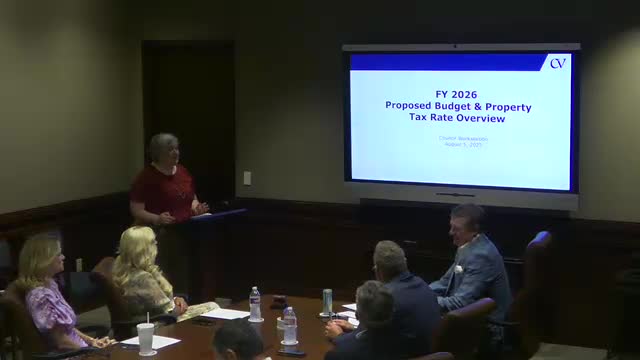
Colleyville staff presented a proposed $68 million operating budget and a calculated total property tax rate of 0.311931 during the City Council work session on Aug. 5, 2025, saying the city expects to increase property tax revenue while many homeowners will see a slightly lower tax bill due to an expanded homestead exemption.
City staff summarized the fiscal year proposal, saying the budget would increase property tax revenue by about $850,000 and that the council earlier increased the residential homestead exemption from 7% to 14%. “We had adopted the homestead exemption and increased that from 7% to 14%, so which will provide relief to our residential homeowners,” a staff member said. Staff told council the homestead change lowers the taxable value for qualifying homeowners and therefore can reduce an individual homeowner’s bill even if the nominal tax rate rises.
The nut graf: the city’s proposed total tax rate would be higher than the current year’s rate in order to generate needed revenue, officials said, but the expanded homestead exemption and changes in appraised values mean many residential homestead taxpayers should see modest decreases in their bills. Staff emphasized the difference between a tax rate and the tax bill: a higher rate does not always mean a higher bill when taxable values or exemptions change.
Key details offered by staff included: a proposed total revenue package of about $68,000,000 with proposed expenses of roughly $67.3 million; general-fund revenue of $30.7 million and general-fund expenses of $29.8 million yielding an operating surplus of $17,000; and utility-fund projected revenue of $26 million and expenses of $25 million with a net surplus of about $157,600. Staff also proposed adding a cybersecurity administrator position, to be cost‑shared with the utility fund, and recommended modest utility base-rate increases to take effect Oct. 1: a $0.60 bump to one-meter rates and a $1.07 increase on wastewater base rates (staff clarified the final volumetric rates tied to TRA flows would be adjusted in January).
On property taxes, staff said appraised values for the city increased slightly from the prior year — roughly 2.76% overall — and that some taxable values are “frozen” for over‑65 homeowners, shifting a greater share of the burden to other taxpayers. Staff explained the city’s calculated “no‑new‑revenue” rate and a “voter‑approval” comparison, and noted that had the council not increased the homestead exemption the apparent rate change would be smaller even though revenue needs remain. “Your rate is a function of the value and the revenue generated, and so sometimes the revenue is flat and the rate can still go up,” staff said.
Staff described next steps and timeline: finalizing the posted budget later that week (numbers were still settling), and bringing back tax-rate discussion at the Aug. meeting with a goal of setting public hearings for Sept. 3 and Sept. 16 for first and second readings of the tax-rate ordinance and the budget. Staff said the city is operating above its 90‑day operating reserve target but is budgeting conservatively to allow transfers from operating to capital funds if needed.
Council members asked clarifying questions about the homestead change, the amount of revenue sought, and components of increased expenditures. Staff attributed the bulk of the general fund revenue to property and sales taxes (about 78% of general‑fund revenue), noted a portion of the overall budget that flows through the utility fund (about $20 million), and identified higher insurance and electricity costs as notable expenditure increases. No formal council vote was recorded in the work session; staff said formal public hearings and readings would occur on the September agenda.
Ending: Staff will post the budget once final figures are confirmed and return to council with formal public‑hearing notices and ordinance readings on the schedule they described.