Get Full Government Meeting Transcripts, Videos, & Alerts Forever!
Get email alerts on the Water Quality topic
No spam. Unsubscribe anytime.
San Benito officials outline water-plant disinfection work, say drinking water meets state standards
Summary
City staff and the water plant superintendent briefed the City Commission on a state-approved 30‑day free-chlorine conversion and flushing regimen conducted to remove biofilm and sediment from older distribution mains after residents reported taste and odor concerns.
City staff and the water plant superintendent described steps taken in July to address taste and odor complaints by temporarily converting the distribution system to a free-chlorine disinfection regimen, flushing mains and sampling at multiple points across the system.
Julio Gonzales, the city’s water plant superintendent, said the conversion is a state-approved procedure for systems with older mains and biofilm accumulation: the plant used a free-chlorine treatment for 30 days, crews flushed lines and then converted back to normal disinfection once residuals and samples met targets. Gonzales said the work knocked down biofilm in the oldest parts of the system and that some sections of the distribution network took longer for chemical residuals to stabilize, which produced temporary odors residents reported.
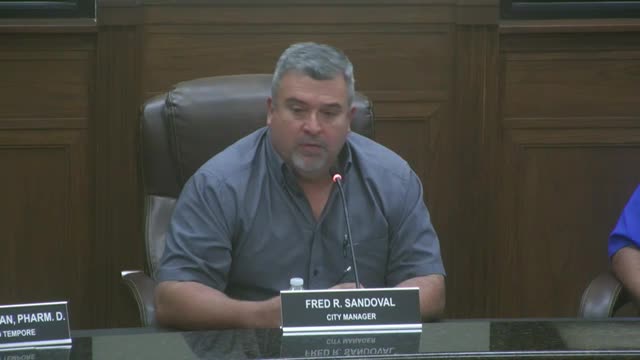
City Manager and plant staff explained that the city’s surface-water sources and reservoirs are shallow and more sensitive to temperature and turnover; those conditions can force bottom-layer water into the supply and produce a “fishy” odor. Staff emphasized they must remain within regulated dosing limits for disinfectant and that over-treatment can be both ineffective and out of compliance.
Finance Director Stephanie Saturn and distribution staff described the city’s customer service process: residents with concerns may file a work order via the utilities customer-service line or email; crews will inspect at the tap, perform targeted flushing and, if needed, sample for laboratory testing. Staff said the city performs daily regulated monitoring at sites across the distribution network and uses outside labs for compliance testing required by the Texas Commission on Environmental Quality (TCEQ). The city also plans to mail a bilingual water-quality report to customers and to publish contact information and FAQs online.
Commissioners asked whether residents can have in-home samples taken; staff said the department can triage complaints, schedule a crew visit and take samples for lab testing if needed. Council members and staff urged residents not to rely on informal “electrolysis” tests posted on social media; staff said such DIY tests can produce misleading results and are not substitutes for regulated laboratory analyses.