Get Full Government Meeting Transcripts, Videos, & Alerts Forever!
Get email alerts on the Consent Agenda topic
No spam. Unsubscribe anytime.
Brazos County commissioners discuss adopting consent agenda to shorten meeting calendars
Summary
At a Oct. 14 workshop, Brazos County officials considered guidelines for a consent agenda to streamline twice-monthly commissioners court meetings; no formal vote was taken and staff will continue drafting procedures.
Brazos County commissioners on Oct. 14 discussed adopting a consent-agenda process meant to shorten and streamline the county's biweekly commissioners court meetings, with staff directed to refine proposed rules but no formal action taken.
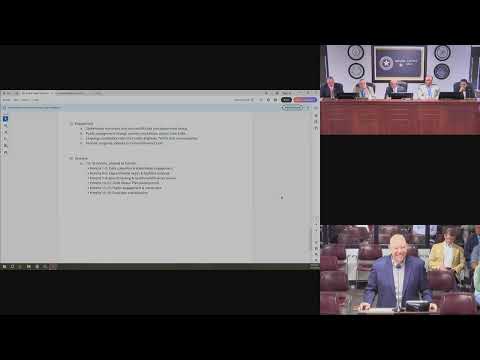
The proposal, presented by Trevor Lansdowne, director of project management, would group routine items such as budget amendments, tax refund applications, payment of claims, policy adoptions, committee appointments and certain contract renewals under a single consent item "to make this whole process more efficient," Lansdowne said.
The item matters because the county is moving to two meetings a month and commissioners said they expect agendas to grow. "As we go to bimonthly, the agendas are gonna grow and this should sort of help us make it make this whole process a little bit more efficient," Lansdowne said.
Commissioners discussed which types of items should remain on the regular agenda. Commissioner Fred Brown said the court should keep contract change orders larger than a threshold on the regular agenda: "the only thing I'd like to see moved to regular agenda items is contract change orders less than a 100,000." Later discussion clarified that previous action authorizes the purchasing agent to execute certain change orders up to preset limits on contracts the purchasing agent executes; change orders on contracts awarded by the court would continue to return to the court for approval.
Commissioner Knowles asked whether other counties use consent agendas; Lansdowne said practices vary and that local cities use the procedure. Commissioners agreed the proposed consent list is a starting point and a working document that can be adjusted. Lansdowne noted the sample agenda would reduce the number of individual items requiring separate votes on a typical meeting from roughly 30 to about 13 under consent.
On public participation, Lansdowne and commissioners said the public would keep the ability to speak on consent items: "there will be a public input portion for the consent agenda item as a whole, and so public will still be able to speak on those items," Lansdowne said. Commissioners also discussed whether a single commissioner should be able to pull an item from consent; participants said the court needs to set a clear procedure (for example, whether pulling requires a motion or can be done by one commissioner) before fully implementing the format.
No formal vote or ordinance was adopted at the workshop. Court members described the proposal as a draft that staff will continue to refine and bring back for further direction.
The court will continue to develop written procedures that specify which items qualify for consent, how an item is removed for discussion, and what thresholds (for example, dollar limits on change orders) apply. Staff also noted that acknowledgements (ceremonial items) and regular presentations such as road-and-bridge or capital-project updates would remain outside the consent agenda so they can be presented in full to the public.
Items discussed but left for future clarification included the precise dollar threshold for change orders to remain on the regular agenda, whether personnel action forms with linked budget changes should be separated from other personnel items, and whether certain memoranda of understanding and interlocal agreements with no financial impact should be handled via consent.