Get Full Government Meeting Transcripts, Videos, & Alerts Forever!
Get email alerts on the Wheel Tax topic
No spam. Unsubscribe anytime.
Evansville council hears public concerns, engineer briefing during first reading of proposed wheel tax
Summary
The Evansville Common Council held a first reading on a proposed municipal wheel tax and heard multiple public commenters oppose the levy, while the city engineer described how recent state law changes restructured road grant funding and made a local wheel tax a condition for access to a larger grant pool.
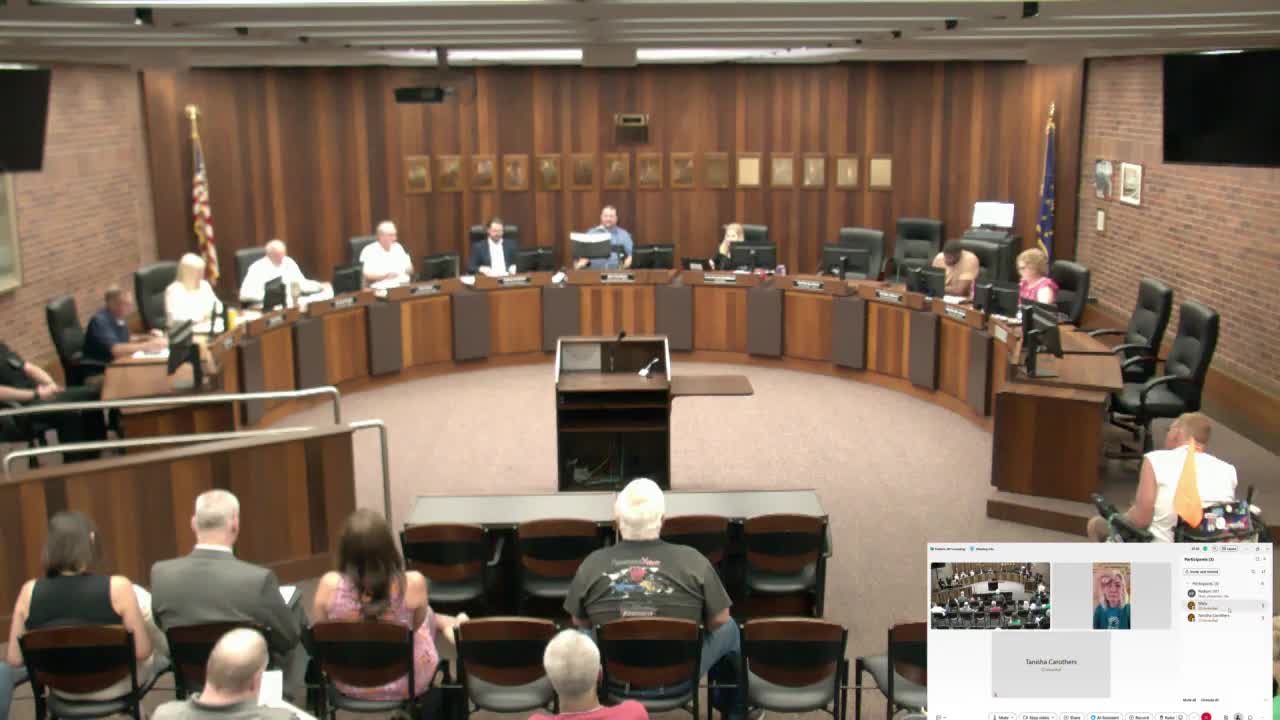
The Evansville Common Council held a first reading Aug. 11 on a proposed municipal wheel tax and spent more than an hour hearing public comment and an engineering briefing about state grant program changes that council members and staff say make the local tax necessary to secure future road funding.
Council President Trotman opened public comment after the council noted that the wheel-tax ordinance would not be voted on that evening and was at first reading, allowing residents to speak before a vote at a subsequent meeting.
The proposed wheel tax has been tied by city officials to two state actions: Senate Bill 1, which council members said has reduced local revenue, and House Bill 1461, which restructured the Community Crossings matching-grant program. "We will lose upward of $15,000,000 over the next three years," President Trotman said as an explanation the administration and finance staff have given for exploring the levy; that figure was cited during council remarks explaining why the tax is under consideration.
Residents raised objections to the tax's fairness and permanence. Michael Tanya of 839 East Powell Avenue told council members he owns multiple vehicles and called the proposal regressive: "This is a regressive tax," he said, adding that some of his vehicles are rarely driven in the city and suggesting exemptions for veterans.
Brent Jarbo of 822 East Powell urged council members to consider conditions that would sunset or trigger repeal of the tax if state funding returns: "If something is triggering this new wheel tax... I would think that there would be something to trigger it to make it go away," he said, warning that new local levies often persist.
Community organizers also linked the wheel-tax debate to utility-billing strains. Christopher Norwood, representing Direct Action Against CenterPoint Energy (DACE), cited recent high electric bills and disconnections and urged the council to consider the combined burden of local and state changes. "This should be a crime to unhook electric in the middle of summer," Norwood said, describing spikes in summer bills and disconnect notices that he said are already harming residents.
City Engineer Mike Lubitsky gave a technical briefing on how the Community Crossings Matching Grant (CCMG) has been restructured by the legislature. He said the program was split into two funding "buckets": the traditional competitive application process, which he said has been cut from roughly $400 million to $100 million, and a second $160 million distribution that will be available only to municipalities that levy a local wheel tax. "That bucket is significant... we would be eligible for almost 1.2% of that money or anywhere from $2 to $3,000,000 in fiscal year 2027," Lubitsky said, referencing Evansville's lane-mile share.
Lubitsky and council members provided additional figures: Evansville receives a share of the existing county wheel tax but House Bill 1461 requires each municipality to have its own levy to access the new distribution; the city has roughly 1,100 lane miles; and the city engineer estimated about $300,000 to pave a mile of road. Council members said the city currently maintains about 551 miles of streets, of which roughly 140 miles are arterials/collectors and about 411 miles are local roads that currently receive little to no resurfacing funding.
Council members acknowledged reluctance about new taxes but framed the choice as protecting existing local services and the city’s ability to compete for road funding. "I don't like more taxes. Nobody likes this," one council member said, while emphasizing that state legislation left local governments with difficult options.
The council took no vote on the wheel tax during the Aug. 11 meeting; members said a vote is scheduled for the next council meeting on Aug. 25. Council staff distributed a packet of supporting numbers to members at the Aug. 11 session.
Ending: The council's next business meeting is Monday, Aug. 25, when the wheel-tax ordinance is expected to return for action. Until then, city staff recommended that residents and council members submit written questions to citycouncil@evansville.in.gov for follow-up.