Get Full Government Meeting Transcripts, Videos, & Alerts Forever!
Get email alerts on the Gaza Humanitarian topic
No spam. Unsubscribe anytime.
UN: Gaza offensive deepens humanitarian crisis; aid deliveries impeded, strikes raise Lebanon concerns
Summary
UN spokesperson Stéphane Dujarric said the offensive in Gaza City is producing mass displacement, shortages of food, water and shelter, and that looting and security constraints continue to block deliveries. He also reported UN peacekeeper concerns after recent strikes in southern Lebanon.
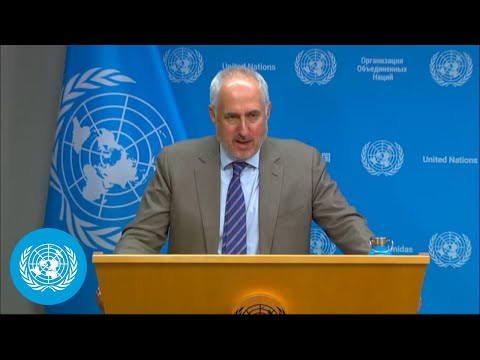
Stéphane Dujarric, Spokesperson for the Secretary-General, said Wednesday that an intensified Israeli offensive in Gaza City and related movements of people are creating a severe humanitarian crisis that is outstripping available aid.
Dujarric said the Office for the Coordination of Humanitarian Affairs (OCHA) has reported “people are arriving deep into the night, many of them walking for long hours without food, without water, and without shelter,” and that displacement into southern Gaza is putting “even more stress on already overstretched services.”
The UN spokesperson warned that key routes are congested or unusable. He said Saladin Road, which Israeli authorities had briefly allowed for movement, is now closed after a 48-hour window expired; Al Rashid coastal road remains extremely congested and is effectively the only passage available for civilians fleeing north. He added that Zikim Crossing, the only direct crossing into the north, “remains closed.”
Dujarric said delivery attempts have been repeatedly impeded: he reported a fuel convoy to Gaza City was aborted after waiting “over 5 hours for approval,” and that the volume of supplies currently entering Gaza is “below the threshold necessary to address people's deepening needs.” He added that humanitarian operations require “safe, rapid, unimpeded access” to reach the most vulnerable.
The UN highlighted security risks to aid convoys and reported criminal interference with relief supplies. Dujarric said UNICEF informed the UN that “yesterday, 4 trucks full of ready to eat therapeutic food were stolen at gunpoint at Gaza City,” supplies that the UN said would have helped “at least 2,700 severely and acutely malnourished children.” He said UNICEF had to cancel a mission to pick up supplies for the third day in a row because of the risk of looting on a route that had been cleared by Israeli authorities.
Turning to cross-border hostilities, Dujarric said UN peacekeepers in southern Lebanon observed what they described as recent Israeli air strikes inside UNIFIL’s area of operations, and called on the Israeli Defense Forces to refrain from further strikes and to withdraw from Lebanese territory. He said the strikes “put the lives of Lebanese soldiers, the peacekeepers themselves, and civilians in danger,” and that peacekeepers found an unguarded weapons cache and unexploded ordnance while assisting Lebanese authorities.
The spokesperson reiterated calls for restraint by all parties and urged that humanitarian relief be allowed to pass through “all available crossings and routes.” He said the Secretary-General “calls on all actors to exercise maximum restraint and avoid actions that could further inflame tensions.”
The General Assembly on Tuesday adopted a resolution to allow the Palestinian president to participate in the general debate and a related international conference via prerecorded video. Dujarric said questions about visa status should be addressed to the Palestinian delegation or the United States; he did not provide further details on the visa question.
Dujarric also noted a recent Security Council vote on a ceasefire was blocked by a veto, and echoed the Secretary-General’s continuing call for a ceasefire, for humanitarian access, and for the release of hostages.
The UN said further operational constraints — damaged roads, congestion on coastal routes, closed crossings, and theft of supplies — are preventing partners from delivering assistance at scale, and warned that without secure, sustained access relief efforts cannot meet rising needs.