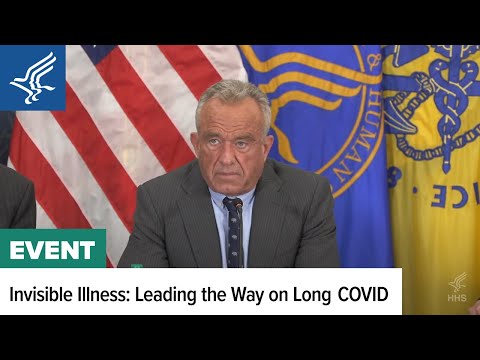
HHS launches long COVID consortium, pledges website, faster trials and private‑sector outreach
Loading...
Summary
Secretary Kennedy convened a roundtable of patients, clinicians and agency officials to hear frontline experiences, direct a CDC-hosted website, and press NIH, FDA and ARPA‑H to accelerate biomarkers, trials and private‑sector partnerships for long COVID research.
Secretary Kennedy convened a long COVID consortium at the U.S. Department of Health and Human Services on Tuesday, launching a coordinated effort that he said will “listen to doctors who are on the frontline” and create a public information platform to connect patients, clinicians and researchers.
The meeting brought patients, clinicians and senior officials from the National Institutes of Health, the Food and Drug Administration, the Centers for Disease Control and Prevention and ARPA‑H together to discuss next steps on diagnostics, clinical trials, data sharing and private‑sector engagement. “Today, we’re launching a long COVID consortium,” Secretary Kennedy said at the start of the session.
Why it matters: Millions of Americans continue to report prolonged symptoms after SARS‑CoV‑2 infection, and participants said the pace of research and the availability of practical clinical guidance have not matched the scale of need. HHS officials and outside clinicians called for faster, pragmatic trials, validated biomarkers and a centralized public resource to help patients find clinicians and track promising treatments.
Most important initiatives and commitments
- Website and public data platform: HHS officials said they will build a public website at CDC to gather patient‑reported information, clinician resources and research data. Jim O’Neil, deputy secretary of HHS and acting director of CDC, said the site is intended to be “a single place where patients and providers and pharma companies can all share information about symptoms and diagnosis and repurpose drugs and treatments.” Zach Terrell, HHS chief technology officer, and Kristen Honey, chief data officer, were named as technical leads.
- Faster, pragmatic trials and partnerships: NIH leaders described a shift toward more practical clinical trials and signaled expansion of the Recovery/TLC program. NIH director Jay Bhattacharya said he does not want to “wait to get the perfect diagnostic test before we start to have real answers for patients,” and described ongoing work to prioritize trials that can move rapidly into the field. ARPA‑H acting director Jason Roos said the agency will develop an investment plan in short order and emphasized ARPA‑H’s role in “high‑risk, high‑impact” projects.
- Private‑sector engagement and regulatory pathways: Several participants urged HHS to convene industry for a pharma roundtable to discuss incentives and regulatory expectations for long COVID therapeutics, including repurposed drugs and new monoclonals. FDA officials said they support efforts to validate biomarkers and to create accelerated review pathways where appropriate.
What clinicians and patients told officials
Patients and clinician‑researchers described a wide range of clinical approaches in use and emphasized that long COVID appears to be heterogeneous. Clinicians on the panel described treating groups of patients who show immune dysregulation, viral persistence, autonomic dysfunction or vascular/venous problems.
- Repurposed drugs and combinations were discussed repeatedly; Dr. Robert Redfield, former CDC director, described using repurposed agents (he cited Miravirac, rapamycin and probenecid) in combination to address cognitive dysfunction in some patients. Dr. Bruce Patterson described a two‑drug combination (miravirac with a statin) his team plans to take into clinical trials and said their data analytics suggested “viral persistence in the absence of replication.”
- Structural and device interventions were raised by clinicians who treat venous problems. Dr. Jordan Vaughn and others described “pelvic vein congestion” in some patients and said interventional procedures such as iliac vein stenting produced symptomatic relief for selected patients.
- Supportive and adjunctive therapies mentioned by patient speakers included hyperbaric oxygen, stem‑cell treatments, monoclonal antibody infusions and peptides; speakers and clinicians emphasized that evidence for many approaches is preliminary and that randomized testing is needed.
Evidence and research priorities cited at the meeting
- Funding and trial pipeline: Participants cited roughly $1.5 billion in NIH funding targeted at long COVID research to date and said much more pragmatic and coordinated trial work is needed. NIH described four Recovery/TLC interventional trials currently under way: low‑dose naltrexone, GLP‑1 agents, stellate ganglion block and baricitinib.
- Biomarkers and diagnostics: Multiple speakers urged development and independent validation of diagnostic biomarkers that can stratify patients (for example, those with persistent viral antigen versus autoantibody‑driven disease). Dr. Bruce Patterson and others said diagnostic stratification is central both to recruiting appropriate clinical trial cohorts and to assessing response to therapy.
- Data access and federation: Several participants, including outside researchers, urged wider access to RECOVER and other federal datasets. HHS staff said they are working on a “real‑world data platform” to make government data more usable while protecting patient privacy.
Limits and next steps
No formal policies or approvals were adopted during the roundtable. HHS officials said the immediate next steps are: to build the CDC‑hosted website and data platform; to finalize ARPA‑H’s short‑term investment plan; and to accelerate NIH’s trial portfolio and processes for faster funding review. Jason Roos (ARPA‑H) said planning would move on a timeline of weeks rather than months. Participants urged a public‑private pharma roundtable and more rapid biomarker validation through FDA engagement.
Voices from the meeting
- “We’re launching a long COVID consortium,” Secretary Kennedy said when opening the session. - “Long COVID is real. It’s been underestimated and overestimated,” Marty McCary, FDA commissioner, told the group. - “I don’t wanna wait to know everything about the physiology… I don’t wanna wait to be able to get the perfect diagnostic test, before we start to have… real answers for patients,” Jay Bhattacharya, NIH director, said. - “We discovered a new mechanism… that there can be viral persistence in the absence of replication,” Dr. Bruce Patterson said of his team’s analytics and clinical experience.
The meeting highlighted broad agreement among agency leaders, patient advocates and clinician‑researchers that faster, coordinated work is needed. Officials committed to concrete next steps — a CDC website and data platform, a rapid ARPA‑H planning effort and an expanded NIH trial portfolio — while continuing to emphasize the need to validate biomarkers and to engage industry and academics in randomized trials.