Get Full Government Meeting Transcripts, Videos, & Alerts Forever!
Get email alerts on the Airport topic
No spam. Unsubscribe anytime.
Naples Airport presents FY2026 budget, plans new landing fees and airfield work
Summary
Naples Airport Authority officials showed a user-funded FY2026 operating and capital plan emphasizing airfield lighting repairs, reserves drawn down for capital, and exploring landing fees after uncertain grant funding. Staff said no new hangars or growth in flight activity are planned for FY2026.
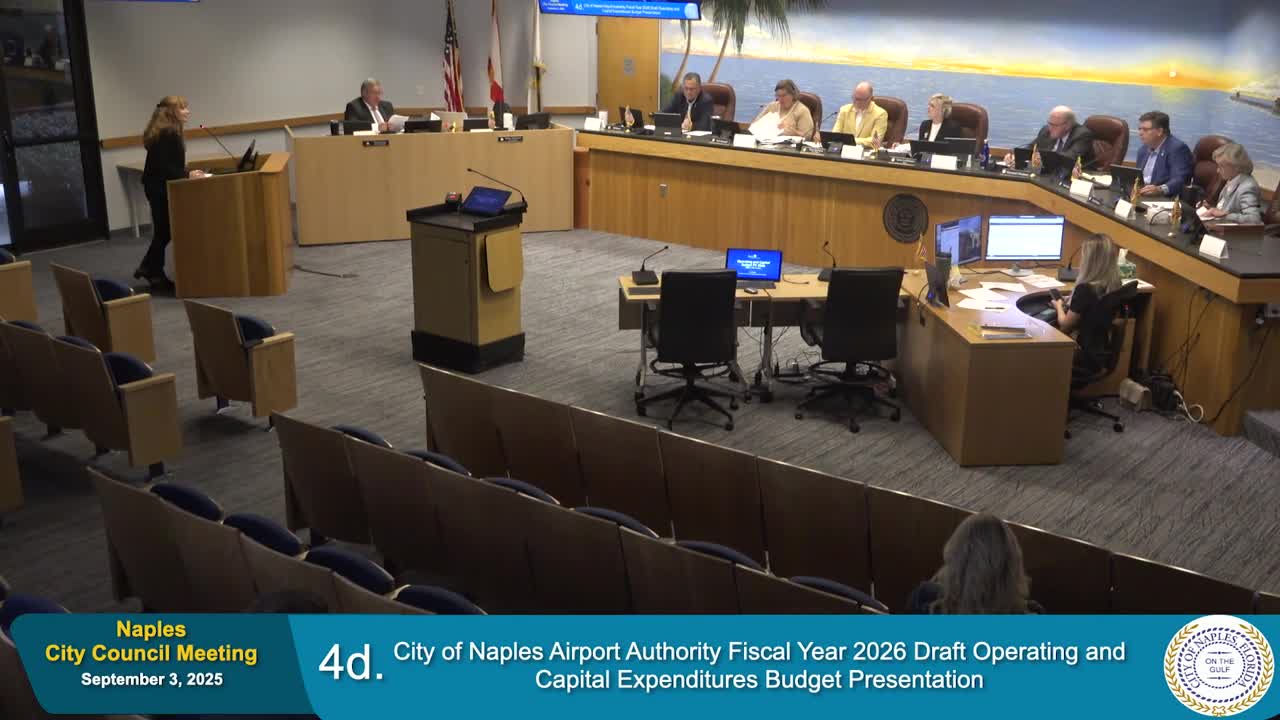
The Naples Airport Authority presented its fiscal 2026 operating and capital plan to the City Council on Sept. 3, showing the airport will remain user-funded while drawing down reserves to pay for major airfield work and preparing to introduce a landing-fee program if expected grants do not materialize.
The airport projected operating revenues of about $3.7 million and $11.8 million in nonoperating receipts for FY2026, including roughly $9 million in insurance proceeds related to airfield lighting and vault damage from Hurricane Ian, Lynn Wiggins, assistant director of finance and administration at the Naples Airport, said. The authority expects roughly $45 million in capital needs next year, with about $28.3 million — roughly 63% — earmarked for airfield work.
"The bulk of our spend is going to be on the airfield," Wiggins told council members. She said the airport is preparing a new landing-fee program to offset possible gaps in grant funding and that no new development projects are included in the FY2026 budget.
Why it matters: The airport handles a substantial volume of operations by private and business aviation and most capital work is eligible for state or Federal Aviation Administration grants. With grants uncertain, the airport is considering new fees to preserve runway, lighting and vault systems and to fund resilience work.
Major details
- Reserves: The airport expects unrestricted cash and investments of about $67 million at Sept. 30, 2025; reserves are projected to drop to about $40.4 million by the end of FY2026. Staff proposed retaining roughly $17 million in operating reserves (about six months of operating liquidity) and carrying forward an estimated $23.4 million in excess reserves for future capital projects. Wiggins said operating reserves are held in short-term, liquid instruments.
- Airfield lighting and vault: The budget lists a large project to replace airfield lighting and construct a new vault. Wiggins and airport staff said that project is a leading driver of next year’s capital needs and is a resilience priority following hurricane damage in recent years.
- Grants and contingency: Wiggins told council that the airport historically receives $2–3 million in aviation grants per year but that FY2026 grant awards are uncertain. The authority asked the council and public to expect the airport to pursue a landing-fee program to close potential gaps if grant funding is not available.
- No new hangars or added flight activity: Wiggins confirmed the FY2026 budget does not include new hangar construction or redevelopment to increase hangar capacity; interior repairs such as skylights and lighting are included for several executive hangars. She characterized the airport’s near-term work as maintenance and resilience rather than expansion of flight capacity.
- Sustainable aviation fuel: Airport staff said the fuel farm project includes equipment and segregation to continue supplying sustainable aviation fuel (SAF), which currently represents an estimated 20% of jet fuel sales at Naples Airport and was cited as an innovation the airport supports.
Council discussion and next steps
Council members asked detailed questions about the budget and longer-term plans for the airport, including whether luxury developments near the airport were modeled in revenue assumptions, how parking and hangar sales proceeds would be applied, and whether the airport’s strategic plan will be updated to reflect community goals such as noise mitigation.
Airport Executive Director Chris Rozanski said the authority has been updating a strategic plan and that a final iteration will go to the airport board in September. Rozanski and Wiggins said the airport will continue to coordinate with the city, particularly on resiliency and noise-mitigation efforts, and that they plan to return with future budget updates and results from engineering and stormwater monitoring projects.
What council asked staff to do: council members pressed the airport to return with additional details about runway and lighting project timing, proposed landing-fee structure and how possible new revenue would be applied; staff agreed to bring follow-up briefings as projects and funding plans develop.
Ending
Wiggins and Rozanski closed the presentation emphasizing the airport’s user-funded model and the authority’s intent to preserve runway safety, airfield resilience and fiscal stability while watching grant availability. Council members thanked staff and airport leaders for the detailed budget briefing and asked staff to return with updates as projects and funding options evolve.