Get Full Government Meeting Transcripts, Videos, & Alerts Forever!
Get email alerts on the Tax Increment Financing topic
No spam. Unsubscribe anytime.
San Antonio staff brief council on city-initiated Tax Increment Financing zones and housing outcomes
Summary
City staff reviewed nine city-initiated Tax Increment Financing (TIF) zones, project timelines and projected funds — about $45 million available in 2025 — and answered council questions about affordable housing, board representation and use of TIF proceeds.
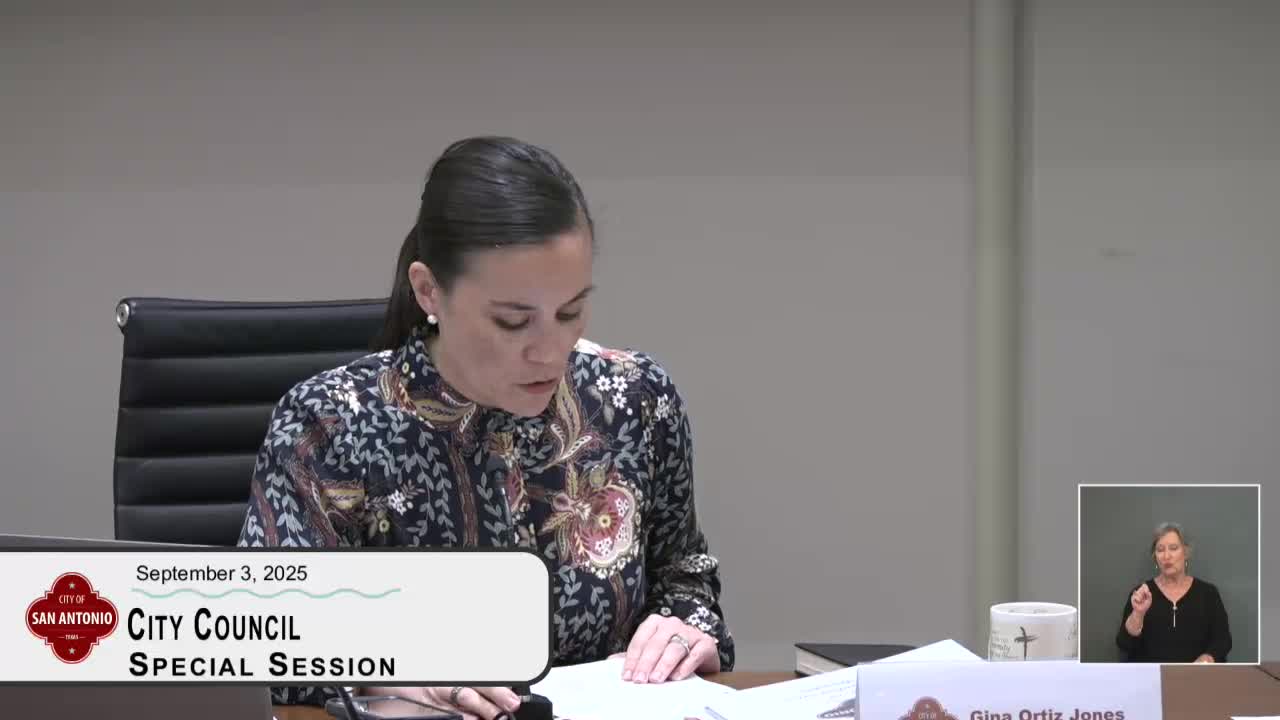
San Antonio city staff presented an overview of the city’s Tax Increment Financing program and nine city-initiated TIF zones to a council committee on Sept. 3, 2025, outlining projects, projected revenue and how the program is intended to support housing and public infrastructure.
The presentation, given primarily in Spanish by city finance staff, described TIF as a tool authorized under Chapter 311 of the Texas Tax Code that freezes a property value base for a zone, captures the incremental property-tax growth from subsequent development and directs that increment to projects in the same zone. Troya Lane, a city finance official, summarized scope and eligible costs: “Esta es una herramienta financiera pública que se puede utilizar para promover el desarrollo económico en un área específica bajo el capítulo 311,” and noted eligible uses include acquisition, public improvements, demolition, professional financial services and studies.
City staff said the total annual contribution available for TIF purposes in 2025 would be about $45 million, with roughly $37 million dedicated to city-initiated TIF zones and about $8 million earmarked for other development-related activities. Staff described that some existing zones — such as Houston Street, Midtown and Brooks — were created years ago, with bases frozen at their establishment and extensions applied in some cases. The Houston Street TIF was noted as created in 1999 and recently extended; several slide notes in the presentation indicated some TIFs have expiration dates in the 2030s–2060 timeframe.
Why it matters: council members pressed staff on how TIF funds translate to affordable housing units and other community benefits, how boards that oversee TIF projects are composed, and when projects return funds to the city general fund after a TIF expires. Several councilmembers said they want stronger representation of district councilmembers on TIF boards and clearer commitments to affordable housing when projects come before the city.
Details from the presentation
- Program mechanics: Staff said a TIF “freezes” a zone’s base appraised value and captures the increase in property value resulting from investment; the increment is used to reimburse approved project costs. Staff cited Chapter 311 of the Texas Tax Code as the enabling statute and a city TIF policy adopted in 2015 and revised in December 2022 that guides project selection and priorities.
- Funding picture: For fiscal 2025 staff presented an approximate total TIF contribution of $45 million. According to staff slides, the city portion of that for city-initiated TIFs is roughly $37 million; $8 million was noted as dedicated for other development uses (staff referred to this second figure in the presentation). Staff characterized the $45 million as roughly 5% of the city’s tax increment allocation that otherwise would go to the general fund for debt service and other uses.
- Project examples and unit counts: Staff reviewed individual zones and selected projects, citing unit counts and timelines included on slides. Examples mentioned in the presentation included: - Rosillo Creek: described as the largest proposed development, with 5,239 single-family units, roughly 67 acres of multifamily, 50–120 acres for commercial uses and 420 acres for industrial uses; the developer is expected to donate 50 acres to the San Antonio housing trust for future affordable housing. Staff said Rosillo Creek could begin in 2028. - Multiple neighborhoods and infill projects: staff reviewed Mission Drive, Midtown, Brooks, Summer (Verano) TIF, Houston Street, North Corridor/Texas A&M–San Antonio area, and others. Several completed and near-complete projects were cited: Stablewood Farms, Mission Creek and Heather School projects finished recently; others remain in active development. - A number of city-initiated projects were described as yielding both for-sale and rental units. Staff said some projects include a portion of homes priced for low- and moderate-income households; for example, one slide indicated nearly half of a project’s homes were expected to be priced under $200,000.
Council questions and concerns
Councilmembers raised multiple questions about transparency, board composition, affordable housing guarantees and use of TIF proceeds outside zone boundaries. Several councilmembers asked how many affordable units have been produced by completed TIF projects; staff replied that four TIFs had closed in the last two to three years and that collective returns to the general fund from those closures were approximately $1.0–$1.2 million (staff characterized this number as an approximate, based on slides). Councilmembers asked for more detailed breakdowns of how many of the units produced are deed-restricted affordable housing and what share of each project’s increment is committed to affordability.
Board composition and council representation: multiple councilmembers said they want clearer processes to ensure district representation on TIF boards and to know whether a change in ordinance is required to mandate councilmember seats. Staff response indicated boards can include elected officials and county or city staff in seats authorized by the TIF governing documents; staff said the council can appoint or require councilmember representation through council action, and that some changes would require an ordinance amendment.
Use of proceeds and interjurisdictional participation: staff explained that county participation in a zone affects how a county’s increment is used (county increment is available only for county projects), and that some zones include participation by Bexar County and other taxing entities. Councilmembers asked about using TIF proceeds for public infrastructure vs. drawing on the general fund; staff said priorities and approvals are set by council and the respective TIF boards after staff analysis.
Next steps and staff commitments
Staff said they will return to the council with more detailed financing plans for individual zones and updated project screens where slides flagged items that need revision before coming back to council. Councilmembers asked for follow-up materials quantifying affordable-unit counts by project, the share of increment committed to affordability, and clarification on which projects are developer-initiated versus city-initiated.
Quotes
Troya Lane, city finance official: “Esta es una herramienta financiera pública que se puede utilizar para promover el desarrollo económico en un área específica bajo el capítulo 311.”
A councilmember: “We need clearer representation on these boards and stronger commitments to affordable housing,” (remarks during committee discussion).
Ending
City staff closed the committee briefing saying a number of the slides and zone screens would be updated and returned to the council for further review. Committee members requested additional documentation on unit-by-unit affordability, board membership rules and the timing of funds returning to the general fund when TIFs expire. The meeting adjourned at the end of the Sept. 3 session.