Get Full Government Meeting Transcripts, Videos, & Alerts Forever!
Get email alerts on the School Vaccinations topic
No spam. Unsubscribe anytime.
Austin Public Health expands summer immunization pilot with Austin Voices and AISD to boost school vaccine compliance
Summary
Austin Public Health and partners turned a summer pilot with Austin Voices for Education and Austin ISD into an ongoing program after a series of off-hour clinics that brought more than 100 students up to date on required school vaccines and doubled expected mobile-clinic capacity.
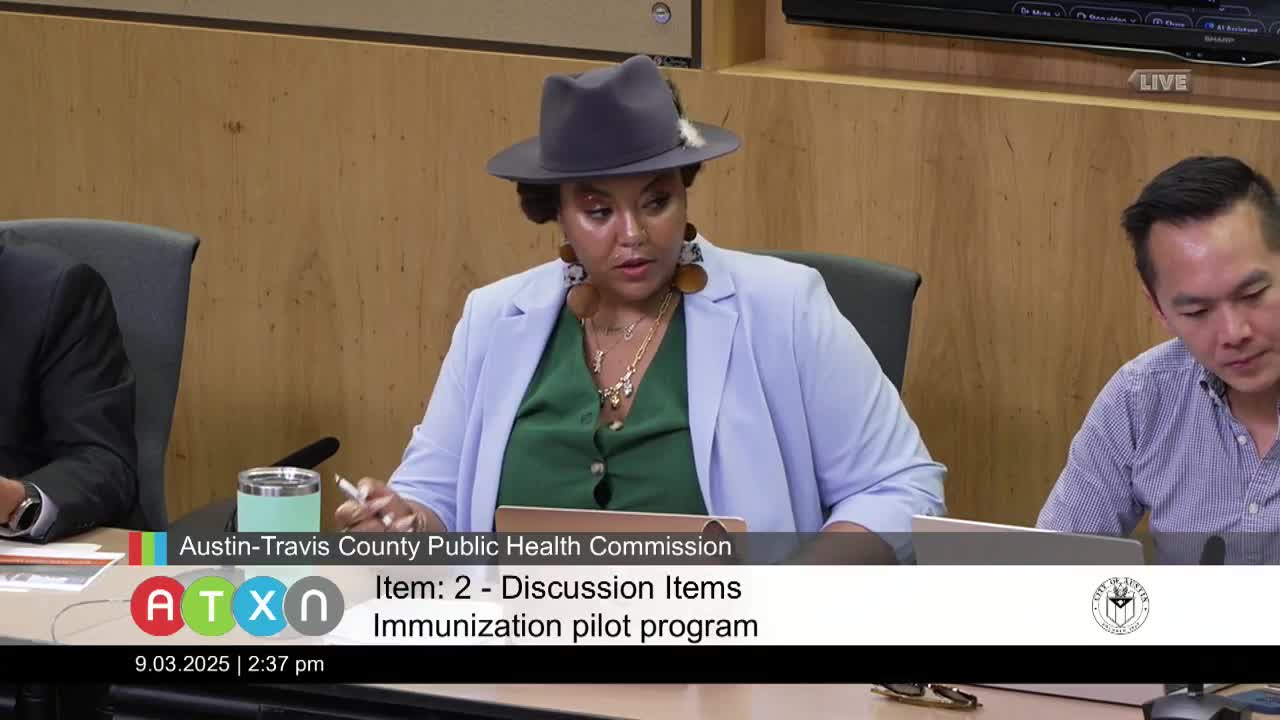
Austin Travis County Public Health Commissioners heard an update on a summer immunization pilot that Austin Public Health (APH) ran with Austin Voices for Education (AV) and the Austin Independent School District (AISD), and learned the agency will expand the pilot into an ongoing program.
The pilot used promotoras from AV to pre-register students flagged by AISD as delinquent on required school vaccinations and complete paperwork ahead of clinics at APH's St. John’s Shots for Tots site. ‘‘Any vaccine that's available and recommended, we offer and provide,’’ the presenter said, describing how APH offered recommended childhood and adolescent vaccines at the clinics.
The commission was told the model reduced on-site paperwork, improved family navigation and language access, and allowed APH to schedule off-hour clinics (Wednesday evenings and Saturday mornings) targeted at working families. The pilot used AV staff and promotoras to screen students in several AISD Family Resource Center schools, complete intake and documentation, and escort families at clinic check-in so nurses could vaccinate more efficiently.
Why it matters: APH said the pre-registration and paperwork work done by partner promotoras reduced no-shows and front‑end time burdens for clinic staff, enabling APH to increase throughput on both fixed-site and mobile clinics. The department plans to apply the same intake model to its mobile vaccination program to nearly double the number of patients served per mobile event.
Key details presented to commissioners: - Scope: APH scheduled a series of six off-hour clinics but completed five during June–July; clinics were held at the St. John’s Shots for Tots site and targeted AISD schools where AV has Family Resource Centers. - Participation and outputs: APH reported 122 planned appointments, 186 appointment offers, and 104 students identified as brought up to date on required vaccines; staff administered a total of 266 vaccine doses at the clinics and served an additional 19 siblings who accompanied targeted students. The clinics reached students from 15 schools and nine ZIP codes, with the largest shares coming from ZIP codes 78753 and 78758 (29 clients each). Age distribution reported: about 74% age 10 or younger, roughly 10% age 11–13, and 16% age 14–18. - Records and data workflow: AV’s promotoras collected students’ Texas school health records and completed intake paperwork before clinic days so APH staff could verify records in the immunization registry and create or update electronic health records ahead of vaccination.
Programmatic outcome and next steps: APH said the pilot demonstrated ‘‘anecdotal benefit’’ to partners and the community and will be continued as an official program. The department reported the intake partnership will allow mobile clinics to increase capacity from roughly 20 to between 30 and 40 patients per event with pre-registration support from partner organizations. APH indicated clinics are scheduled for October and November and staff are exploring applying the same screening/registration model to adult safety-net community vaccination clinics.
Caveats and data notes: Commissioners were shown race and ethnicity tables during the presentation; the presenter also flagged an internal inconsistency in school reporting, noting some students AISD flagged as noncompliant were up to date when APH reviewed records. APH said it will follow up with AISD to improve the accuracy of delinquency lists. The presentation noted APH’s team will perform more detailed statistical analysis when updated AISD coverage data for 2024–25 are released.
Commissioner response: Commissioners asked about funding sustainability and whether the model could be expanded to seasonal respiratory vaccinations. The presenter replied the model’s value is that it reallocates front‑end paperwork to partners and therefore increases throughput without requiring proportionally more APH staffing; APH also said flu, COVID and other recommended vaccines will be offered at these clinics as supplies and schedules permit.
The commission did not take a formal vote on the program at the meeting; APH said it will return with updated analysis when AISD releases final coverage data.