Get Full Government Meeting Transcripts, Videos, & Alerts Forever!
Get email alerts on the Homelessness Services topic
No spam. Unsubscribe anytime.
Council seeks revised RFP for homelessness grant after application problems; staff to reissue with clarifications
Summary
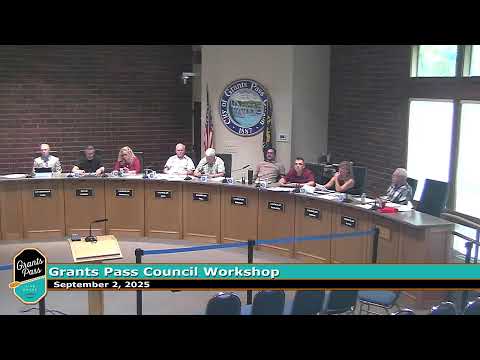
After one applicant withdrew and staff identified verification and process problems, Grants Pass staff proposed canceling the current homelessness grant RFP and reissuing a clarified solicitation; council directed staff to prepare a cleaned, redlined draft for council review and to accept written council comments before the next meeting.
City staff recommended that the Grants Pass City Council cancel the current RFP for a homelessness grant and reissue a revised solicitation after the application process produced inconsistencies and lobbying activity the city deemed problematic.
Stephanie (staff) told the council that an applicant withdrew, saying key partnership commitments had not been verified before submission. Staff also described a process that had become contentious with lobbying and applicants lacking required experience or documentation. Based on that experience, Stephanie recommended canceling the current RFP and reissuing a revised document that sets clearer and firmer requirements.
Key proposed changes staff described include: requiring a preliminary site plan with a visual site layout showing sleeping areas, communal areas and amenities; documented landowner intent or proof of site control if the applicant does not already own a parcel; clearer requirements on meeting applicable codes and ADA compliance (including an explanation of how approvals and variances will be obtained); requiring three references (ideally including a local government entity and a partner service provider); adding disqualifying criteria (for example, proposals that demonstrably cannot meet code or applicants who engage in improper communications or attempts to influence the process); making proposals open for public inspection once distributed to council; and adding an applicant cover sheet with a signed oath attesting to the truthfulness of application materials.
Stephanie also suggested shifting scoring to give more weight to site/location and operational readiness (including budget for staffing and programming), requiring a timeline that shows when the site would accept clients and reach the target capacity (the program’s stated target is to provide 150 shelter spaces and be operational within specified months), and conducting applicant interviews in a public workshop so council can question applicants directly. She recommended setting a firm maximum award amount in the solicitation rather than a flexible “up to” number.
Council discussed options: proceed with the current process; cancel and reissue a new RFP with clarified language; or pause for further discussion about alternative approaches (including whether to pursue direct contracting or city-owned property). Several councilors said they wanted time to review changes. The council directed staff to prepare a clean, revised RFP and circulate it to council the next morning; staff offered to provide printed copies by 10 a.m. and asked council members to return comments by 4 p.m. so staff could assemble a final draft for council consideration, which the council planned to discuss at the next meeting.
Stephanie said the draft revisions also explicitly address improper communications (applicants contacting decision makers outside established channels or lobbying), and require staff review of site/code viability so council would have staff assessments prior to scoring. She said reference checks could also be standardized as part of the review.
Quoted: “There is a point at which we do say no,” staff said when describing contractor and supplier price risks; on the RFP changes she said applicants should expect that “this information will be public once those proposals are opened.”
Next steps: staff will prepare a redlined and clean version of the revised RFP, distribute it to council (electronic and printed copies) and accept council comments on a short timeline so the council can revisit the item at the next scheduled meeting. Staff also indicated they could consider alternatives to an RFP if the council later prefers them, but staff recommended reissuing a clarified solicitation to ensure a fair, public process.