Get Full Government Meeting Transcripts, Videos, & Alerts Forever!
Get email alerts on the Transportation Infrastructure topic
No spam. Unsubscribe anytime.
Council gives direction to pursue moving Booth railroad crossing to Dimock
Summary
Grants Pass staff briefed council on feasibility of shifting the Booth Street railroad crossing to Dimock Street to improve arterial connectivity and safety; council reached consensus to proceed with design work with the railroad and city engineers and to develop funding plans.
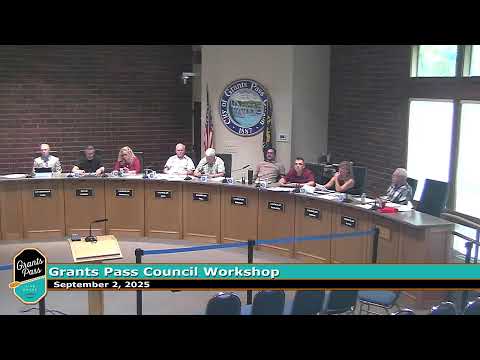
City public works staff presented a multi-year transportation project on Sept. 2 that would relocate the Booth Street railroad crossing and extend Dimock Street to a new crossing near Oak Street, a move staff said would improve north–south arterial connectivity and address a high-accident intersection.
Wade Elliott, assistant public works director, described the crossing’s poor condition, pedestrian-safety concerns and the offset intersection geometry at Booth and G that contributes to crashes. He said the city’s Transportation System Plan (TSP) lists the Dimock extension and crossing as a fiscally constrained Tier 1 project and that the railroad has recently agreed to negotiate a one-for-one swap—an opportunity city staff had sought for years.
Elliott said the railroad’s design-engineering estimate is roughly $85,000; the city currently has a capital project (TR6247) with about $300,000 budgeted that could cover railroad design, survey and some city engineering work. He estimated construction at about $1 million (final cost to be developed with detailed design) and said likely funding sources are gas tax dollars and transportation system development charges (SDCs). He also noted a possible Metropolitan Planning Organization allocation of about $600,000 could help close any remaining gap.
After discussion about priorities and opportunity cost, councilors voted by voice roll call and reached a consensus to move forward with the project and authorize staff to proceed with railroad design contracts and the city’s design work. The recorded responses were: Indra — No; Rick — Yes; Kathleen — Yes; Eric — Yes; Seth — Yes; Rob — Yes; Joel — Yes; Victoria — Yes. Councilors emphasized the chance to capitalize on the railroad’s willingness to cooperate after years of unsuccessful outreach.
Next steps described by staff include negotiating a design contract with the railroad’s engineer, concurrent in-house design for the city portions (Thornton Engineering is noted as the in-house engineer), right-of-way work if needed, and eventual contractor procurement for construction. Staff indicated the bulk of construction funding would be programmed in future budget cycles; the current capital line has initial design funds.
Quoted: “I finally got a hold of the right person at the railroad that is willing to let us move the intersection or the crossing,” said Wade Elliott, assistant public works director.