Get Full Government Meeting Transcripts, Videos, & Alerts Forever!
Get email alerts on the Utilities Water Rates topic
No spam. Unsubscribe anytime.
Grants Pass staff outline rate options after FEMA BRIC grant loss for treatment plant
Summary
City staff presented three water rate scenarios to finance completion of the replacement water treatment plant after the city lost an anticipated FEMA BRIC grant; councilors asked for business impact analysis and more timeline detail before a vote scheduled for Sept. 3.
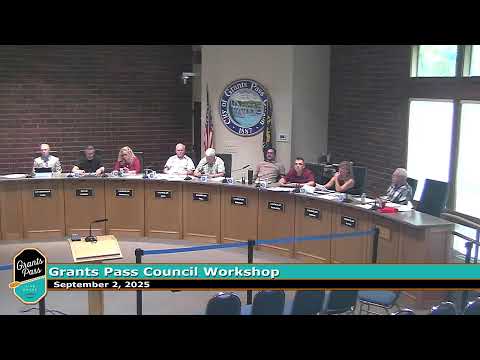
City staff told the Grants Pass City Council on Sept. 2 that the city must adopt new water rates before January if it wants to issue bonds in mid-2026 to complete and commission the city’s replacement water treatment plant.
Jason (staff) said the city previously approved a guaranteed maximum price (GMP) and a tentative financing plan for the treatment plant, but the FEMA Building Resilient Infrastructure and Communities (BRIC) grant that the city expected was canceled. That loss increases the borrowing the city must incur and the amount of revenue it must demonstrate to bond markets.
“The issue is the coverage ratio — the difference between the money we have coming in and the money we have going out — and we need to be at least at a 1.25 for us to be able to get the bonds to complete the project,” Jason said during his presentation.
Staff presented three rate scenarios developed with consultants: two options that raise the treatment plant replacement fee (from the current $13.50 per single-family equivalent toward $16) combined with various annual rate increases and an option that spreads increases across all rates without raising the urban renewal agency (URA) contribution. Staff showed projected effects through 2029: under one scenario the water portion of a residential bill would rise from $47.45 to $54.26 by 2029 (about $6.81 per month); the other scenarios showed roughly $7.01 and $7.54 per month differences over the same period, depending on URA participation and compounding.
Staff also reviewed URA funding; the adopted URA budget currently contributes about $438,000 per year toward the plant and the URA plan contemplated a potential contribution up to roughly $17,970,000 tied to the project’s debt plan. Jason said current URA reserves exceed $2.6 million but any increased URA contribution would reduce funds available for other projects.
Councilors asked several follow-ups: whether the city can still seek federal grants (staff said smaller grants such as an EPA hazard mitigation award have been explored but are unlikely to replace BRIC and federal grants are often barred if construction begins before award), what happens if suppliers keep raising prices (staff said most primary suppliers are now under contract but contract terms allow tariff pass-through in some cases), and how the scenarios would affect commercial customers (staff will run comparable business-impact numbers for the council packet). Several councilors also asked staff to model longer windows for increases and the long-term differences caused by compounding.
The council did not adopt rates at the session; staff placed a resolution for council consideration at the next meeting (listed by staff for Sept. 3) and councilors directed staff to include business-impact charts and longer-term modeling in the packet for the adoption vote.
Clarifying figures discussed in the presentation include the current treatment plant replacement fee ($13.50 per single-family equivalent), the proposal to raise that fee toward $16 under two scenarios, a projected residential water portion growing from $47.45 to $54.26 by 2029 under one scenario, and the URA’s current $438,000 annual contribution and plan-level potential of about $17,970,000 against a $56,000,000 identified debt.
Next steps: staff will provide the council with detailed business-impact spreadsheets, options that stretch increases over more years, and the financing resolution for the council’s upcoming meeting. The council did not vote on a rate change during this session.
Quoted: “We can make our debt service payments today with the rate structure as it is. What we cannot do is cover the coverage ratio,” Jason said, describing the need to meet bond coverage thresholds.