Get Full Government Meeting Transcripts, Videos, & Alerts Forever!
Get email alerts on the Zoning Industrial topic
No spam. Unsubscribe anytime.
Joint session OKs amendment to allow railcar repair as permitted light‑industrial use
Summary
Clay County and Vermillion approved a second‑reading ordinance adding railcar repair and light maintenance to permitted uses in a light‑industrial district after public testimony on noise, water containment and operating hours.
Clay County commissioners and Vermillion city councilors voted to approve on second reading an amendment to the light‑industrial zoning code that adds railcar repair and related maintenance as a permitted use in specified light‑industrial areas.
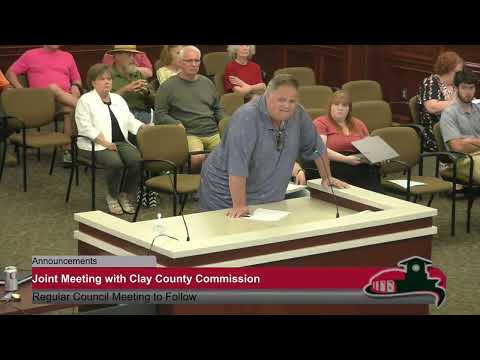
The change, carried as ordinance 15‑33 during the meeting’s joint jurisdiction segment, was framed by an applicant’s presentation about operations, followed by questions from elected officials and several nearby residents who said they were worried about noise, hours and water runoff.
The applicant described the proposed operations as primarily inspection and light repair of railcars that would use a low‑profile “tugger” to move cars on site. “It’s quiet — the tugger is more quiet than a lawnmower,” the applicant said, citing measurements and an informational sheet provided to the councils. He told officials the loudest, on‑site noise would reach about 80–85 decibels at the machine and that such exposure levels would require hearing protection for workers on site but would attenuate with distance and tree cover from adjacent properties.
Residents asked for limits and clarifications. “My concern is the noise level,” said Sue Christiansen, who said she lives immediately next door to the proposed property. She noted the proposed allowed hours of operation, 6 a.m. to 9 p.m., and asked whether the town was approving a commercial‑grade or consumer‑grade noise profile. Patrick Roach, a neighbor, asked about pneumatic wrenches and whether high‑noise tasks could be restricted to daytime hours. The applicant replied that such work is intermittent, that the 85‑decibel figure reflects a maximum when cars are being moved, and that standard hours of operation at similar sites are about 6:30 a.m. to 5 p.m. but that occasional overtime may occur.
On stormwater and cleaning operations, the applicant said most cleaning uses water or air only; any dirty water would be collected in an on‑site containment system and shipped off‑site by a licensed third party for disposal. “They put it under [a] containment system and then have it shipped off,” the applicant said when describing how wash water would be handled.
Jim Peterson of the Vermillion Chamber and Development Company and a company representative said the operation would likely handle mostly grain cars, with an expected weekly drop‑off of 15–25 cars for inspection and repair and create family‑wage jobs. Cole Crosby, identifying himself as a company representative, said the company operates similar facilities in Minnesota and North Dakota near residences without recorded problems and reiterated that the proposed tugger is quieter than locomotives often used elsewhere.
City and county staff told the governing bodies they had published required notices and that planning and zoning review had taken place; the county confirmed there were no changes from earlier meetings. After the public comment period and council discussion, both governing bodies conducted a roll‑call vote and the motion to adopt the ordinance on second reading passed.
Officials said standards in the zoning text will require containment of wash water to the site and set the stated allowable hours but will not set a company‑specific work schedule; actual business hours would be set by any operator.
Copies of the applicant’s noise measurements, a description of the tugger, and a statement about on‑site containment were submitted for the public record and discussed at the meeting. The councils advanced the ordinance on a roll‑call vote that concluded, “Motion passes,” and the ordinance will be reflected in the jurisdictional zoning code going forward.