Get Full Government Meeting Transcripts, Videos, & Alerts Forever!
Get email alerts on the General Plan 2045 Climate topic
No spam. Unsubscribe anytime.
Hundreds testify for and against Bill 66 as Hawaii County council begins deliberation on General Plan 2045
Summary
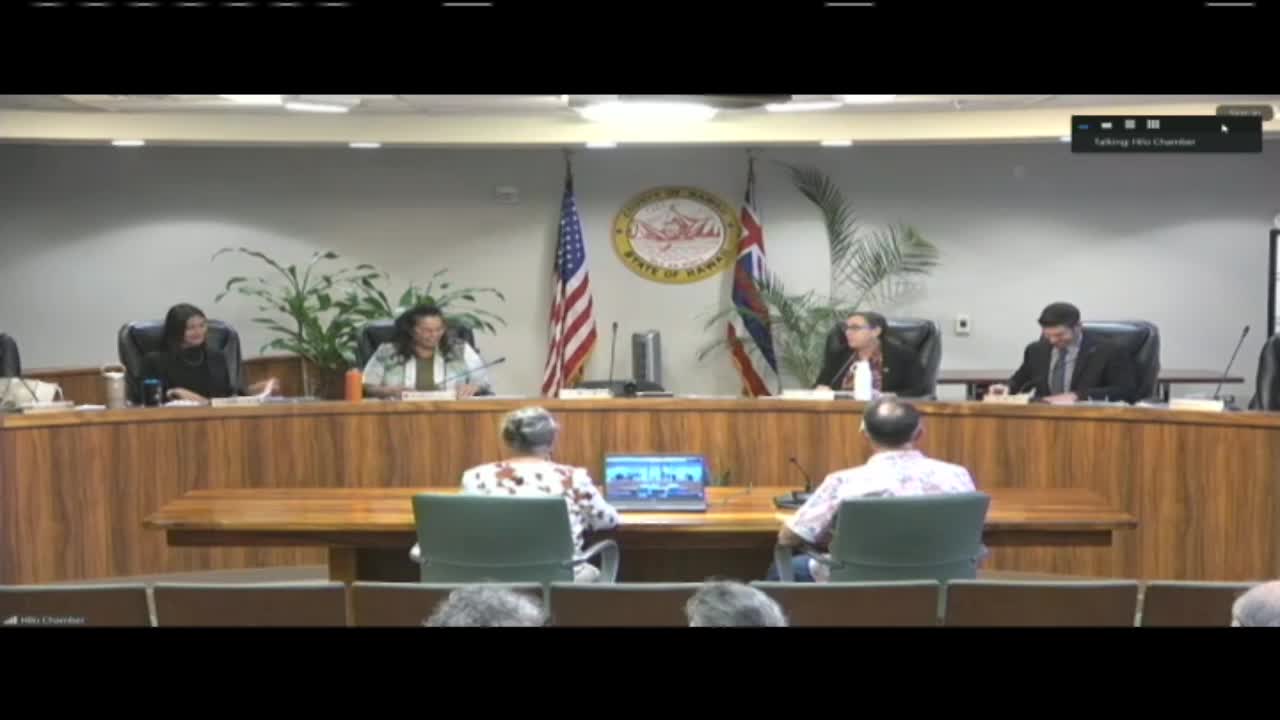
Dozens of residents and community leaders provided testimony Aug. 20 before the Hawaii County Council Policy Committee on Planning, Land Use and Economic Development as the committee opened deliberations on Bill 66 (Draft 2), the proposed General Plan 2045.
Dozens of residents and community leaders provided testimony Aug. 20 before the Hawaii County Council Policy Committee on Planning, Land Use and Economic Development as the committee opened deliberations on Bill 66 (Draft 2), the proposed General Plan 2045. The hearing, held at the West Hawaii Civic Center with simultaneous video in Hilo and Kona, drew sustained public comment on Chapter 3 (climate change) and on proposed land‑use designations such as changing agricultural lands to “natural.”
The topic matters because the county’s general plan guides long‑range land use, infrastructure priorities and policy direction for future county decisions. Supporters told the committee the draft integrates climate mitigation and adaptation and protects public health; opponents urged additional public outreach, questioned scientific foundations of the chapter on climate, and raised concerns about process and potential effects on farmers and private property rights.
Shelly Ogata, a public health professional, urged the committee to back Bill 66 and the chapter on climate, saying the plan “proposes reasonable land use regulations designed to protect life sustaining resources and consider the compounding effects of social and ecological determinants of health.” Doug Adams, a Hilo resident, told the committee he supported Chair Dennis Inaba’s motion to pass Bill 66 as amended and highlighted the draft’s linkage to the county’s Integrated Climate Action Plan and the need for monitoring and evaluation of actions.
Other speakers called for more community outreach and clarity on how the plan would be used. Skye Narvaez of Hilo asked the committee to “continue to hold another round of in‑person community outreach events across all districts,” citing difficulty navigating the online draft. Josephine Calipio of Kailua‑Kona told the committee that 12,000–13,000 people participated in prior outreach and contrasted that with a county population figure she cited (208,000), saying broader participation is needed before approving the plan.
A number of testifiers raised objections rooted in disputed scientific claims or concerns about geoengineering. Several speakers referenced historical weather‑modification programs and alleged ongoing geoengineering activities; Kenneth Honma called for the council to treat geoengineering as a primary item of investigation. Other opponents, including multiple public commenters, urged removal of the word “natural” from maps that reclassify certain important agricultural lands, asserting that the change could restrict farming operations, increase permitting burdens, or change tax assessments for affected properties.
Several speakers linked the general plan to larger political or economic concerns. Testimony included claims that global finance interests and international agendas were driving the plan; some speakers named entities such as the World Economic Forum and private investment firms while urging the council to preserve local control. Other public comments pressed for concrete local resilience measures—more support for local food production, investments in local irrigation and water infrastructure, and policies that explicitly protect cultural sites and Native Hawaiian practices.
Council Member Ashley Kirkowitz, chair of the committee, responded to process questions during the meeting. Kirkowitz said the draft plan is not final and that council deliberations remain ongoing. She also described two county communications the council will use to organize materials and testimony (communications labeled in the record as 3‑26 for schedules/meetings and 3‑72 for submitted testimony) and described a 176‑page crosswalk she and staff prepared to compare goals, policies and actions across older plans and the 2045 draft to aid deliberations. “The draft 2045 plan is not in full force,” Kirkowitz said; she said the council will continue review and will schedule a planning department presentation and discussion at a future meeting.
No formal action or vote on Bill 66 occurred at the Aug. 20 special meeting; the committee recessed to reconvene for a planning‑department presentation and further deliberations at a later date. Public testimony at this meeting focused on three recurring themes: the substance of Chapter 3 (climate change), potential rezoning of agricultural lands to “natural” uses, and the adequacy of community engagement and transparency in the plan’s drafting and review process.
The committee accepted a wide range of views and asked planning and legal staff to provide follow‑up materials. Council leaders and several testifiers urged clearer public communications, additional in‑district outreach events and more specific language in the plan about how policies would be implemented and used in county decision‑making.
The committee will reconvene to continue deliberations; the chair identified a follow‑up planning‑department presentation for the next scheduled meeting so the council can discuss specific changes and implementation steps.