Get Full Government Meeting Transcripts, Videos, & Alerts Forever!
Get email alerts on the Public Works Maintenance Facility topic
No spam. Unsubscribe anytime.
Inver Grove Heights council adopts bond CIP to fund new central maintenance facility; residents press tax concerns
Summary
The Inver Grove Heights City Council adopted a bond capital improvement plan authorizing up to $58 million in general obligation bonding for a new central maintenance facility, after a public hearing in which residents asked about cost, tax impacts and reuse of existing buildings.
The Inver Grove Heights City Council on July 14 adopted a bond capital improvement plan (CIP) that authorizes the city to issue general obligation bonds to help fund a proposed new central maintenance facility, city staff said.
The action follows a public hearing and an extended staff presentation that described the current maintenance facility as undersized and out of date, summarized proposed design and phasing, and presented draft estimates of tax impacts for homeowners and commercial properties.
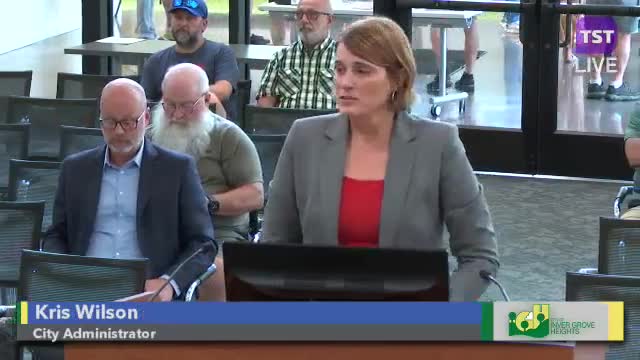
City Administrator Wilson opened the council’s presentation by saying “the item before the council this evening is consideration of a bond capital improvement plan or a bond CIP,” and said the CIP would give the council the authority to issue debt to pay for a new central maintenance building. Public Works Director Brian Connolly and Finance Director Amy Hov led the staff report and answered council questions and public comments.
Why it matters
Staff told the council the current maintenance campus was built in 1985 (main building) with a cold storage building added in 1991 and can no longer meet the city’s equipment, parts-storage and staff-space needs. Connolly said the city’s fleet has grown from about 24 vehicles at the time the building was built to 72 licensed vehicles stored at the site and another roughly 83 vehicles stored elsewhere. He summarized facility deficiencies including insufficient indoor parking (about 32 spaces), an inoperable vehicle wash bay, undersized parts storage, inadequate locker rooms (the site lacks a women’s locker room), cramped mechanic bays and safety concerns from separated welding and mechanic areas.
Staff recommended a design that would keep most of the existing main building for cold storage and construct a new maintenance building on an adjacent city-owned site. Connolly described the preferred “option B” layout presented to council in April and said the design would allow the existing maintenance operation to continue while new construction occurs. He gave a spring-2025 study cost estimate of about $55,500,000 and said the project team included Wold Architects (design) and Kraus-Anderson (construction management).
Financing and tax impact
Finance Director Hov said the city does not have sufficient cash on hand to pay the full project cost and recommended using general obligation (G.O.) tax-exempt bonds as the principal financing tool. She said staff proposed issuing bonds in two phases: an initial issuance in 2026 with first debt service in 2027, and a second issuance in 2027 with first debt service in 2028. “We would be recommending to issue bonds sort of in 2 phases,” Hov said.
Hov and Jason Arzold, the city’s financial advisor from Ehlers, described the estimate assumptions: a $61,000,000 maximum project cost (to allow room for inflation), $3,000,000 of city funds already set aside for preliminary design and management, and a recommended maximum bond authorization in the CIP of $58,000,000. Arzold said the plan used a conservative interest-rate assumption of about 5.2 percent (a 1 percentage-point cushion over current market levels) to model tax impacts and protect the city from market volatility: “we put that on there just to be conservative.”
Staff provided example tax impacts under three bond scenarios. Using the median 2026 home value of $362,200, the modeled annual city tax increase ranged from about $252.49 (lower estimate) to $287.01 (maximum CIP). For a $500,000 home the city increase would be about $411 annually; for a $250,000 home about $186 annually. Hov also presented levy-level impacts: in the higher scenario the new debt levy would increase by about 14.57 percent compared with the city’s 2025 debt levy; spread over two years, that is roughly a 7.2 percent increase per year in the illustrative example. On the lower scenario the modeled increase was about 12.8 percent (about 6.4 percent per year if phased).
Public comment and council discussion
The council opened the public hearing and heard more than a half-dozen residents. Several speakers said the facility needs work but pressed for clearer cost comparisons, alternatives and community outreach. Frank Alexander asked, “Is that an enclosed gun range or is that something…?” Administrator Wilson replied, “There will be no gun range in this facility.” Some residents asked why a referendum was not required; City Attorney Nason explained the statute applicable to the bond CIP allows a reverse referendum petition after adoption but does not permit the city to hold a binding referendum in advance for this type of financing.
Residents also questioned schedule and transparency. Several speakers requested more documentation about assumptions behind cost and schedule, and asked whether parts of the existing building could be reused to lower cost. Connolly said the city intends to keep the main building and estimated “if I had to ballpark it, it’s probably on the order of 85% of the existing building” would be reutilized primarily for cold storage. He said some outbuildings would likely be demolished to allow site grading and circulation.
Council members expressed a range of perspectives. Some emphasized the need to protect and maintain expensive city rolling stock and to improve mechanic workspaces and employee facilities; others urged caution about the timing and cumulative tax burden given other pending local levies and county property-tax increases.
Council action
After the public hearing and staff responses, a council member moved adoption of the resolution to adopt the bond CIP. The council voted to approve the resolution adopting the Capital Improvement Plan authorizing bonds up to the CIP ceiling. The motion passed with no named roll-call recorded in the transcript report (voice vote: “aye;” no opposed recorded). The adopted CIP authorizes bonding and sets a maximum ceiling and a multi-year window for issuance; it does not obligate the city to borrow the full amount and allows the city to choose lower issuance amounts as final design and bids are completed.
Votes at a glance
- Bond Capital Improvement Plan (central maintenance facility) — Resolution adopting the CIP and authorizing bonds up to $58,000,000 (maximum project ceiling $61,000,000; $3,000,000 cash on hand). Outcome: approved (voice vote). Notes: Bonding planned in two issuances (2026 and 2027) with first payments 2027 and 2028; 30‑day reverse referendum period applies after adoption.
- Platt Rezoning and Easement Vacation (Orchard Heights third edition, 184570 7th St. W.) — Resolutions and ordinance approving preliminary and final plat, rezoning and easement vacation. Outcome: approved (voice vote). Note: Planning Commission recommended approval 7‑0.
- City Project 2020‑38 Babcock Trail multi‑use trail (Upper 50th St. to I‑494) — Resolutions awarding construction contract to Max Steininger ($971,495.23), approving budget and awarding construction administration contract to Short Elliott Hendrickson (SEH). Outcome: approved (voice vote). Funding includes a Transportation Advisory Board (TAB) grant, Dakota County participation and municipal state aid.
- First reading: ordinances updating licensing code provisions (liquor, cannabis/hemp, massage therapy re‑application period, and repeal of an obsolete solid-waste vehicle license section) — First reading approved. Outcome: approved (first reading; further council action required).
- Rental housing license (one applicant) — Approved (consent action).
What the CIP adoption does and does not do
Adoption of the bond CIP gives the city authority under the referenced statute to issue tax‑exempt general obligation bonds within the CIP’s parameters without a preemptive referendum; it triggers a 30‑day reverse‑referendum window in which residents may file a petition to challenge the authorization. The action does not obligate the city to issue debt immediately or to borrow the full amount of the CIP; staff and council will make further decisions after final design and bidding. Hov told the council the city could use some cash on hand to “buy down” the bond amount and that other internal or partner funding sources may reduce the amount to be issued.
Next steps
Staff said they will proceed with final design and schematic review, continue outreach and refine cost estimates. If the council proceeds with bond sales, the first issuance would target spring–summer 2026, subject to market conditions and final approvals. The council and staff reiterated they will provide further cost detail, bond issuance options and opportunities to use internal funds as the project moves from design to bidding.
Staff and residents asked for additional follow-up on several items — specifically final reuse percentages for the existing building, precise phasing descriptions, and more explicit documentation of the assumptions behind the tax‑impact figures.
(Reporting by the Inver Grove Heights City Council meeting, July 14, 2025.)