Get Full Government Meeting Transcripts, Videos, & Alerts Forever!
Get email alerts on the Elections topic
No spam. Unsubscribe anytime.
Marion County Election Board requests higher general-fund budget, plans new service center
Summary
Marion County Clerk Kate Sweeney Bell presented the Election Board’s 2026 budget request, citing higher personnel costs after a recent pay increase for poll workers, rising vendor and security costs, and plans to move to a new Election Service Center at 3737 East Washington.
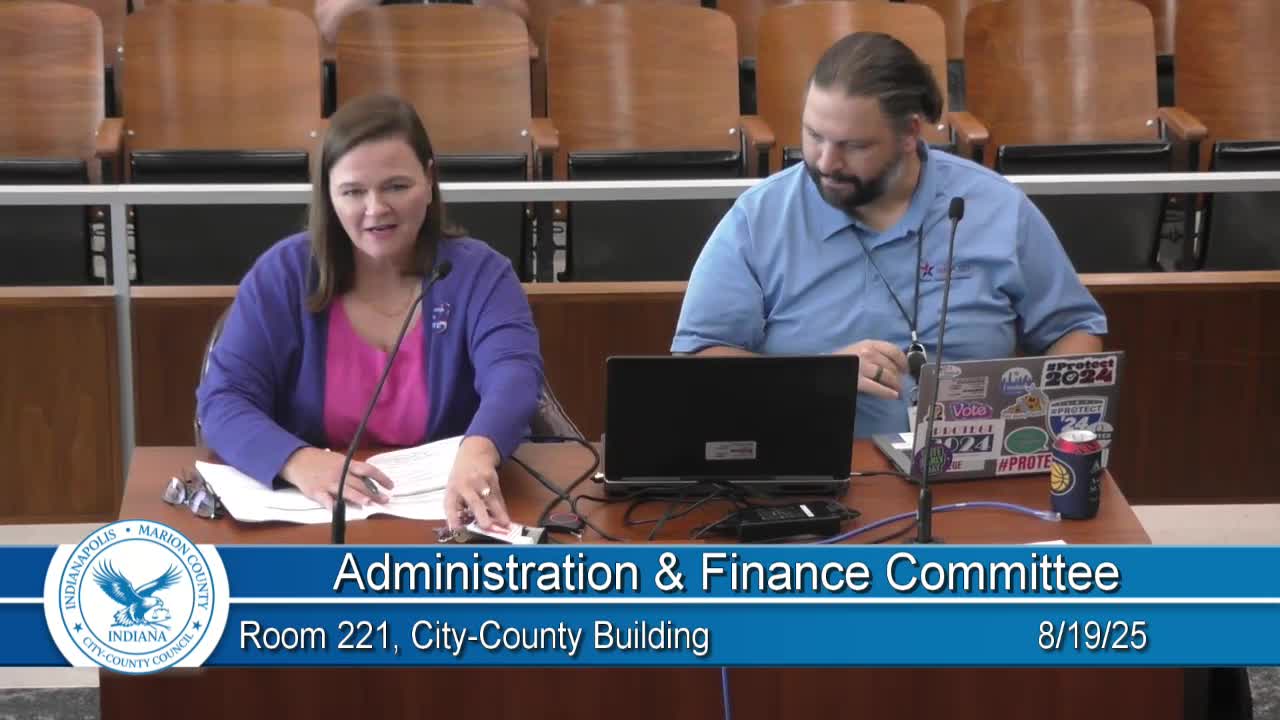
Marion County Clerk Kate Sweeney Bell, who serves as secretary of the Marion County Election Board, told the City-County Admin and Finance Committee that the board’s 2026 general-fund budget request reflects rising personnel and operational costs and preparations for a new Election Service Center.
The board is responsible for administering primary, general and special elections in Marion County, Sweeney Bell said. She described duties that include poll-worker recruitment and training, in-person early voting, coordinating military and overseas voting, and campaign finance compliance. “Our board is bipartisan and we are responsible for governing and administering all primary general and special elections in the county,” she said.
The requested budget shows a year-over-year increase in the general fund. Sweeney Bell said some of that increase stems from higher salaries approved last year, including a raise in poll-worker pay from $11 to $15 per hour and higher rates for clerks and inspectors. “They’re worth their weight in gold as far as I’m concerned,” she said of poll workers.
Sweeney Bell outlined other cost pressures: higher rents for a planned move from the current warehouse after 15 years to a “more modern” Election Service Center expected at 3737 East Washington, upgraded security during election season (including 24-hour armed security), vendor logistics, election-day support and project management. She said the new center will include enhanced security features, and that staff had been advised to separate the mail-handling ventilation system for safety reasons.
The presentation noted zeros in special funding lines for 2025 and 2026 and said the office will rely on special funds in election years to pay for projects that require competitive bidding. Sweeney Bell also described recruitment and staffing: the office employs full‑time staff, seasonal workers and poll workers, with seasonal staff coordinating election preparations and poll workers staffing precincts on election day.
Committee members asked about vote-by-mail rules, residency requirements for poll workers and whether expanding early-vote sites is constrained by funding or supply of locations. Sweeney Bell said absentee-by-mail eligibility in Indiana requires an application and that the state maintains central records of approved absentee voters; she added that federal executive orders apply only to federal agencies, not municipalities. On early-vote site expansion, committee members were told that selecting locations is part of a vote center plan and that adoption of that plan requires unanimous approval of the Marion County Election Board before it can be enacted.
Committee members also asked about the proportion of poll workers who return their pay to political parties; Sweeney Bell said some workers do return pay and that money remains in the office budget if not disbursed. She said the office faces ongoing challenges recruiting poll workers and that statutory residency requirements limit the pool; the office has, by unanimous board decision in some instances, allowed out-of-county workers for counting to meet operational needs.
The Election Board presentation concluded with a note on equity in recruitment: staff said they seek poll workers who reflect the community’s diversity but that few election-equipment vendors qualify as XBEs (excluded-business enterprises) and that the office actively seeks vendors and vendors’ bids.