Get Full Government Meeting Transcripts, Videos, & Alerts Forever!
Get email alerts on the Ranked Choice Voting topic
No spam. Unsubscribe anytime.
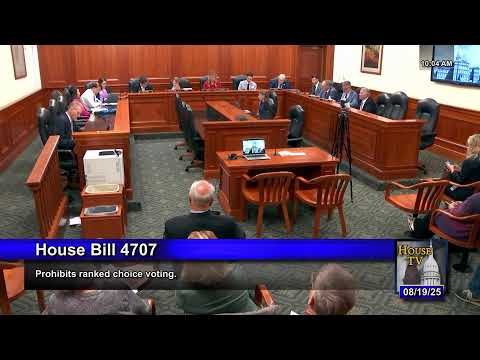
House committee advances bill to ban ranked-choice voting after hours of testimony
Summary
The Michigan House Committee on Election Integrity reported House Bill 4707 with a 6–3 vote after extensive testimony from election administrators and advocacy groups on both sides. Proponents said RCV is complex and risks delays; supporters said it increases voter choice and avoids runoffs.
The Michigan House Committee on Election Integrity on Tuesday voted to report House Bill 4707, a proposal that would prohibit ranked-choice voting (RCV) in Michigan for local, state and federal elections.
Representative Hoadley moved to report the bill; the motion passed on a roll call 6–3. The committee’s chair said the bill would “prohibit ranked choice voting for local, state and federal elections.”
Supporters of the ban — including witnesses from the Stop RCV coalition and election-integrity groups — told the committee RCV introduces administrative burdens, complicates ballot design and can delay results. Trent England of Honest Elections told lawmakers, “Ranked choice voting makes voting harder at every step of the way. It makes ballot design more difficult. It makes ballot instructions longer and more difficult.”
Jason Snead, executive director of the Honest Elections Project ACTION and co-chair of the Stop RCV Coalition, argued RCV requires centralized tabulation and can produce delayed results and opaque counts. “It is an algorithmic black box where you don't know whether you made an inadvertent mistake and accidentally voted for 2 people in the first place,” he said, adding that some jurisdictions that used RCV later found tabulation errors that changed outcomes.
Witnesses opposed to the ban included Rank My Vote campaign director Joe Spalding and others who said RCV gives voters more choices without increasing error rates. “The error rate for ranked choice voting is roughly the same as single choice elections,” Spalding said, and he called RCV “a level playing field that favors voters not political parties.”
Local election officials who testified raised practical concerns about ballot spoilage in absentee and drop-box settings. Shelly Lake, a deputy clerk, said a voter who ranks the same choice for every slot in a mock ranked ballot produced an overvote in the absentee-counting process, and “if she had been in absentee...her ballot would be spoiled.”
Committee members questioned whether the state law already effectively bars RCV because Michigan prescribes the time and manner of elections. Chair Smith said the bill seeks to remove ambiguity and preempt potential legal disputes or local adoption efforts that would vary across jurisdictions. Several members also asked whether a statewide constitutional amendment — if enacted by voters — would override the statute; the bill’s proponents acknowledged that a constitutional change would supersede the statute.
After roughly two hours of testimony from proponents and opponents, the committee moved the bill forward. Representative Hoadley moved to report HB 4707; the roll call recorded six yes votes (Smith, Spots, Altman, Alexander, Hoadley, Pablo) and three no votes (Wooden, Colzard, Song).