Get Full Government Meeting Transcripts, Videos, & Alerts Forever!
Get email alerts on the General Government Operations And Appropriations topic
No spam. Unsubscribe anytime.
Legislature approves $16.38M for Simon Sanchez rebuild, restores rainy day funds; proposed tax rollback fails
Summary
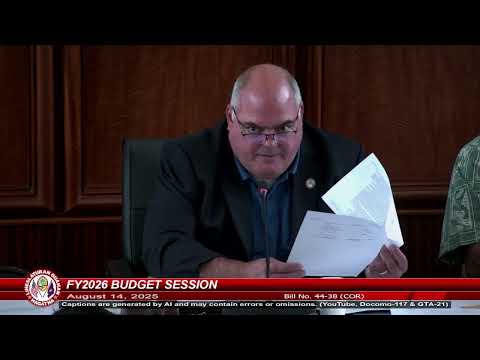
The Guam Legislature on Aug. 4 approved a $16,377,125 appropriation for Simon Sanchez High School from projected FY2025 unobligated general fund revenues and passed an amendment to deposit up to $10 million into the rainy day fund, while rejecting a proposed tiered rollback of the business-privilege tax.
The Guam Legislature on Aug. 4 moved several budget amendments tied to the FY26 budget bill, approving a $16,377,125 appropriation to cover construction leaseback payments for Simon Sanchez High School and voting to deposit up to $10,000,000 from projected FY2025 unobligated general fund revenues into the general fund reserve (the rainy day fund). Lawmakers debated but rejected a substitute amendment that would have created a tiered business-privilege-tax rollback that raised rates on the largest corporations while lowering rates for many smaller businesses.
The Simon Sanchez appropriation was offered by Senator Joe St. Augustine (JSSA L16 P7). St. Augustine read language that would appropriate $16,377,125 from the “net projected unobligated fiscal year 2025 general fund revenue balance as identified in the June 2025 consolidated revenue and expenditure report” to pay construction leaseback obligations for Simon Sanchez High School. After extended floor debate and a technical amendment to place the appropriation in a standalone section, senators voted to approve the appropriation. Supporters said the money is needed so the long-delayed rebuild can move forward; opponents did not contest the floor motion during the final vote.
Supporters highlighted procurement delays and cost increases since the public law authorizing the project passed. Senator Duane (floor comments) said the public law authorizing the project already allows the government to go to market but that delays in issuing the request for proposals have increased costs, including interest and inflationary pressure. Multiple senators who identified themselves as former students or who represent the affected community urged passage so the project could proceed to market and avoid further cost escalation.
On the rainy day fund, Senator Joe St. Augustine also offered an amendment (JSSA L21–26 P12) to appropriate up to $10,000,000 from the June 2025 CRER-identified net unobligated FY25 general fund balance and to deposit any FY25 fourth-quarter unobligated revenues collected above adopted levels into the rainy day fund. Senate fiscal staff (OFB) reported the June 30, 2025 net unobligated projected FY25 general fund revenue balance as $30,900,000. Debate focused on how much should be deposited to meet the statutory cap for the rainy day fund, and whether the bill’s “up to” language left too much discretion about the final deposit amount. An amendment to raise the “up to” figure to $13,000,400 (an attempt to meet a previously cited statutory cap calculation) failed on the floor. The main amendment—appropriating up to $10,000,000—passed.
Senators discussed the statutory limit that constrains rainy day deposits. A fiscal office staffer recited language cited from the statute on deposits: that no deposit shall be made if the fund’s assets exceed 10% of the average gross operating requirements funded by the general fund over the prior three fiscal years. Senators and staff used FY23–FY25 figures to calculate a cap of about $90.4 million, and said current balances plus previously passed appropriations leave an amount short of that cap; supporters argued the $10 million (or a larger sum) should be set aside to improve the government’s fiscal resilience and preserve bond ratings.
A high-profile substitute amendment offered by Senator William Parkinson (WAPL1P2 S) would have restructured the business-privilege-tax (BPT) schedule. Parkinson’s plan would have reduced the rate to 3% for businesses under $1 million in gross receipts, set 4% for businesses between $1 million and $50 million, and increased the top band for businesses with more than $50 million in gross receipts to 6%. Parkinson said the substitute sought to target relief to many more local businesses while offsetting revenue loss by raising the rate on a small number of very large firms; he cited preliminary numbers saying roughly 1,744 businesses would receive a substantial cut while 33 firms would pay a higher rate. Fiscal staff said the amendment would reduce revenues in some tiers and increase them at the top, but that, without complete data, it was difficult to produce a definitive net estimate. After extended debate that included concerns about raising the top rate without a public hearing, the Parkinson amendment failed on a roll-call/voice raise vote.
Other actions and proposals on the floor included a failed amendment to increase expected withholding revenue by $7,014,994 (ruled on and subsequently voted on; the amendment failed), and a proffered amendment by Senator Chilahi to increase the tax-refund set-aside from the bill’s $25 million to $46,021,874 to cover anticipated corporate and individual refund liabilities; that proposal was under review by fiscal staff at the end of the provided transcript.
The Legislature’s floor discussion repeatedly referenced the June 2025 Consolidated Revenue and Expenditure Report (CRER) and the Office of Finance (OFB) calculations. Senators pressed for clarity about how excess (unobligated) FY25 general fund revenues may be used, emphasizing that some earlier committee guidance had limited use of FY25 funds and that the floor was setting a precedent by authorizing specific appropriations from the FY25 unobligated balance.
The actions approved on the floor will be incorporated into the final FY26 budget if the overall bill is adopted with these floor amendments. For items still under consideration—most notably the increase in tax-refund set-asides—final outcomes were not recorded in the provided transcript excerpt.
Votes at a glance - Simon Sanchez High School appropriation (JSSA L16 P7 as amended): motion carried; appropriation $16,377,125 (source: net projected unobligated FY25 general fund balance, June 2025 CRER). - Rainy day fund deposit (JSSA L21–26 P12, as amended): motion carried; “up to $10,000,000” appropriation from unobligated FY25 general fund balance and deposit of any FY25 fourth-quarter unobligated revenues above adopted levels. - Parkinson BPT substitute (WAPL1P2 S): failed. - Withholding increase (TMT L20 P7 etc., to raise withholding by ~$7.015M): failed. - Tax-refund increase (TM T / Chilahi amendment proposing increase to ~$46.02M): proffered and under OFB review at transcript end; no final vote recorded.
Context and next steps Appropriations drawn from FY25 unobligated revenues are unaudited projections; senators and fiscal staff clarified repeatedly that the June 2025 CRER figures are projections and that final audited balances could change. Lawmakers also noted that delays in procuring the Simon Sanchez project have increased capital costs, a reason supporters cited for making the appropriation now.
Senators signaled continuing floor debate ahead on remaining budget provisions, and staff were asked to provide final estimates for outstanding amendments (including the tax-refund set-aside) before the Legislature completes action on the FY26 budget.