Get Full Government Meeting Transcripts, Videos, & Alerts Forever!
Get email alerts on the Behavioral Health Grants topic
No spam. Unsubscribe anytime.
Larimer County commissioners back 2025 Impact Fund grant recommendations and ask staff to advance awards
Summary
Larimer County’s behavioral health staff recommended funding 42 organizations from 70 applications for the 2025 Impact Fund. The board signaled support to forward the recommendations — including a one-time $200,000 increase request — to an upcoming administrative matters meeting as a discussion item.
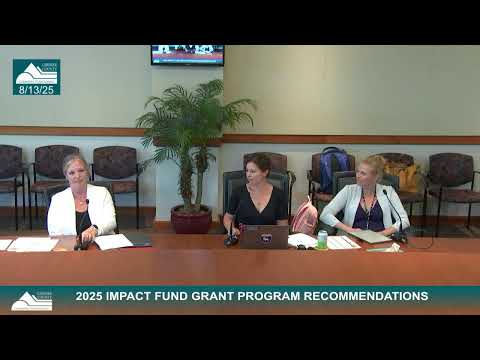
Larimer County commissioners on Aug. 13 heard staff recommendations for the county’s 2025 Impact Fund grant portfolio and signaled consensus to move the awards forward for administrative approval, with a request that the item be presented as a discussion item at the administrative matters meeting.
The proposal presented by Amy Martinis, director of behavioral health for Larimer County, and Jessica Plummer, the county’s Impact Fund grant program manager, recommends funding 42 organizations from 70 applications for a $3,000,000 portfolio. Martinis told the board the department has $2.8 million currently allocated and $3.0 million budgeted for the grant program; the additional $200,000 would require board approval.
Staff described why the recommendation matters and how it was reached. The program, funded by behavioral health sales tax dollars, used a multi-step review: staff prescreening, three external subject-matter expert reviews per application, an executive review panel and review by the Behavioral Health Policy Council. Plummer said that 15 organizations qualified for a pilot renewal pathway (applicants with five or more years of prior funding) and that the executive panel focused on producing a balanced portfolio across targeted service areas.
Plummer summarized the portfolio: 70 applications from 65 unique organizations requested $5,175,000; 42 organizations are recommended for awards totaling $3,000,000. She said 55 of the applications were competitive and 15 were renewal submissions, that one application was ineligible, and five competitive applications were recommended for decline after subject-matter review. Plummer noted staff recommended 27 competitive awards plus the 15 renewals if the board authorizes the full $3.0 million; if the board approves only the $2.8 million already allocated, the package would include 23 competitive awards plus the 15 renewals.
Staff emphasized administrative changes adopted for 2025: a pilot renewal streamlining for long-term grantees, four new budget tiers to reduce the number of partial awards, an earlier review deadline to give reviewers more time, and additional applicant support (budget and objectives webinars plus informal “coffee and connection” networking). Plummer said those changes reduced partial awards from 22 in the previous cycle to five this year (a 78% reduction) and saved applicant organizations substantial time — 14 organizations reported saving roughly 123 hours each through the renewal pilot.
Commissioners asked for clarifying detail about the recommendations. When Commissioner Kefalas asked what “systems integration” grants fund, staff said the category includes projects such as cross-system data sharing, shared referral processes and integrated care settings that combine medical and behavioral health services. Commissioners also asked about geographic reach; staff said the application data are self-reported and not mutually exclusive (an organization may report serving “Larimer County” and also list specific towns). Plummer offered to provide a list of which organizations reported serving specific communities on request.
Commissioners expressed support for moving the package to the administrative matters agenda and for presenting it there as a discussion item so the public and the board can hear about the process. Commissioner Shattuck McNally, Commissioner Claus and others praised the program’s accountability: Plummer described interim and final reporting requirements, quarterly reviews of reports, demographic and financial reporting, and the department’s ability to recover misspent or unspent funds. Plummer said 100% of 2024 grantees were in good standing as of the work session.
Staff highlighted trends and targeted areas funded by the Impact Fund: care coordination and system integration; workforce expansion and support; alternatives and interventions in criminal justice; services in diverse settings (frequently peer support and nonclinical services); and expansion of child and youth services. Staff reported 89% of recommended funding goes to those targeted areas (the program’s advisory groups had recommended at least 70% be spent in them).
Plummer described several new or notable awards recommended in the portfolio without naming organizations in the public presentation: programs serving older adults to reduce social isolation; caregiver and trauma-informed trainings; expanded peer work targeting high-risk industries and Latino communities; bilingual family therapy in Estes Park; intensive outpatient treatment for justice-involved clients; and training that will allow organizations to bill Medicaid and Family First funding in the future. Staff also noted an honorary Gary A. Darling distinction will be included in the awards package for a program in the alternatives and criminal justice interventions category.
With discussion complete, commissioners agreed to staff’s recommendation to advance the awards for administrative approval and to present the item as a discussion item at admin matters. No formal roll-call vote was taken during the work session; staff will bring the formal administrative matter to the board for approval at the next scheduled administrative meeting.
Planned next steps described by staff include posting award and decline notifications following board approval, sharing post-award evaluation materials publicly on the department website, and, later in the fall, sharing renewal applicants’ organizational impact stories gathered during the pilot process.